
Pharma Cold Storage in UAE: How Medical Chillers Impact Energy Costs, ROI & Compliance
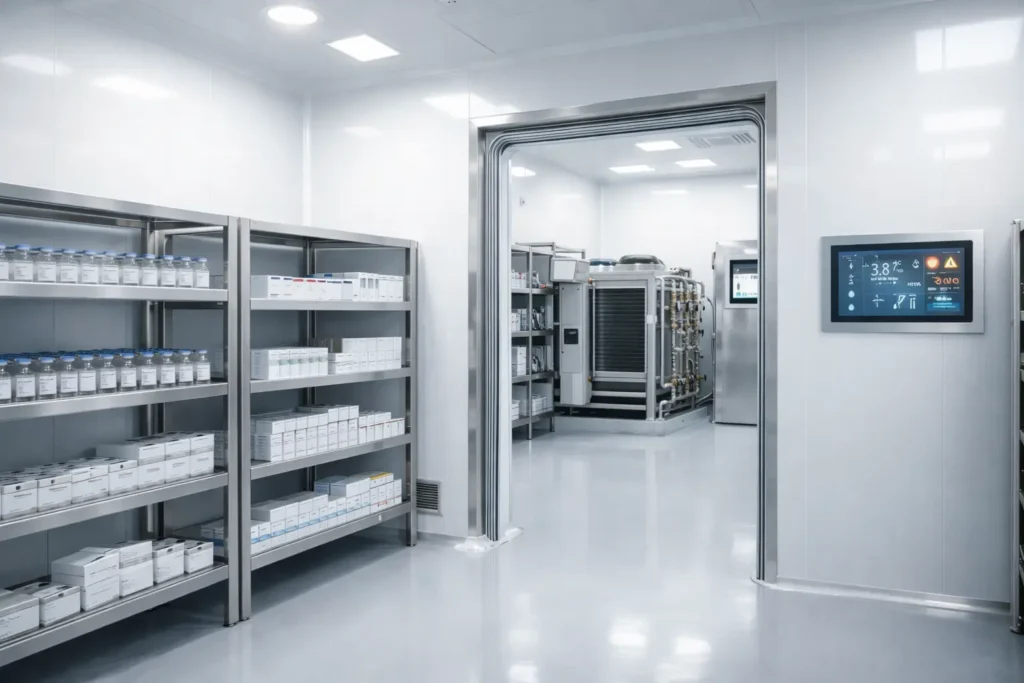
Table of Contents
Pharma cold storage in the UAE is no longer just about “keeping medicines cold.” In a region where ambient temperatures routinely cross 45–50°C, the medical chiller system becomes the single most critical factor determining energy consumption, long-term ROI, and regulatory compliance.
Many pharmaceutical distributors, hospitals, labs, and 3PL operators in the UAE invest heavily in insulated panels, monitoring software, and documentation — yet still face temperature excursions, soaring electricity bills, and audit pressure. Experienced UAE cold storage specialists like Chiller Room UAE frequently observe that system failures are rarely caused by the cold room itself, but by incorrectly designed or under-specified medical chiller infrastructure. This guide breaks down, in practical and commercial terms, how medical chillers directly affect pharma cold storage performance in the UAE, what buyers often get wrong, and how to evaluate systems for real-world ROI and compliance — not brochure promises.
Why Pharma Cold Storage Is Uniquely Challenging in the UAE
Pharmaceutical cold storage globally operates under tight margins of error, but the UAE adds three compounding risk layers:
Extreme ambient temperatures
Summer design conditions in Dubai, Abu Dhabi, and industrial free zones regularly exceed 45°C, with rooftop condenser surfaces reaching even higher temperatures. Systems designed for “normal” climates lose efficiency rapidly under these conditions.
High energy costs over the lifecycle
While UAE electricity tariffs may appear stable, continuous 24/7 operation of chillers makes energy the largest cost component over 5–10 years. A small efficiency loss multiplies into massive OPEX.
Regulatory and audit pressure
Pharmaceutical cold storage must demonstrate:
- Continuous temperature compliance
- Alarm response capability
- Documented validation (IQ, OQ, PQ)
- Data integrity and traceability
A failure is not just technical — it is commercial and legal.
This is why medical chillers, not just panels or sensors, determine success or failure.
What Is Pharma Cold Storage (and Where Medical Chillers Fit)
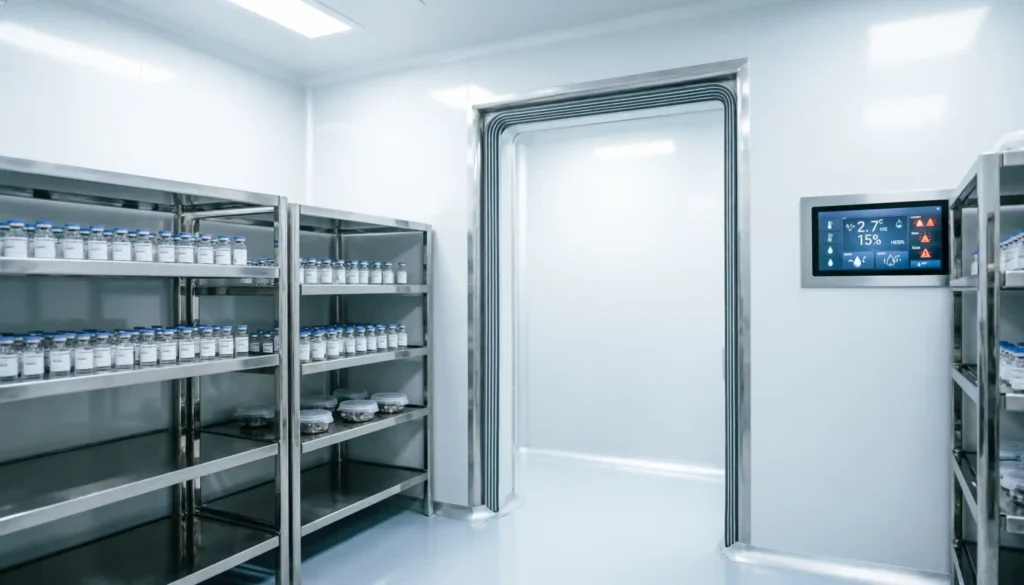
Pharma cold storage refers to controlled environments designed to store pharmaceuticals, vaccines, biologics, APIs, and medical products within defined temperature bands, most commonly:
- 2°C to 8°C (refrigerated medicines, vaccines)
- 15°C to 25°C (controlled room temperature products)
- -15°C to -25°C (select biologics, APIs)
- Ultra-low temperatures for specialized therapies
A pharmaceutical cold room or pharma cold room — typically implemented using walk-in chiller systems designed for temperature-sensitive products — consists of:
- Insulated enclosure (panels, doors, vapour barriers)
- Air distribution and evaporators
- Sensors, monitoring, alarms
- Medical chiller system supplying stable cooling energy
The chiller is the heart of the system.
If it fails, no amount of insulation or monitoring can save compliance.
What Is a Medical Chiller in Pharmaceutical Applications?
A medical chiller is a precision cooling system designed for continuous, mission-critical operation, supplying chilled water or glycol to:
- Air handling units serving pharma cold rooms
- Process equipment
- Redundant cooling loops
Unlike comfort HVAC (Heating, Ventilation, and Air Conditioning) chillers, medical chillers are engineered for:
- Tight temperature tolerance
- High reliability
- Redundancy
- Continuous duty cycles
- Integration with monitoring and alarm systems
In pharma cold storage, chillers are not optional equipment — they are risk-control assets.
The Biggest Mistake UAE Buyers Make: Designing for CAPEX, Not OPEX
One of the most common and costly errors in UAE pharma cold storage projects is optimising for upfront cost instead of lifecycle performance. Most buyers unintentionally prioritise CAPEX (capital expenditure) — the initial equipment investment — while underestimating OPEX (operational expenditure), which includes long-term electricity consumption, maintenance, efficiency losses, and failure risk. In high-ambient climates like the UAE, OPEX quickly becomes the dominant cost driver.
Typical mistake pattern:
- Lowest-cost chiller selected
- Minimal redundancy
- Non-tropicalized compressors
- Undersized condenser capacity
- No part-load efficiency consideration
Result after 12–24 months:
- Rising energy bills
- Frequent compressor cycling
- Alarm events during summer peaks
- Emergency service calls
- Compliance stress during audits
A cheaper chiller can cost 2–3× more over its operational life.
How Medical Chillers Directly Impact Energy Costs
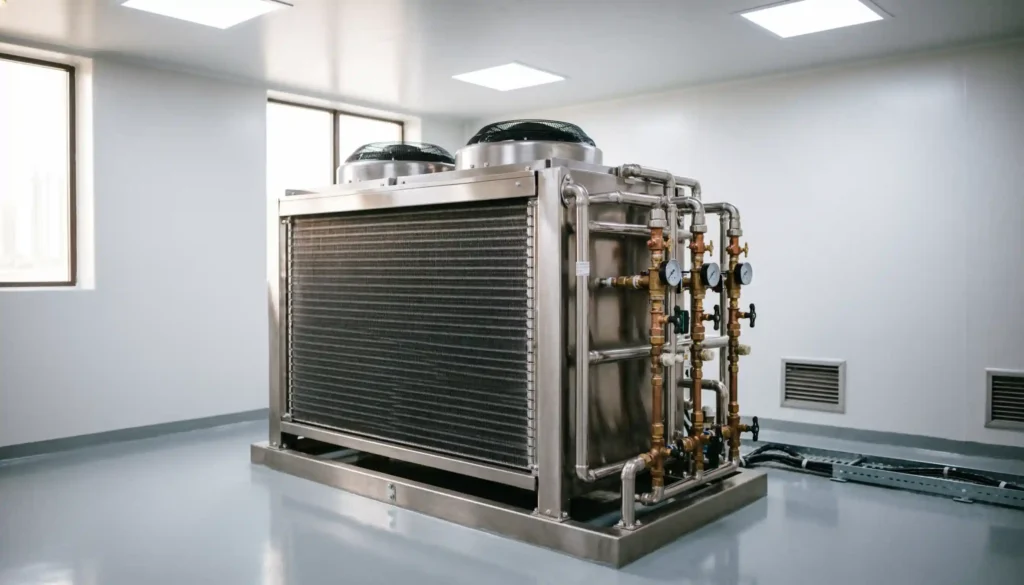
High ambient temperature derating
At 45–50°C ambient:
- Compressor efficiency drops
- Condenser pressure rises
- Power consumption increases
Medical chillers designed for temperate climates can lose 15–30% efficiency in UAE summers.
Tropicalized chillers mitigate this through:
- Oversized condensers
- High-ambient-rated compressors
- Optimised refrigerant selection
- Variable-speed drives (VFDs)
Part-load efficiency matters more than peak rating
Pharma cold storage rarely runs at full load 24/7. It operates in:
- Partial load
- Variable demand
- Night/day temperature swings
Chillers with poor part-load efficiency consume excessive energy even when demand is low.
Modern medical chillers with VFDs:
- Reduce compressor cycling
- Match output to real load
- Cut energy usage by 20–40% annually
Redundancy reduces energy waste
Counterintuitively, redundant systems often use less energy.
Why?
- Load sharing improves efficiency
- Each circuit operates closer to the optimal range
- Avoids inefficient emergency operation
A properly designed N+1 redundancy architecture improves both safety and energy economics. In practical terms, N+1 means the system includes one fully independent backup component beyond the required cooling capacity. If a compressor or circuit fails, the additional unit maintains temperature stability without triggering compliance risk, emergency operation, or costly downtime.
ROI: How to Calculate Real Returns on Pharma Cold Storage Systems
CAPEX vs OPEX reality
True ROI calculation must include:
- Initial equipment cost
- Annual energy consumption
- Maintenance & spare parts
- Downtime risk
- Product loss risk
- Compliance failure cost
In pharma cold storage, the risk cost often exceeds the energy cost.
Example ROI logic (simplified)
Assume:
- Standard chiller CAPEX: lower
- Medical-grade tropicalized chiller: +15–20% CAPEX
But:
- Energy savings: 25–35% annually
- Reduced maintenance & breakdowns
- Lower audit risk
- Longer operational life
Payback typically occurs within 2–4 years, after which savings compound.
ROI is also about avoiding losses
A single temperature excursion can:
- Quarantine the entire inventory
- Trigger batch destruction
- Cause reputational damage
- Delay shipments
- Invite regulatory scrutiny
Medical chillers protect not just power bills — they protect business continuity.
Compliance: Why Chillers Are Central to Regulatory Approval
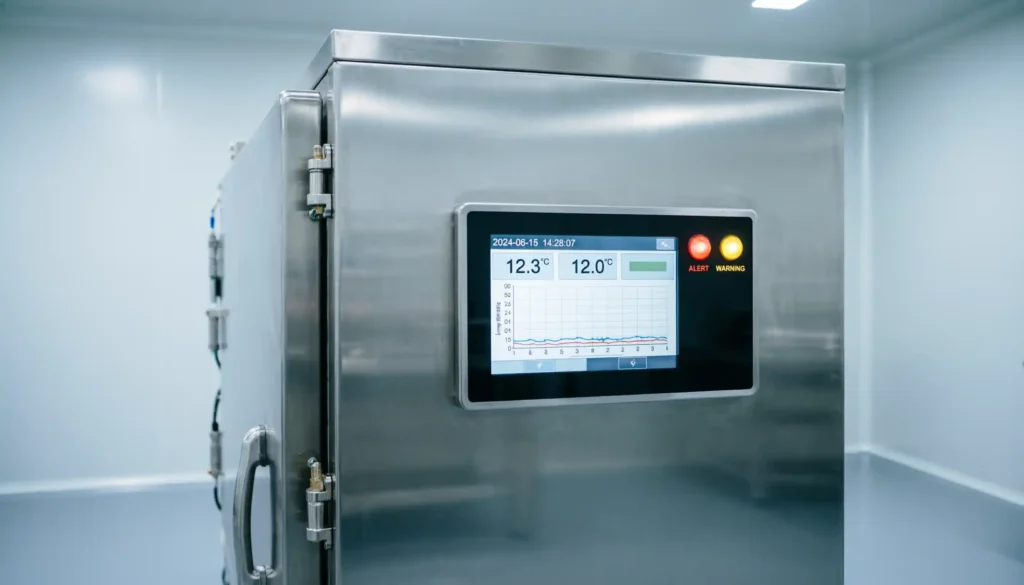
Pharma cold storage compliance is not theoretical. Inspectors and auditors focus on system behaviour under stress.
Medical chillers must support:
IQ / OQ / PQ validation
- IQ (Installation Qualification): Correct installation, materials, and wiring
- OQ (Operational Qualification): Alarm response, setpoint control, sensor failure simulation
- PQ (Performance Qualification): Loaded thermal mapping under worst conditions
A weak chiller will fail PQ during summer, even if it passes winter tests.
Continuous monitoring & alarms
Medical chillers must integrate with:
- Digital data loggers
- Alarm systems (SMS, email, BMS)
- Backup power strategies
If the chiller cannot stabilize temperature quickly after door openings or power events, compliance is compromised.
Data integrity & audit trails
Modern pharmaceutical cold storage increasingly requires:
- Secure data logging
- Tamper-proof records
- Time-stamped alarms
The chiller’s control system must support this ecosystem.
Pharma Cold Room vs Pharmaceutical Chiller Room: Where Confusion Happens
Many buyers are confused:
- Pharma cold room (the storage space)
- Pharmaceutical chiller room (the cooling infrastructure area)
In practice:
- The cold room holds the product
- The chiller room holds the risk
Neglecting chiller room design (ventilation, redundancy, access) leads to:
- Heat buildup
- Reduced efficiency
- Maintenance difficulties
- Emergency shutdowns
Good pharma cold storage design treats the chiller room as core system infrastructure, not merely an equipment area.
Selecting Medical Chillers for UAE Pharma Cold Storage: A Buyer Checklist
Before finalizing suppliers or pharmaceutical chiller manufacturers, decision-makers should demand clear answers to the following:
Technical questions
- Is the chiller rated for 50°C ambient operation?
- What is the part-load efficiency curve?
- Is N+1 redundancy supported?
- What refrigerant is used and why?
Compliance questions
- Are IQ/OQ/PQ templates provided?
- Can the system support thermal mapping?
- How are alarms integrated?
Commercial questions
- What is the 5–10-year energy cost projection?
- Local service availability in UAE?
- Spare parts lead time?
A supplier who avoids these questions is not suitable for pharmaceutical cold storage.
Pharmaceutical Chiller Manufacturers: How to Evaluate Them Properly
Not all pharmaceutical chiller manufacturers understand UAE conditions.
Strong manufacturers demonstrate:
- Local installation references
- UAE climate design data
- Validation support experience
- After-sales service infrastructure
Avoid suppliers who:
- Rely on generic international brochures
- Cannot explain summer derating
- Treat validation as “client responsibility only”
In pharma cold storage, manufacturer competence is as important as equipment specs.
Energy Efficiency Is Also a Financial & Sustainability Strategy
Energy-efficient medical chillers:
- Reduce carbon footprint
- Support corporate ESG goals
- Lower operational stress on infrastructure
In large pharma cold storage facilities, upgrading chillers is often the single biggest sustainability win.
The Strategic Takeaway for UAE Pharma Buyers
If you remember one thing:
In UAE pharma cold storage, the medical chiller determines energy cost, ROI, and compliance success more than any other component.
Panels, sensors, and software matter — but they cannot compensate for an underperforming chiller in extreme heat.
Design for:
- High ambient conditions
- Redundancy
- Lifecycle economics
- Audit reality, not brochure claims
That is how pharma cold storage systems remain compliant, profitable, and stress-free in the UAE.
For deeper technical guidance on pharmaceutical cold storage, validation, and energy-efficient refrigeration strategies, explore our latest industry articles and cold chain insights.
If you are planning or upgrading pharma cold storage in the UAE, evaluating your medical chiller strategy should be the first engineering decision — not the last.
A properly designed system can:
• Cut energy costs
• Protect high-value inventory
• Simplify audits
• Improve long-term ROI
Discuss your pharma cold storage requirement with our engineers →
https://chillerroom.ae/contact-us/
Frequently Asked Questions (FAQs)
Pharma cold storage refers to temperature-controlled environments designed to safely store medicines, vaccines, biologics, and medical products within validated temperature ranges. Unlike standard refrigeration, pharmaceutical cold storage systems must ensure temperature stability, continuous monitoring, alarm protection, and compliance with regulatory standards.
Global pharmaceutical cold chain standards — such as WHO, EU-GMP, and FDA guidance — emphasise precise temperature stability, excursion prevention, and documented validation. These principles inform requirements in the GCC and UAE regulatory environment, where extreme ambient temperatures increase the risk of product degradation. Rather than generic temperature guidance, UAE facilities must adapt these standards to local conditions to maintain compliance.
Room temperature in a pharmacy typically refers to 15°C to 25°C, also known as controlled room temperature (CRT). This range is critical for medicines that do not require refrigeration but are sensitive to excessive heat or humidity. Maintaining this band helps preserve drug stability and regulatory compliance.
Cold storage in a pharmacy involves storing temperature-sensitive medicines, commonly between 2°C and 8°C, using pharmaceutical refrigerators or cold rooms. These systems are designed to prevent temperature excursions, protect drug efficacy, and comply with pharmaceutical storage guidelines.
HVAC (Heating, Ventilation, and Air Conditioning) systems in the pharmaceutical industry control temperature, humidity, air filtration, and pressure differentials. These systems are essential for cleanrooms, production facilities, and pharmaceutical cold rooms, ensuring environmental stability and contamination control.
Chillers for pharmaceutical use are sized based on expected heat load, humidity, duty cycle, and ambient design conditions. In UAE environments, engineers factor in high ambient temperatures to avoid derating and oversized energy consumption. Oversized condensers, variable-speed drives, and correct refrigerant selection reduce part-load inefficiencies.
Most pharmaceutical cold storage systems operate within 2°C to 8°C, the standard range for vaccines and refrigerated medicines. Other products may require controlled room temperature (15°C–25°C) or frozen storage. Exact temperature requirements depend on product stability data and regulatory guidelines.
Yes — but only when implemented as purpose-built pharmaceutical cold rooms designed for temperature-sensitive products. These systems include validated cooling, redundancy, and monitoring safeguards.
A chiller in pharmaceutical applications is a precision cooling system that removes heat by circulating chilled water or glycol. Properly designed medical chiller systems support pharma cold rooms and HVAC infrastructure.
Pharmaceutical cold room pricing depends on capacity, temperature band, redundancy architecture, monitoring systems, and lifecycle efficiency. Discussing project-specific requirements with qualified engineers ensures accurate cost modelling.
N+1 redundancy means adding one full backup component beyond the required system capacity. In pharma cold storage, this reduces compliance risk and prevents emergency shutdowns, ensuring that cooling operations continue even if one component fails. This concept is a key differentiator of industrial-grade medical chillers versus commodity refrigeration.