
Reduce Chiller Room Electricity Costs in UAE by 20–40%
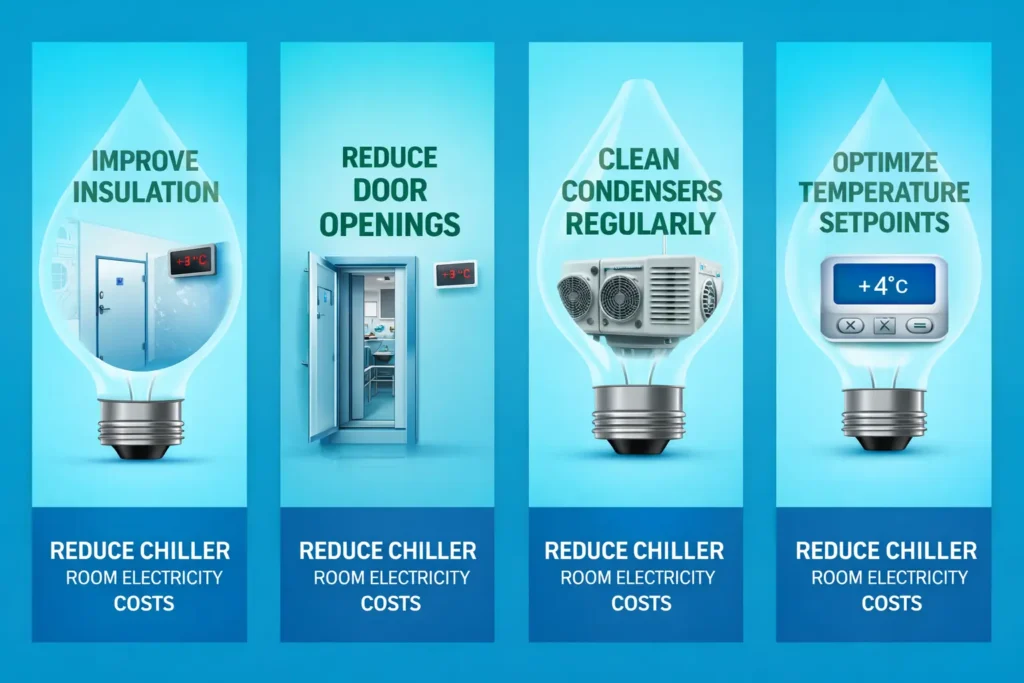
Table of Contents
Quick Answers
What is a chiller room?
A temperature-controlled cold storage space operating between 0°C and +8°C, depending on the application.
What temperature should a chiller room be in UAE?
- Food storage: 0°C to +5°C
- Pharmaceutical storage: 2°C to +8°C (tight control required)
How much electricity does a chiller room use?
It depends on system design, usage, and ambient conditions—not just room size.
How to reduce chiller room electricity costs?
Improve insulation, reduce door heat gain, maintain condensers, and optimize system performance.
What is the biggest cause of energy waste?
Poor system design under extreme UAE conditions (45°C+ ambient).
Key Takeaways
- High electricity bills are caused by poor engineering, not the electricity price
- UAE ambient conditions significantly increase compressor workload
- Air infiltration is one of the largest hidden energy loads
- Insulation quality determines long-term system efficiency
- Dirty condensers increase energy use by 5–15% (up to 30% in extreme cases)
- Lowering temperature increases energy use by ~2–6% per °C (higher in inefficient systems)
- Compressors typically consume 60–80% of total energy
- Lifecycle cost is more important than installation cost
- Energy savings come from reducing system load—not just upgrading equipment
Introduction: The Hidden Cost of Poor Refrigeration Design in UAE
Most businesses in Dubai, Abu Dhabi, and Sharjah assume high electricity bills are unavoidable.
They’re not.
Most businesses struggle to reduce chiller room electricity costs because the system is not designed for UAE conditions.
Chiller rooms consume excessive energy not because electricity is expensive, but because they are not engineered for UAE operating conditions.
In an environment where ambient temperatures reach 45–50°C, every inefficiency becomes a permanent energy cost.
What is a Chiller Room?
A chiller room is a cold storage system designed to operate between 0°C and +8°C, depending on the application.
Application-Based Temperature Ranges
- Food storage: 0°C to +5°C
- Pharmaceutical storage: 2°C to +8°C (±0.5°C tolerance)
- Beverage storage: typically, +4°C to +8°C
This differs from:
- Freezer rooms: ≤ −18°C
- Blast freezers: −30°C to −40°C
👉 Each category requires a different design, load calculation, and energy considerations.
How Chiller Room Energy is Measured
There is no single universal metric.
Engineers evaluate:
- kWh per m² of floor area
- kWh per tonne of refrigeration
- Total annual energy consumption
Why kWh/m³ Can Be Misleading
- Smaller rooms have higher heat gain per volume
- Larger rooms benefit from lower surface-area ratios
- Usage patterns distort comparisons
👉 Energy performance must always be evaluated based on actual operating conditions.
Understanding Energy Consumption
Coefficient of Performance (COP)
COP = Cooling Output ÷ Power Input
- Higher COP = better efficiency
- Drops significantly in UAE due to high ambient temperatures
Power Consumption Formula (Compressor Only)
Energy (kWh) = Cooling Load × Operating Hours ÷ COP
⚠️ This covers compressor energy only
Additional contributors:
- Fans
- Defrost heaters
- Lighting
- Control systems
👉 These add 15–30% to total consumption
🔧 Engineer’s Insight
A reduction in COP from 3 to 2 increases energy consumption by 50% without increasing cooling demand.
How Refrigeration Works
- The compressor raises the refrigerant pressure
- The condenser rejects heat to the outside air
- The expansion valve reduces pressure
- The evaporator absorbs heat from inside
👉 Efficiency depends on how well this cycle operates under UAE conditions.
The Real Reasons Your Electricity Bill is High
1. High Compression Ratio
Higher outdoor temperatures increase condensing pressure
→ Compressor works harder
→ Energy consumption rises
2. Air Infiltration (Door Openings)
Typical operational estimates:
- Restaurants: ~50–100 openings/day
- Warehouses: frequent access
Each opening introduces heat and humidity.
3. Poor Insulation
With outside at 45°C and inside at 4°C:
→ Continuous heat gain
→ Continuous compressor load
🔧 Engineer’s Insight
In UAE projects, insulation failure is usually caused by:
- Vapor barrier degradation
- Poor joint sealing
- Moisture ingress into panels
—not just low insulation thickness.
💡 Getting the design right early prevents long-term energy waste.
Engineering Design Factors That Control Energy Use
Heat Load Sources
- Transmission load (walls, roof)
- Product load
- Infiltration load
- Internal load
Refrigerant Selection in UAE
Common options:
- R448A / R449A
- R452A
- R744 (CO₂ systems)
🔧 Engineer’s Insight
Most systems are sized using room dimensions—not actual product load. This is where inefficiency begins.
Critical Components That Affect Energy Efficiency
Insulation & Thermal Bridging
- PIR panels perform better than PUR
- Poor installation creates hidden losses
Doors & Air Curtains
- Reduce infiltration by 60–80% in real conditions
- Up to 90% in ideal installations
Airflow Design
- Poor airflow leads to uneven cooling
- Forces the compressor to work harder
🔧 Engineer’s Insight
We often see systems with enough capacity—but poor airflow prevents effective cooling.
Defrost Systems
- Electric defrost increases energy consumption
- Demand-based defrost improves efficiency
Temperature Settings and Energy Impact
Lowering the temperature increases energy consumption:
👉 ~2–6% per °C in well-designed systems
👉 Higher in inefficient or high-load systems
🔧 Engineer’s Insight
Temperature settings are often lower than necessary—this creates avoidable energy cost without improving product safety.
UAE Climate Challenges
- 45–50°C ambient temperature
- Sand fouling on condensers
- High humidity in coastal regions
Real-World UAE Scenarios
🍽️ Restaurant (Dubai)
Frequent door openings → high infiltration load
🛒 Supermarket (Abu Dhabi)
Overcooling → unnecessary energy use
🚚 Logistics (Sharjah)
Humidity + access → unstable cooling
Common Mistakes That Increase Running Costs
- Dirty condensers → 5–15% higher energy (up to 30% extreme)
- Incorrect refrigerant charge → 5–20% efficiency loss
- Overcooling → ~2–6% per °C
- Oversizing → up to 20–30% higher energy in severe cases
- Poor airflow → uneven cooling
Energy Optimization Strategies
These strategies are the most effective ways to reduce chiller room electricity costs in high ambient environments like the UAE.
Quick Wins (0–3 Months)
- Clean condensers
- Adjust temperature setpoints
- Fix door leaks
Mid-Term Improvements
- Install air curtains
- Optimize fan speeds
- Improve control systems
Long-Term Engineering Solutions
- Upgrade insulation
- Replace inefficient compressors
- Redesign airflow
🔧 Engineer’s Insight
Energy reductions of 20–40% are achievable when multiple inefficiencies are corrected together.
💡 Typical Results:
- 15–25% from partial improvements
- 30–40% from full system optimization
Cost Reality: Installation vs Running Cost
| Factor | Low-Cost System | Engineered System |
|---|---|---|
| Initial Cost | Low | Higher |
| Energy Cost | High | Lower |
| Lifespan | Short | Long |
What Drives Cost in UAE
- Insulation thickness
- Compressor type
- Condenser placement
- Usage pattern
- Ambient exposure
What Businesses Get Wrong
- Choosing the lowest installation cost
- Ignoring lifecycle energy cost
👉 The cheapest system often becomes the most expensive to operate.
When to Upgrade vs Replace
Upgrade if:
- Structural condition is good
- Issues are operational
Replace if:
- Insulation failure
- Incorrect sizing
- Frequent breakdowns
How to Choose the Right System
Portable Chiller
- Temporary use
Walk-In Chiller
- Restaurants and supermarkets
Customised Chiller
- Logistics and industrial applications
Blast Chiller
- Rapid cooling applications
💡 System selection should be based on usage—not just room size.
Real UAE Case Study
Issues:
- Dirty condenser
- Door leakage
- Incorrect setpoint
- Continuous fan operation
Improvements:
- Condenser cleaning
- Door sealing
- Setpoint optimization
- Fan control
This project demonstrates how targeted improvements can significantly reduce chiller room electricity costs.
Result:
~44% reduction in energy consumption
This represents a higher-than-average improvement achieved by correcting multiple system inefficiencies simultaneously.
What Most Contractors Won’t Tell You
- Oversizing increases energy consumption in poorly controlled systems
- Insulation failures are common in UAE humidity
- Airflow design is often ignored
- Systems are rarely optimized after installation
Frequently Asked Questions (FAQs)
High energy consumption is mainly caused by poor insulation, frequent door openings, dirty condensers, incorrect refrigerant charge, and improper system sizing. In UAE conditions, high ambient temperatures amplify these issues, forcing the compressor to run longer and use more power.
These issues are explained in detail in our chiller room failures in UAE guide.
Chiller rooms in the UAE typically operate between 0°C and +8°C, depending on the application. Food storage usually requires 0°C to +5°C, while pharmaceutical storage operates between 2°C and 8°C with stricter tolerances.
For detailed temperature guidelines, see our chiller room temperature guide. Lower-than-required settings can increase energy consumption unnecessarily
Yes, increasing the chiller room temperature within safe limits can reduce electricity consumption. Typically, energy use decreases by around 2–6% per °C in well-designed systems, although the exact savings depend on system efficiency, refrigerant type, and operating conditions in the UAE climate.
Chiller rooms in the UAE should be maintained at least once a month due to dust, sand, and high ambient temperatures. Regular maintenance includes cleaning condensers, checking refrigerant levels, inspecting insulation, and verifying control settings to ensure efficient operation and prevent energy waste.
Air curtains are effective in reducing heat and moisture entering the chiller room during door openings. In real UAE operating conditions, they typically reduce air infiltration by 60–80%, although performance depends on correct installation, door usage patterns, and pressure balance within the space.
The compressor is the largest energy consumer, typically accounting for 60–80% of total electricity usage. However, in UAE systems with high door traffic and frequent defrost cycles, fans and defrost heaters can also contribute significantly to overall energy consumption
Upgrade your chiller room if the structure and insulation are in good condition and inefficiencies are operational. Replace it if insulation has degraded, the system is incorrectly sized, or failures are frequent—especially in UAE conditions.
For a broader comparison, see our cold storage system guide.
Conclusion
Chiller room inefficiency in the UAE is not a technology problem.
It is an engineering problem.
Most systems fail because:
- They are not designed for real operating conditions
- They ignore thermodynamics
- They prioritize cost over performance
The goal is not just cooling—it is to reduce chiller room electricity costs through better engineering decisions.
If you’re planning a project in Dubai, Abu Dhabi, or Sharjah:
👉 Focus on engineering decisions—not just equipment
Because the difference between an inefficient system and a high-performing one is determined before installation begins.