Chiller Room Temperature in UAE: Engineering Accuracy, Humidity Control, and Compliance Reality
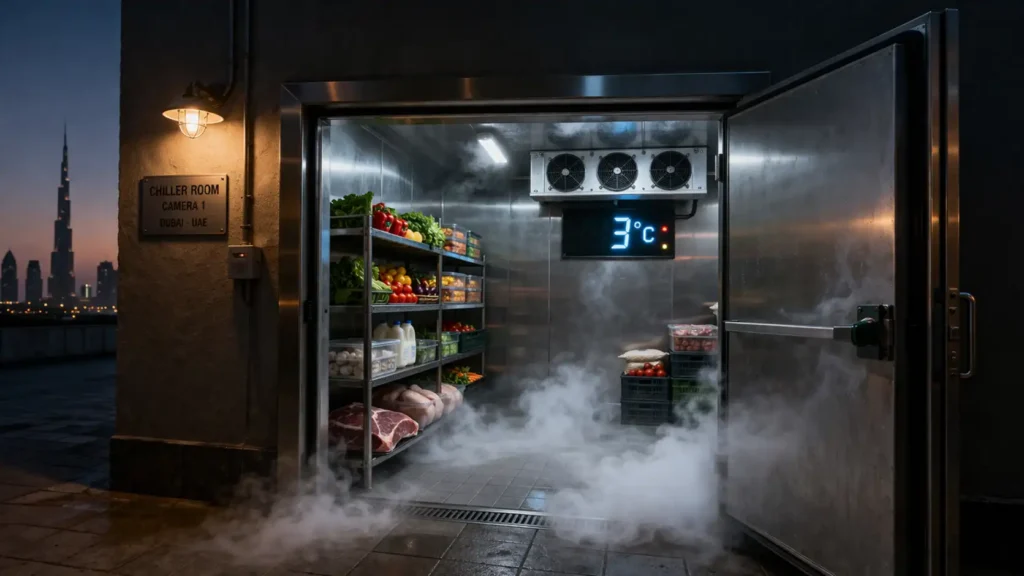
Table of Contents
Quick Answer
What is the ideal chiller room temperature in UAE?
- General chiller range: 0°C to +8°C
- Food-safe range (most applications): 0°C to +5°C
- Actual requirement depends on:
- Product type
- Regulatory standards
- Humidity and airflow conditions
A chiller room operates within 0°C to +8°C, but most food applications require tighter control within 0°C to +5°C.
Introduction
In many UAE facilities, temperature is treated as a fixed setting.
In practice, this leads to:
- Uneven cooling
- Product dehydration or spoilage
- Compliance risks
Chiller room performance is not defined by temperature alone. It depends on:
- Airflow distribution
- Humidity control
- System design
For businesses looking for reliable systems, working with Chiller Room Manufacturers in UAE is critical to ensure proper engineering design from the start.
👉 Explore complete solutions here: Our Home Page
What Chiller Room Temperature Actually Means
A chiller room operates above freezing:
👉 0°C to +8°C
This range supports:
- Food storage
- Pharmaceutical cold chain
- Industrial applications
However:
- Food safety systems (HACCP and municipality regulations) typically require ≤5°C
- Pharmaceutical storage commonly uses 2°C to 8°C
These ranges reflect different applications—not a contradiction.
Chiller Room vs Cold Room
| Type | Temperature Range | Function |
|---|---|---|
| Cold Room | Varies | General category |
| Chiller Room | 0°C to +8°C | Above-freezing storage |
| Freezer Room | ≤ -18°C | Frozen storage |
| Blast Freezer | -30°C to -40°C | Rapid freezing (process stage) |
Many businesses still confuse these systems, which leads to incorrect storage design and higher operational costs. If you’re unsure about the differences, read this detailed comparison of Cold Room vs Chiller Room to understand when to use each system.
Product-Specific Temperature Guidelines
Standard Storage Ranges
- Meat: 0°C to 2°C
- Poultry: 0°C to 4°C
- Seafood (fresh): -1°C to 1°C
- Dairy: 2°C to 4°C
- Vegetables: 0°C to 5°C
Processed Food
- ≤4°C → ready-to-eat or perishable processed foods
- Up to 8°C → certain packaged or less perishable products (based on specification)
⚠️ Seafood Note
- Live seafood and shellfish require:
- Species-specific temperature ranges
- Oxygenation systems
- Different storage methods
Flower Storage
Temperate Flowers
- 0°C to 2°C
Tropical Flowers
- Orchids: 5°C to 13°C (varies significantly by species — consult supplier specifications)
- Anthuriums: 13°C to 15°C
- Heliconia: 12°C to 15°C
Incorrect temperature or humidity can cause rapid product deterioration.
Pharmaceutical Storage
- Standard cold chain: 2°C to 8°C
Some products require:
- ±0.5°C tolerance
- Validated systems
- Continuous monitoring
Standard chiller rooms may not meet strict pharmaceutical requirements without proper validation and monitoring systems. For a deeper understanding, see how Pharma Cold Storage & Medical Chillers are designed for temperature-sensitive products.
Humidity Control in Chiller Rooms
Temperature alone does not ensure product quality—humidity control is equally important.
Why Humidity Matters:
- Low humidity → dehydration and weight loss
- High humidity → condensation and mold growth
Typical Humidity Requirements:
- Fresh vegetables: 90–95% RH
- Leafy greens: 95–98% RH
- Flowers (e.g., roses): 90–95% RH
- Fresh meat: 85–90% RH
- Fresh seafood: 85–95% RH (varies based on storage method)
- Dairy: 75–85% RH
Engineering Considerations:
- Evaporator design (low TD systems — which reduce the temperature difference between the evaporator and room air, minimizing moisture loss)
- Airflow management
- Defrost cycle control
- Door usage
Many UAE systems maintain temperature but fail to control humidity, resulting in product quality loss.
UAE Climate Impact on Chiller Room Performance
Temperature
- Can exceed 45°C across all emirates
Humidity
- Coastal areas: high humidity
- Inland areas: lower humidity but high heat load
System design must reflect actual site conditions.
How Chiller Systems Maintain Temperature
Core components:
- Compressor
- Condenser
- Expansion device
- Evaporator
Modern systems maintain a setpoint, but:
Product temperature depends on airflow, loading, and room conditions.
Airflow & Temperature Distribution
Inside a chiller room:
- Warmer zones near doors
- Colder zones near evaporators
- Vertical temperature differences
Poor airflow leads to inconsistent product temperatures.
Air Infiltration & Door Management
When doors open:
- Warm air enters
- Moisture condenses
- Frost gradually forms
Control Methods:
- Strip curtains
- Air curtains
- Controlled access
Pull-Down Load vs Storage Load
- Storage load → maintaining temperature
- Pull-down load → cooling newly introduced products
Defrost Cycle Impact
- Frost buildup reduces efficiency
- Defrost restores performance
- Temporary temperature variations occur
Insulation & Thermal Performance
Key factors:
- Insulation thickness
- Sealing quality
- Joint integrity
Energy Consumption vs Temperature
Lower temperatures increase energy consumption.
Typical estimate:
- ~2–4% increase per 1°C reduction
For accurate planning, calculations must be based on system design and operating conditions.
Temperature Monitoring & Data Logging
Effective systems include:
- Multi-point sensors
- Alarm systems
- Continuous monitoring
Temperature Mapping
Used for:
- Validation
- Uniformity checks
- Compliance audits
UAE Compliance & Standards
Chiller rooms must comply with:
- ESMA (Emirates Authority for Standardization and Metrology)
- Municipality regulations (Dubai, Abu Dhabi, Sharjah, and other emirate authorities)
- HACCP systems
Requirements:
- Maintain safe temperature ranges
- Record temperature data
- Ensure regular calibration
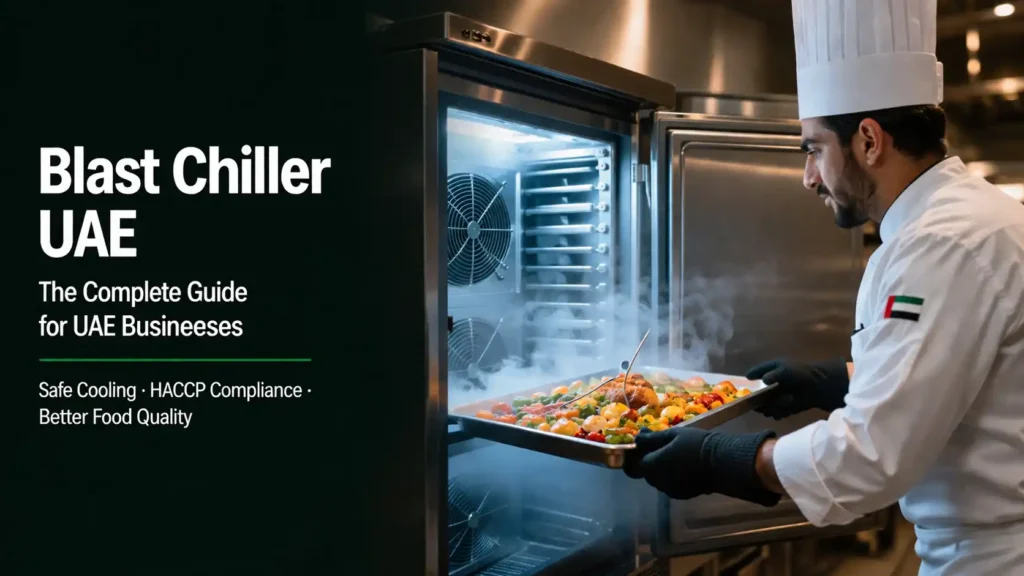
What Is a Blast Chiller
A blast chiller rapidly reduces product temperature after cooking or processing.
Purpose:
- Minimize bacterial growth
- Improve food safety
Difference:
- Blast chiller → rapid cooling
- Chiller room → storage
Common Mistakes in UAE Chiller Rooms
- Ignoring humidity control
- Using one temperature for all products
- Poor airflow design
- Incorrect sensor placement
- Undersized systems
These issues are common across many installations in the UAE and often lead to system inefficiencies or product loss. A detailed breakdown of real-world failures can be found in this guide on Why Chiller Rooms Fail in UAE.
Buyer Decision Guide
- What products are stored?
- Do they require humidity control?
- What is the storage volume?
- What compliance level is required?
Recommended Chiller Solutions
Key Takeaways
- Chiller range: 0°C to 8°C
- Food-safe range: 0°C to 5°C
- Humidity control is critical
- UAE climate increases system load
- Monitoring and compliance are essential
Conclusion
Chiller room performance is not defined by temperature alone.
It depends on:
- Airflow
- Humidity
- System design
- Operational control
In UAE conditions, proper engineering ensures:
- Product safety
- Energy efficiency
- Regulatory compliance
Effective cold storage is achieved through engineering precision—not assumptions.
Frequently Asked Questions (FAQs)
0°C to 8°C overall, with most food applications requiring 0°C to 5°C.
It prevents dehydration and maintains product quality.
No. Requirements vary depending on product type.
A process used to verify consistent temperature distribution inside a chiller room.