Best Insulation Materials for Walk-In Chillers in Hot Climates
Senior Refrigeration Engineer · ChillerRoom.ae
Updated 2026 · Estimated read time: 10–12 min
Specifying insulation for a walk-in chiller in the UAE takes a different approach than in a temperate climate. Ambient temperatures above 45°C and coastal humidity above 80% are the two conditions doing most of the damage here, and DEWA’s progressive tariff structure means a poor material choice shows up on the electricity bill within the first billing cycle. This guide works through PU, PIR, XPS, EPS, and mineral wool for the walls, ceilings, and floor of a walk-in chiller, along with the panel thickness and vapor barrier details that decide whether the room holds up for 20 years or starts having problems within five.
Quick Answers
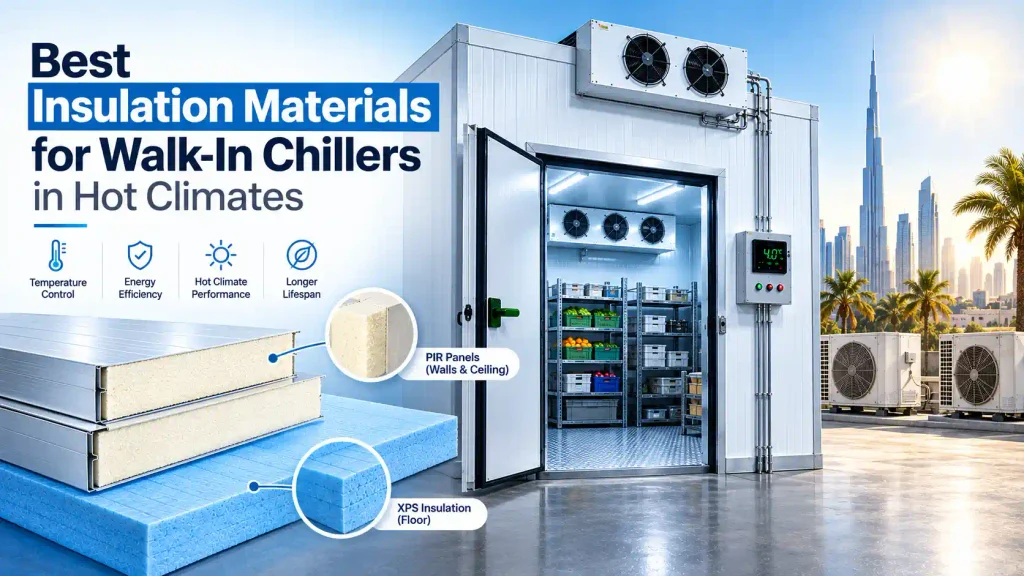
What’s the best insulation for a walk-in chiller in the UAE? PIR sandwich panels for walls and ceilings, XPS for the floor.
What thickness should I specify? 100mm minimum for chillers (+2°C to +5°C), 120–150mm for freezers (-18°C to -25°C).
Is PIR or PU better in hot climates? PIR — it withstands higher service temperatures and offers better fire resistance, both of which matter under direct UAE sun exposure.
Does a walk-in chiller need floor insulation? Best practice, not always mandatory — except above an unconditioned space, where it’s required. Freezers always require it.
Key Takeaways
- PIR (0.020–0.026 W/m·K) is the UAE standard for walls and ceilings — lower thermal conductivity than PU, plus the fire performance needed for UAE Civil Defence compliance (Euroclass B-s1, d0 / FM 4880 Class 1).
- XPS is the standard for cold storage floor insulation, chosen for compressive strength (150–700 kPa) and near-zero water absorption (<1%), not for thermal performance alone.
- EPS and mineral wool are rarely specified for UAE commercial walk-in chillers — EPS on fire-safety and thickness grounds, mineral wool on thermal conductivity and moisture-permeability grounds.
- The vapor barrier must sit on the exterior (warm) side of the insulation; sealing the interior instead traps moisture inside the panel and destroys its thermal resistance from within.
- Thermal bridging — through door frames, suspension rods, or unsealed screws — is a leading cause of exterior condensation and unnecessary compressor strain.
- Under DEWA’s slab tariff, under-insulated cold rooms don’t just run less efficiently — they push consumption into higher-cost billing tiers.
What Are the Best Insulation Materials for a Walk-In Chiller?
Walk-in chiller walls and ceilings in the UAE are built almost exclusively from polyisocyanurate (PIR) or polyurethane (PU) foam panels. Floors use a different material: extruded polystyrene (XPS). The split reflects two separate sets of requirements. PIR has the lowest thermal conductivity of the foams commonly used in cold storage — 0.020 to 0.026 W/m·K — and meets the fire performance standards set by UAE Civil Defence, a requirement that rules out several lower-rated alternatives. XPS is chosen for the floor on different grounds: water absorption close to zero, and compressive strength sufficient to withstand repeated loading from pallet jacks and rolling carts without degrading.
None of this behaves like insulation guidance written for temperate climates. UAE ambient temperatures regularly climb past 45°C, and coastal humidity often sits above 80% — conditions a European or North American spec sheet doesn’t account for. DEWA’s tariff structure adds a second pressure: get the insulation wrong, and it shows up directly on the electricity bill. The sections below cover each material in detail, how much insulation thickness is actually needed, and the installation details that determine whether a walk-in chiller performs efficiently for 20 years or fails within five.
Why Cold Room Insulation Matters in the UAE’s Climate
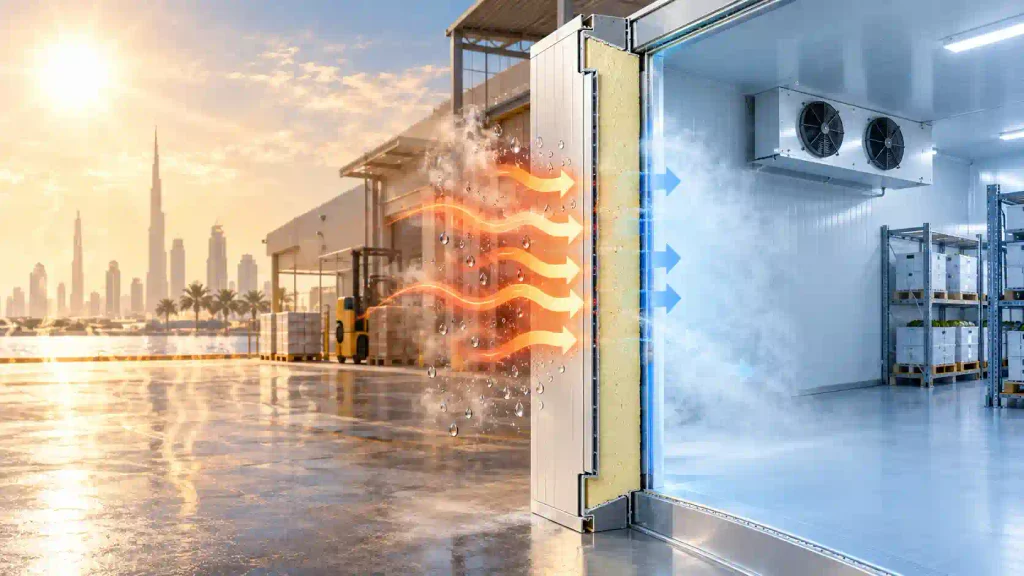
Getting insulation materials for a chiller room right is not a finishing detail — it’s the single factor that determines refrigeration load, running cost, and structural longevity. In Dubai and Abu Dhabi, mechanical refrigeration typically accounts for 60–70% of a cold storage facility’s total energy consumption. Under DEWA’s commercial slab tariff, rates climb from 0.230 AED/kWh at the lowest consumption band to 0.380 AED/kWh once monthly usage passes 6,000 kWh — before fuel surcharges and VAT. Poorly insulated cold rooms push consumption straight into that highest-cost tier.
Beyond running costs, UAE conditions create a second problem that temperate-climate insulation guidance rarely addresses: vapor drive. Hot, humid air outside constantly pushes moisture toward the cold, dry interior of a chiller. If that moisture reaches its dew point inside the insulation core, the panel becomes waterlogged — and since liquid water conducts heat roughly 25 times faster than the trapped gas inside a foam cell, a wet panel loses most of its thermal resistance almost immediately. Material selection has to account for this vapor pressure differential, not just raw thermal conductivity.
Types of Insulation Materials for Walk-In Chiller Systems
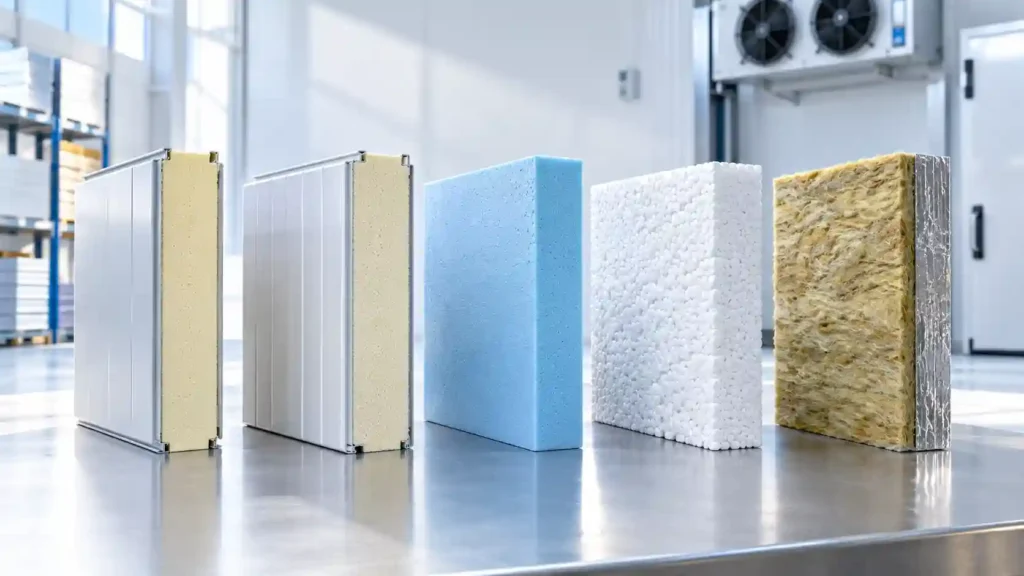
These panels are sometimes called PUF panels in the UAE market — a term covered in more depth in our PUF panel cold storage guide, which looks at panel selection from a broader cold room construction angle rather than the material science covered here.
Polyurethane (PU) Panels for Cold Room Walls and Ceilings
Most walk-in chillers built worldwide over the past several decades have used polyurethane — a closed-cell thermoset foam that became the industry default well before PIR entered the market. Cold room panels made with standard PU generally land in the 0.022 to 0.028 W/m·K range for thermal conductivity, which works out to roughly R-5 to R-6.5 per inch. You’ll sometimes see R-6 to R-8 quoted online; that figure tends to describe PIR, or the higher end of the PU spec range, rather than a typical PU panel. Where PU performs well is moisture resistance — the closed-cell content usually runs above 90%, and the foam bonds permanently to the metal facings, which adds real structural rigidity to the panel. Fire is where it falls short. Standard PU formulations don’t resist fire as well as PIR, and in a serious fire they can contribute to flame spread. That’s increasingly why larger commercial projects in the UAE look elsewhere.
Polyisocyanurate (PIR): The Premium Choice for Cold Storage Insulation
PIR comes from the same chemistry as polyurethane, but the manufacturing process pushes it further: a higher isocyanate-to-polyol ratio, combined with trimerization catalysts, produces isocyanurate rings within the foam structure. Those rings are what set PIR apart — they raise the decomposition temperature well above PU’s and give the material noticeably better fire resistance. In practice, that shows up as certification: well-made PIR panels reach Euroclass B-s1, d0 under EN 13501-1, and FM 4880 Class 1 approval, both of which line up with what the UAE fire code requires. Thermal performance is slightly better too, at 0.020 to 0.026 W/m·K, though you’ll pay for it — PIR generally runs 15 to 20% above the cost of standard PU.
Extruded Polystyrene (XPS): The Cold Storage Floor Insulation Standard
XPS is produced through continuous extrusion, giving it a dense, fully closed-cell structure with thermal conductivity of 0.028–0.034 W/m·K (around R-5 per inch). Its defining property isn’t thermal performance, though — it’s compressive strength (150–700 kPa depending on grade) combined with water absorption below 1% by volume. That makes XPS the default cold storage floor insulation material wherever pallet jacks, forklifts, or heavy foot traffic are present, and wherever sub-slab moisture is a concern.
Expanded Polystyrene (EPS): A Budget Option With Real Limitations
EPS starts as small polystyrene beads, which are fused together with steam and pressure to form rigid boards. It’s the lightest and least expensive option (around R-4 per inch, 0.030–0.038 W/m·K), but it comes with two problems that matter in the UAE: it needs meaningfully thicker panels to match PU or PIR performance, and as a thermoplastic, it melts and drips rather than holding structural integrity in a fire. EPS is rarely specified for commercial walk-in chillers in the UAE outside of tightly budget-constrained, above-freezing applications.
Mineral Wool: Fire-Rated but Rarely Ideal for Chillers
Fire performance is where mineral wool has no real competition. Rockwool and similar products are fully non-combustible, rated Euroclass A1 or A2-s1, d0, a level none of the foam insulations come close to. That advantage doesn’t carry into anything else that matters for a cold room, though. Thermal conductivity tells a different story. At 0.036 to 0.045 W/m·K, mineral wool falls well behind PU, PIR, and even EPS, which means noticeably thicker panels are needed to reach the same insulation value. Moisture is what actually rules it out for most chiller applications. The fibrous core soaks up water vapor easily, and once the exterior barrier develops even a small gap, insulating performance can collapse quickly rather than fade gradually. Mineral wool tends to appear in UAE cold storage only where fire compartmentation is a legal requirement that overrides thermal efficiency.
Insulation Materials Comparison Table
| Material | Thermal Conductivity (W/m·K) | Compressive Strength (kPa) | Water Absorption | Fire Performance | Typical UAE Use |
|---|---|---|---|---|---|
| PU / PUR | 0.022–0.028 | 100–200 | Very low | Low–moderate | General cold rooms |
| PIR | 0.020–0.026 | 120–220 | Very low | High (thermoset) | Premium/fire-rated walls & ceilings |
| XPS | 0.028–0.034 | 150–700 | <1% (exceptional) | Moderate | Floor insulation |
| EPS | 0.030–0.038 | 70–250 | Moderate | Low (thermoplastic) | Budget/above-freezing only |
| Mineral wool | 0.036–0.045 | 40–80 | High if unsealed | Non-combustible | Fire compartmentation only |
PIR vs PU: Which Is Better for Cold Room Insulation in the UAE?
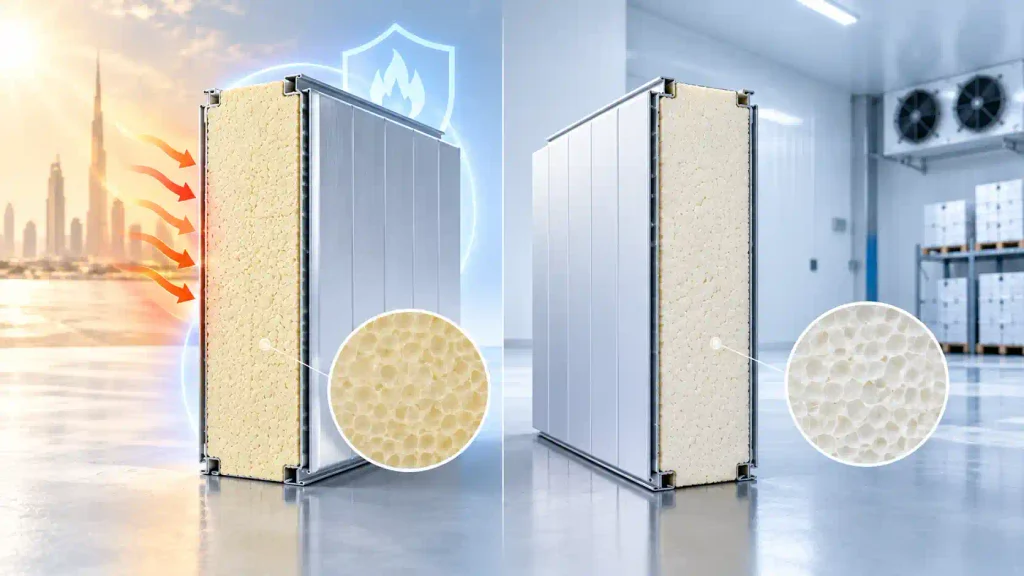
PIR is generally the better choice for commercial and industrial cold storage insulation in the UAE. Both materials offer strong thermal performance, but PIR’s isocyanurate ring structure gives it meaningfully better fire resistance and a higher service temperature (up to +120°C versus roughly +90°C for standard PU). That matters directly in the UAE, where dark metal panel skins exposed to direct sun can reach effective surface temperatures well above 70°C — a phenomenon known as sol-air temperature. PU remains a reasonable choice for smaller or lower-risk installations where the 15–20% cost difference matters more than the fire-rating margin.
Cold Storage Floor Insulation: Why XPS Is Non-Negotiable
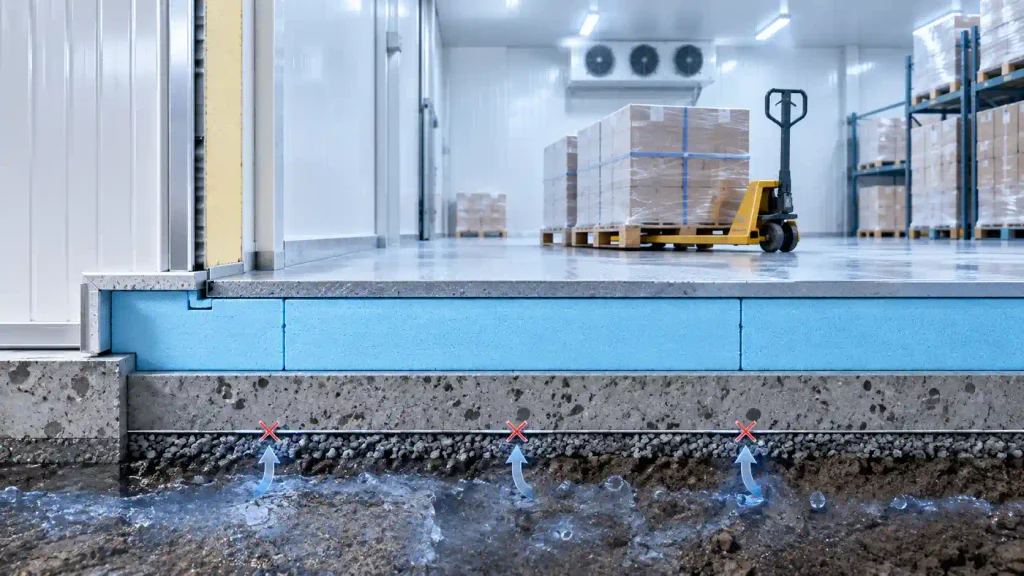
Floor insulation is frequently underspecified, and the consequences differ sharply depending on operating temperature:
- Walk-in chillers (+2°C to +5°C): Floor insulation isn’t always mandated by code on a ground-level slab, since the ground beneath stays above freezing. It’s still considered best practice, because it reduces refrigeration load and stops condensation forming on adjacent surfaces. If the chiller sits above an unconditioned space, floor insulation becomes mandatory to prevent the ceiling below from sweating and developing mold.
- Walk-in freezers (-18°C to -25°C): Floor insulation is mandatory in every case. Without a proper thermal break, sub-zero temperatures penetrate the slab, freeze ground moisture, and cause frost heave — a hydraulic expansion of ice that cracks concrete and can compromise the whole structure. Freezers also typically need sub-floor anti-frost heating or glycol loops beneath the XPS layer.
XPS is specified for cold storage floors under ASTM C578 classifications. Type VI (275 kPa) or Type VII (414 kPa) are the standard specifications for commercial cold storage floors in the UAE, chosen for their load-bearing capacity combined with resistance to sub-slab moisture.
Sandwich Panel Systems for Cold Storage
Most UAE walk-in chillers use insulated sandwich panels — a rigid PU or PIR foam core continuously injected between two metal facings, tested to standards like EN 14509. A standard PU panel for cold room walls remains common on smaller or budget-driven builds, though PIR is increasingly the default core specified for commercial and industrial projects. Our guide to chiller room panels covers the joint systems and panel types below in more detail; the specification points that separate a durable sandwich panel cold storage installation from a problem one:
- Facing material: Pre-painted galvanized iron (PPGI) or aluminum-zinc coated steel (minimum 0.5mm) is standard. In coastal locations — Dubai, Sharjah, Ras Al Khaimah — atmospheric salinity accelerates corrosion, so SS304 or SS316 stainless steel facings are recommended, along with any facility requiring frequent chemical washdowns.
- Joint system: Cam-lock joints with built-in gaskets pull the panel edges tightly together as they’re locked, compressing the seal in a way a basic friction-fit slip joint simply can’t. In the UAE’s humid ambient air, that difference in air-leakage control matters more than it would in a drier climate.
- Joint sealing: Every joint gets sealed on the warm, exterior side with a double layer of butyl rubber tape, then finished on the cold, interior side with food-grade silicone rated to FDA 21 CFR 177.2600 — the combination that keeps the surface HACCP-compliant.
How Much Insulation Thickness Do You Need? (Chiller vs Freezer)
Global industry practice commonly starts at 75–100mm for chillers, but UAE-specific guidance calls for 100mm as the minimum baseline given the region’s heat load. For freezers, 120–150mm is the standard UAE specification.
| Application | Recommended UAE Thickness (PU/PIR) | Approx. R-Value |
|---|---|---|
| Walk-in chiller (+2°C to +5°C) | 100mm minimum | R-25+ |
| Walk-in freezer (-18°C to -25°C) | 125–150mm | R-30–R-37 (estimated)* |
*The R-25 chiller figure is derived directly from the underlying report’s stated U-value (0.22 W/m²·K at 100mm). The freezer R-value range is calculated from PIR’s thermal conductivity range (0.020–0.026 W/m·K) across the 120–150mm thickness range and isn’t stated directly in either source — treat it as an estimate rather than a specified target. A 100mm PU panel brings the U-value down to roughly 0.22 W/m²·K compared to 0.29 W/m²·K at 75mm, which is where the R-25 figure comes from.
Vapor Barriers: Preventing Condensation in High-Humidity Climates
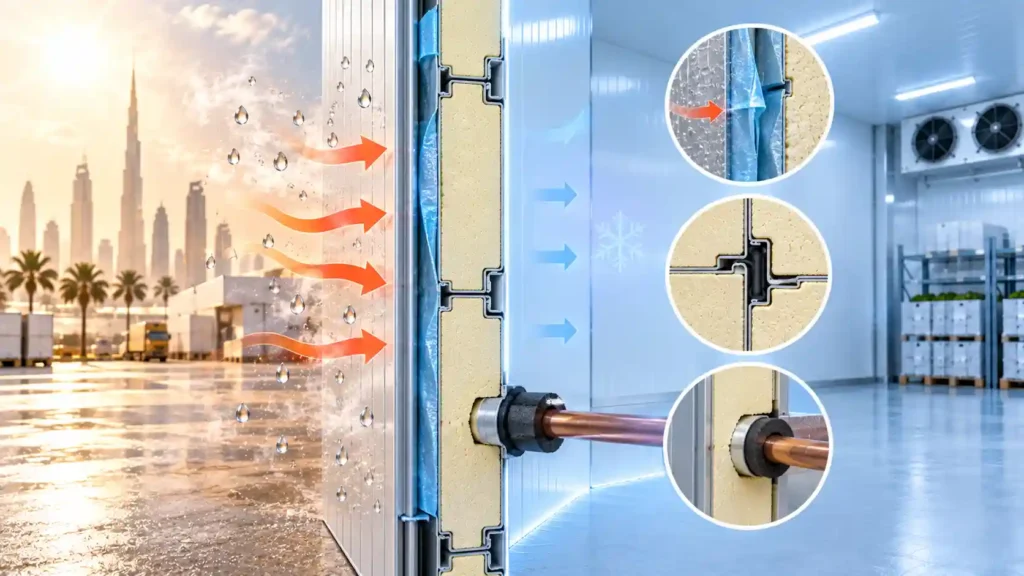
The vapor barrier has to sit on the warm side of the insulation — the exterior face in every UAE application. Sealing the interior instead traps moisture inside the panel joint, which degrades the core from within and can eventually cause interstitial ice formation. A continuous, unbroken exterior vapor barrier — achieved through cam-lock panels, double butyl tape at every joint, and hermetically sealed pipe and electrical penetrations — is the primary defense against the vapor pressure differential created by the UAE’s combination of high heat and high coastal humidity.
Thermal Bridging: The Hidden Cause of Compressor Strain
Thermal bridging happens wherever a conductive material interrupts the insulation layer: unbroken metal door frames, suspension rods through ceiling panels, or steel screws connecting the interior and exterior skins. Each bridge acts as an energy conduit, cooling the exterior surface below the ambient dew point and producing visible condensation — often seen as a line of condensation “dots” tracing screw positions across a panel. Left unaddressed, thermal bridges drive up compressor run-time and create ongoing corrosion and mold risk at the affected points.
Industries That Depend on Proper Chiller Room Insulation
Correctly insulated walk-in chillers are foundational infrastructure across a wide range of commercial and industrial operations in the UAE, including:
- Food and beverage: meat, seafood, dairy, produce, and beverage cold storage
- Pharmaceutical and healthcare: temperature-controlled storage under regulatory oversight
- Hospitality: hotel and restaurant kitchens, catering facilities
- Retail and supermarkets: back-of-house cold storage
- Logistics and industrial warehousing: cold chain distribution hubs
Manufacturers and suppliers serving these sectors across Dubai, Abu Dhabi, Sharjah, Ajman, and the wider UAE increasingly specify PIR-cored panels as a baseline rather than an upgrade, given the fire code and energy cost pressures described above.
Choosing a Supplier for Walk-In Chiller Insulation Installation
When sourcing insulation materials for a walk-in chiller installation or a walk-in freezer system, a few specification points are worth confirming directly with any commercial or industrial supplier:
- Panel core material (PU vs PIR) and its published fire classification
- Facing material and whether stainless steel is available for coastal or high-hygiene sites
- Joint system — cam-lock versus slip joint
- Floor insulation grade (ASTM C578 type) if the floor package is included
- Compliance documentation against the UAE fire code and, where applicable, Dubai Municipality’s Al Sa’fat requirements
UAE Regulations, Climate, and Energy Costs to Consider
- Fire code compliance: The UAE Fire and Life Safety Code of Practice governs fire performance requirements for insulated panels, which is the primary reason PIR has become the default over standard PU for larger commercial installations.
- Energy regulations: Dubai Municipality’s Al Sa’fat green building regulations set maximum U-values for building envelopes (walls: 0.57 W/m²·K, roofs: 0.20 W/m²·K), a useful benchmark even for standalone cold room structures.
- Coastal corrosion: Facilities in Dubai, Sharjah, and Ras Al Khaimah should weigh stainless steel facings against the long-term maintenance cost of standard PPGI in high-salinity air.
- Electricity tariffs: DEWA’s progressive slab tariff, covered above, means under-insulated cold rooms aren’t just less efficient — they get billed at a materially higher rate as consumption climbs into the higher bands.
Common Insulation Mistakes to Avoid
- Treating chillers and freezers identically. Specifying a chiller-grade 100mm panel and skipping floor insulation on a -18°C freezer room all but guarantees frost heave and premature compressor failure.
- Using EPS for floor insulation. EPS lacks the compressive strength for pallet jack traffic and absorbs moisture over time, losing thermal resistance.
- Using fiberglass anywhere in a cold room. Fiberglass batts absorb condensation readily, which destroys their insulating value and encourages mold growth — it has no place in a UAE walk-in chiller.
- Unsealed penetrations. Refrigeration pipework and electrical conduits that pass through the envelope without proper sleeving and sealing become direct paths for humid air to bypass the insulation entirely.
- Ignoring the roof on outdoor installations. Building a chiller outdoors without a secondary weather-protecting roof exposes horizontal ceiling panels directly to solar radiation, pushing the sol-air temperature to extremes and degrading panel joints through repeated thermal expansion and contraction.
- Abrasive cutting on-site. Angle grinders burn the foam core and damage the protective coating on metal facings; cold-cutting saws designed for composite panels should be used instead.
Frequently Asked Questions
It depends on whether you’re insulating a chiller or a freezer. A standard chilled room running between +2°C and +5°C typically uses 75 to 100mm of PU or PIR insulation — and given the UAE’s ambient heat, 100mm is the safer minimum rather than the low end of that range. Freezers, running down to -18°C to -25°C, need considerably more, usually 120 to 150mm, simply because the temperature gap they’re fighting is so much larger.
PIR foam-cored sandwich panels are best for walls and ceilings due to their combination of low thermal conductivity and strong fire performance. XPS is best for floor insulation due to its compressive strength and near-zero water absorption.
PIR is generally preferred in hot climates like the UAE because of its higher service temperature and superior fire resistance, which matters when panel surface temperatures climb well above ambient under direct sun.
It isn’t always legally mandatory for a ground-level chiller, but it’s considered best practice to reduce refrigeration load and prevent condensation. It becomes mandatory if the chiller sits above an unconditioned space, and is always mandatory for freezers.
The UAE’s combination of high coastal humidity and high ambient heat pushes moisture hard toward the inside of a cold room — vapor naturally moves from areas of high pressure to low pressure, and a hot, humid exterior against a cold, dry interior is about as strong a pressure gradient as you’ll find in any building envelope. The trouble starts at the vapor barrier. Any break in it lets moisture travel inward until it hits its dew point inside the insulation core, and once that happens, the panel is waterlogged and has lost most of its ability to insulate.
Thermal bridging is the most common cause — conductive materials like door frames, suspension rods, or unbroken screws create a path for heat to reach the interior, cooling the exterior surface below the local dew point.
Get Expert Help With Your Walk-In Chiller Insulation
Choosing the right insulation materials is only half the equation — installation quality determines whether that specification holds up over a 20-year service life. ChillerRoom.ae designs and installs PIR and XPS-insulated walk-in chillers and cold storage systems for commercial and industrial clients across Dubai, Abu Dhabi, Sharjah, Ajman, and the wider UAE. For a broader look at sizing, cost, and supplier selection, see our complete walk-in chiller buyer’s guide.