Cold Room for Spare Parts: UAE Industrial Storage Guide
Senior Refrigeration Engineer · ChillerRoom.ae
Updated 2026 · Estimated read time: 06–10 min
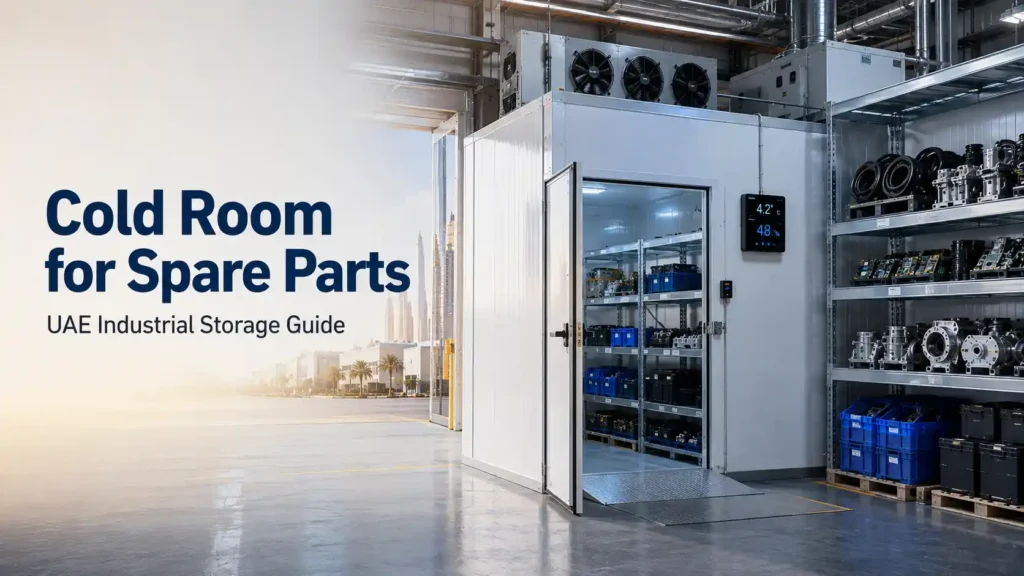
UAE businesses across aviation, oil and gas, EV logistics, marine, and automotive sectors face a shared problem: extreme desert heat degrades sensitive spare parts, seals, adhesives, and electronics faster than anywhere else in the world. A cold room for spare parts solves this by keeping components within their required temperature and humidity range from delivery to installation. This guide covers what a cold room for spare parts actually does, which temperature range different materials need, and how industrial and commercial cold room solutions are used across Dubai, Abu Dhabi, and Sharjah.
Quick Answer: A cold room for spare parts is a temperature and humidity-controlled facility that protects heat-sensitive components — composite prepregs, rubber seals, electronics, batteries, and adhesives — from degradation caused by extreme UAE ambient heat. Storage requirements range from -18°C for aerospace composites to 15°C–30°C for electronics and batteries, depending on the material. ChillerRoom.ae provides both industrial and commercial cold room solutions for spare parts storage across Dubai, Abu Dhabi, and Sharjah.
Table of Contents
What Is a Cold Room for Spare Parts?
A cold room for spare parts is a temperature and humidity-controlled storage facility built to protect heat-sensitive components, materials, and equipment from degradation caused by the UAE’s extreme ambient climate. Unlike food cold storage, which centers on freshness and spoilage, a spare parts cold room is engineered around the specific chemistry and physics of industrial materials — halting resin curing in composite fabrics, preventing rubber seals from hardening, stopping electronic components from absorbing moisture, and protecting lithium-ion cells from thermal stress.
ChillerRoom.ae designs and installs both industrial cold rooms for large-scale spare parts warehousing and commercial cold room units for smaller workshop, depot, or retail-scale storage, across Dubai, Abu Dhabi, and Sharjah.
Why UAE Businesses Need Cold Room Storage for Spare Parts
Summer in the UAE isn’t gentle. Ambient temperatures climb past 45°C, sometimes touching 49°C, and a warehouse without climate control runs hotter still inside. This isn’t just a comfort issue for stored goods — it’s a chemistry problem.
As a general rule of thumb in materials science, every 10°C rise in storage temperature roughly doubles the rate of material degradation, cutting a component’s usable shelf life in half. This principle (based on the Arrhenius relationship between heat and reaction rate) explains why:
- Composite prepregs kept at -18°C last a full 12 months. Store them at a normal 20°C room temperature instead, and they lose their “tack” — the stickiness needed for layup — in about 60 days. Push that up to UAE warehouse heat (37°C to 43°C), and the decay speeds up another 3 to 4.5 times, so the real usable window shrinks to a fraction of even that 60-day figure.
- Rubber O-rings and gaskets go brittle and start cracking years before they’re supposed to.
- Electronic components soak up ambient moisture, and that moisture causes cracking later — during soldering or installation.
- Lithium-ion batteries lose capacity faster and carry a higher risk of thermal stress.
For UAE businesses handling high-value technical inventory — whether that’s an aviation MRO facility, an oilfield equipment depot, or an EV parts warehouse — a properly specified cold room isn’t a luxury. It’s what keeps components within their certified, usable condition until they’re needed.
Freezer or Chiller? Choosing the Right Cold Room for Your Spare Parts
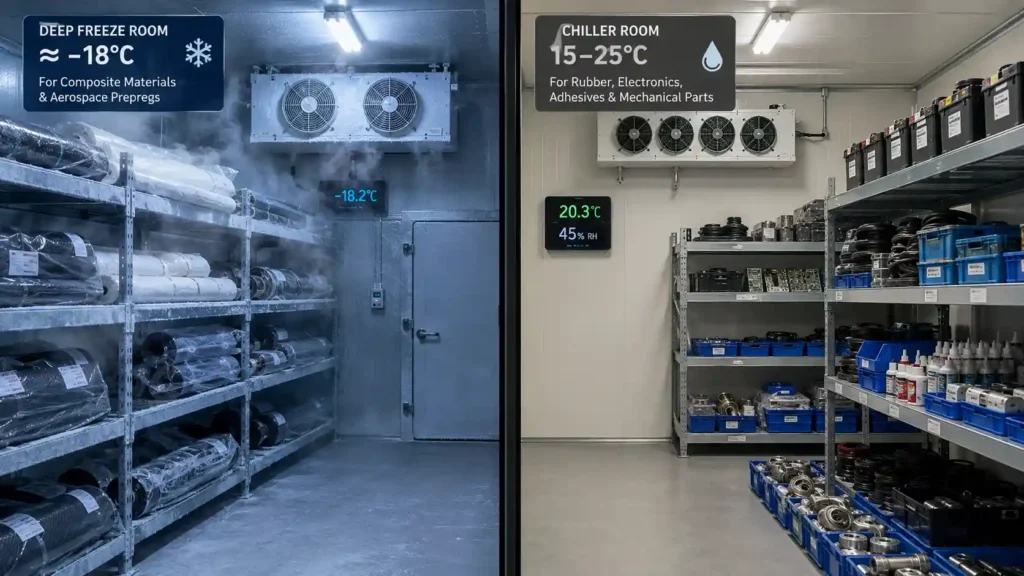
This is the single most common question when specifying a cold room for spare parts, and the right answer depends entirely on what you’re storing:
You need a freezer (deep-freeze, -18°C) if you’re storing:
- Composite prepregs and carbon fiber fabrics used in aviation MRO and high-performance automotive manufacturing — freezing pauses the epoxy resin’s chemical curing process, keeping the material workable
You need a chiller or climate-controlled room (5°C to 30°C, depending on material) if you’re storing:
- Rubber elastomers, O-rings, and gaskets need 5°C to 25°C — anything hotter and they start hardening and cracking.
- Precision electronics, PCBs, and lithium-ion battery packs do best at 15°C to 30°C, and humidity control matters just as much as temperature here — get it wrong and you’re looking at moisture damage or thermal stress.
- Industrial adhesives and resins generally hold up fine at 15°C to 25°C. The exception is highly reactive epoxies and sealants, which need actual refrigeration — down in the 2°C to 8°C range.
In short: if you’re storing aerospace composite material, you need a deep freezer. For seals, electronics, batteries, adhesives, and general mechanical spares, a chiller or precisely regulated ambient-cooling room is the correct — and more common — choice.
Industries That Rely on Cold Room for Spare Parts Storage in the UAE
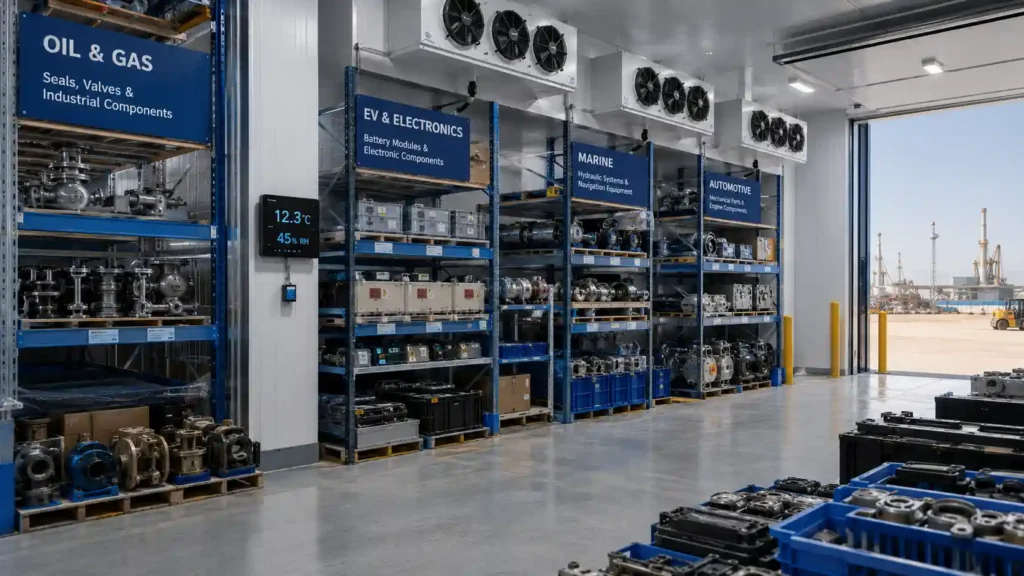
Cold Storage for Aviation Parts
Aircraft maintenance and repair depend on a handful of materials that simply can’t handle heat: composite prepregs, structural adhesives, elastomer seals, precision avionics components. Get the storage wrong, and the consequences show up fast. Composites need deep-freeze conditions at -18°C to stop the resin from curing too early; sealants and adhesives are a bit more forgiving but still need 2°C to 8°C. Around Dubai South and the wider aerospace hub, MRO operators are increasingly expected to show audited, temperature-mapped storage records to keep their maintenance certifications current — which is exactly what a properly specified cold room for aviation parts is built to support.
Cold Room for Chemical Logistics Parts
Chemical logistics involves storing volatile compounds, reactive resins, hazardous sealants, and specialized industrial chemicals that require explosion-proof construction alongside temperature control. A cold room for chemical logistics parts typically includes ATEX-rated electrical fittings, corrosion-resistant panels, gas detection systems, and sealed doors to prevent both thermal degradation and ignition risk — critical in the industrial zones of Abu Dhabi and Dubai where petrochemical and chemical distribution activity is concentrated.
Cold Room for Oil and Cold Room for Gas Industry Parts
Oil and gas operations actually need cold storage for two different reasons, not one. First, there’s the equipment side — elastomeric seals, gaskets, and downhole components that break down fast once heat and acidic exposure get involved. Second, there’s the fluids side: lubricants, hydraulic fluids, and specialized oils that thin out, oxidize, or lose their additive properties once ambient temperatures climb. Elastomer components used in oilfield equipment are typically kept between 5°C and 25°C, while sensitive lubricant grades often require 10°C to 20°C to prevent additive breakdown. Given the scale of petrochemical and industrial storage development in Abu Dhabi’s industrial zones, demand for this category of cold storage continues to grow.
Cold Room for EV Logistics Parts
EV adoption in the UAE is moving fast, and the parts behind it — lithium-ion battery modules, battery management electronics, specialized bonding agents — don’t tolerate heat well. Keep them between 15°C and 25°C, with humidity under control too. Skip either one and you risk condensation forming on terminals and circuit boards, or worse, thermal stress building up inside stored battery cells. Fire-safety integration is a key design consideration for any facility storing EV battery inventory.
Cold Room for Marine Parts
Marine parts have it worse than most — engine gaskets, sonar and navigation electronics, hydraulic pump components, rubber seals, all sitting under a double threat of extreme heat and heavy coastal humidity. That’s why a cold room for marine parts usually gets built differently: stainless steel or coated panels to fight off salt-air corrosion, and an ambient-controlled range (5°C to 25°C) rather than the deep-freeze setup you’d use for food or biological cargo. Port-adjacent storage near Dubai and Sharjah’s maritime zones reduces vessel downtime by keeping critical spares ready for rapid deployment.
Cold Room for Automotive Parts
Rubber hoses, gaskets, adhesives, sensors, wiring harnesses, precision-machined metal parts — sustained desert heat gets to all of them eventually, whether that’s corrosion, lost elasticity, or outright degradation. A cold room for automotive parts typically runs at 15°C to 25°C with active humidity control, mainly to stop flash rust from forming on bare metal. Dealerships, workshops, and parts distributors across Dubai, Abu Dhabi, and Sharjah lean on this kind of setup daily.
Cold Room for Tools and General Industrial Parts
Beyond the sector-specific categories above, many UAE businesses need a cold room for tools and parts more broadly — precision instruments, metal tooling, and mixed mechanical inventory that simply needs protection from rust and humidity rather than deep cooling. These are typically maintained at 10°C to 15°C with strong dehumidification, since condensation (not heat alone) is the primary risk to bare metal tooling in a chilled environment.
Technical Specifications: Cold Room Requirements by Part Category
| Part Category | Temperature Range | Humidity Range | Key Degradation Risk |
|---|---|---|---|
| Composite prepregs/carbon fiber | -18°C | Low, controlled | Premature resin curing, loss of tack |
| Rubber elastomers, O-rings, gaskets | 5°C – 25°C | Below 65% RH | Hardening, cracking, loss of elasticity |
| Industrial adhesives, resins, sealants | 15°C – 25°C (2°C–8°C for reactive epoxies) | Controlled, low | Premature polymerization, viscosity loss |
| Lithium-ion battery packs | 15°C – 25°C | Controlled | Capacity fade, thermal stress |
| Precision electronics / PCBs | 15°C – 30°C | 40% – 65% RH (below 5% for moisture-sensitive devices) | Moisture absorption, delamination |
| Lubricants, hydraulic fluids | 10°C – 20°C | Controlled | Viscosity breakdown, oxidation |
| Tools & general metal components | 10°C – 15°C | Low, dehumidified | Corrosion, flash rust |
Industrial vs Commercial Cold Room Solutions for Spare Parts
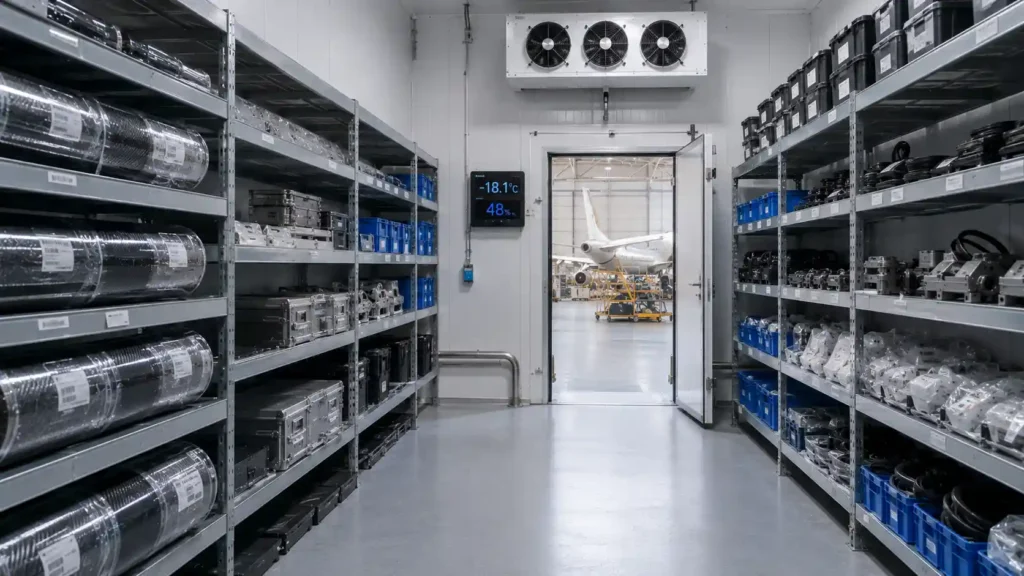
Not every UAE business needs the same scale of cold storage. ColdRoom.ae designs both:
- Industrial cold room solutions — large-format, warehouse-scale facilities for aviation MRO providers, oil and gas depots, chemical logistics operators, and EV parts distributors, often with reinforced flooring, explosion-proof fittings, and heavy-duty racking for palletized inventory.
- Commercial cold room solutions — smaller, modular units suited to automotive workshops, marine chandleries, tool depots, and parts retailers that need reliable climate control without warehouse-scale infrastructure.
Both configurations can be built as modular or prefabricated units, allowing faster installation and easier relocation — a practical advantage for UAE businesses scaling storage capacity as demand grows.
UAE-Specific Considerations for Spare Parts Cold Storage
- Climate extremes: Ambient temperatures exceeding 45°C to 49°C in summer make passive or minimally insulated storage inadequate for heat-sensitive components — this is a baseline design constraint for any UAE cold room, not an edge case.
- Industrial clusters: Aviation-related storage demand concentrates around Dubai’s aerospace and airport free zones; oil, gas, and chemical storage demand concentrates in Abu Dhabi’s industrial zones; marine and automotive parts storage clusters around Dubai and Sharjah’s port and industrial areas.
- Regulatory alignment: Aviation component storage should align with UAE General Civil Aviation Authority (GCAA) maintenance and storage requirements. Hazardous chemical storage is subject to Dubai Municipality and Dubai Civil Defence dangerous goods regulations. These two are UAE-specific legal frameworks. The elastomer guidance (ISO 2230), the electronics/PCB handling guidance (IPC-1601), and the Arrhenius rule of thumb we’ve used throughout this page are a different matter — they’re international engineering standards, not UAE law, and we’re applying them to UAE conditions rather than citing them as local requirements. Worth keeping that distinction straight. And to be clear: none of this is a substitute for checking current requirements with the relevant authority directly — treat it as general guidance, not certification.
- Coverage: ChillerRoom.ae installs both industrial and commercial cold rooms, handles spare parts storage design, and offers maintenance support in Dubai, Abu Dhabi, and Sharjah.
Cold Room for Spare Parts: Comparison by Storage Type
| Storage Type | Typical Range | Best For |
|---|---|---|
| Deep-freeze cold room | -18°C | Composite prepregs, carbon fiber fabrics |
| Chiller / refrigerated room | 2°C – 8°C | Reactive epoxies, highly sensitive sealants |
| Climate-controlled cold room | 15°C – 30°C | Electronics, batteries, general adhesives, elastomers |
| Ambient dehumidified store | 10°C – 15°C | Tools, metal parts, mixed mechanical inventory |
Frequently Asked Questions
The right setup depends on the material. Composite prepregs need a -18°C deep-freeze unit, while adhesives, sealants, and elastomer seals need chilled or climate-controlled storage between 2°C and 25°C, depending on the specific compound.
If you’re storing elastomeric seals, gaskets, or downhole components, yes — heat accelerates the breakdown of these materials significantly in UAE ambient conditions. Lubricants and hydraulic fluids also benefit from stable, cooler storage to prevent viscosity and additive breakdown.
Lithium-ion battery packs are generally kept between 15°C and 25°C with tight humidity control, both to preserve capacity and to reduce the risk of thermal stress during storage.
No. Marine spare parts like gaskets, seals, and electronics need ambient-controlled storage (roughly 5°C to 25°C) built with anti-corrosive, salt-resistant materials — not the deep-freeze conditions used for marine food or biological cargo.
For rubber components, adhesives, and electronics, yes. Sustained desert heat accelerates cracking, curing, and corrosion, so ambient-controlled storage around 15°C to 25°C with humidity control significantly extends usable part life.
If you’re storing aerospace composite prepregs, you need a freezer at -18°C. For virtually everything else — seals, electronics, batteries, adhesives, tools — a chiller or precisely controlled ambient-cooling room is correct.
Get a Custom Cold Room for Spare Parts
Heat doesn’t wait, and neither should your storage plan. Whether you’re protecting a batch of aviation composites, a warehouse of elastomer seals, or a fleet of EV battery modules, ChillerRoom.ae builds cold rooms sized and specified for exactly what you’re storing — not a generic setup that happens to run cold. Our team serves clients across Dubai, Abu Dhabi, and Sharjah.