
Solar Cold Room Suppliers in UAE
Solar-powered cold storage solutions for farms, food suppliers, remote sites, logistics businesses, supermarkets, and commercial facilities across Dubai, Abu Dhabi, Sharjah, and the UAE.
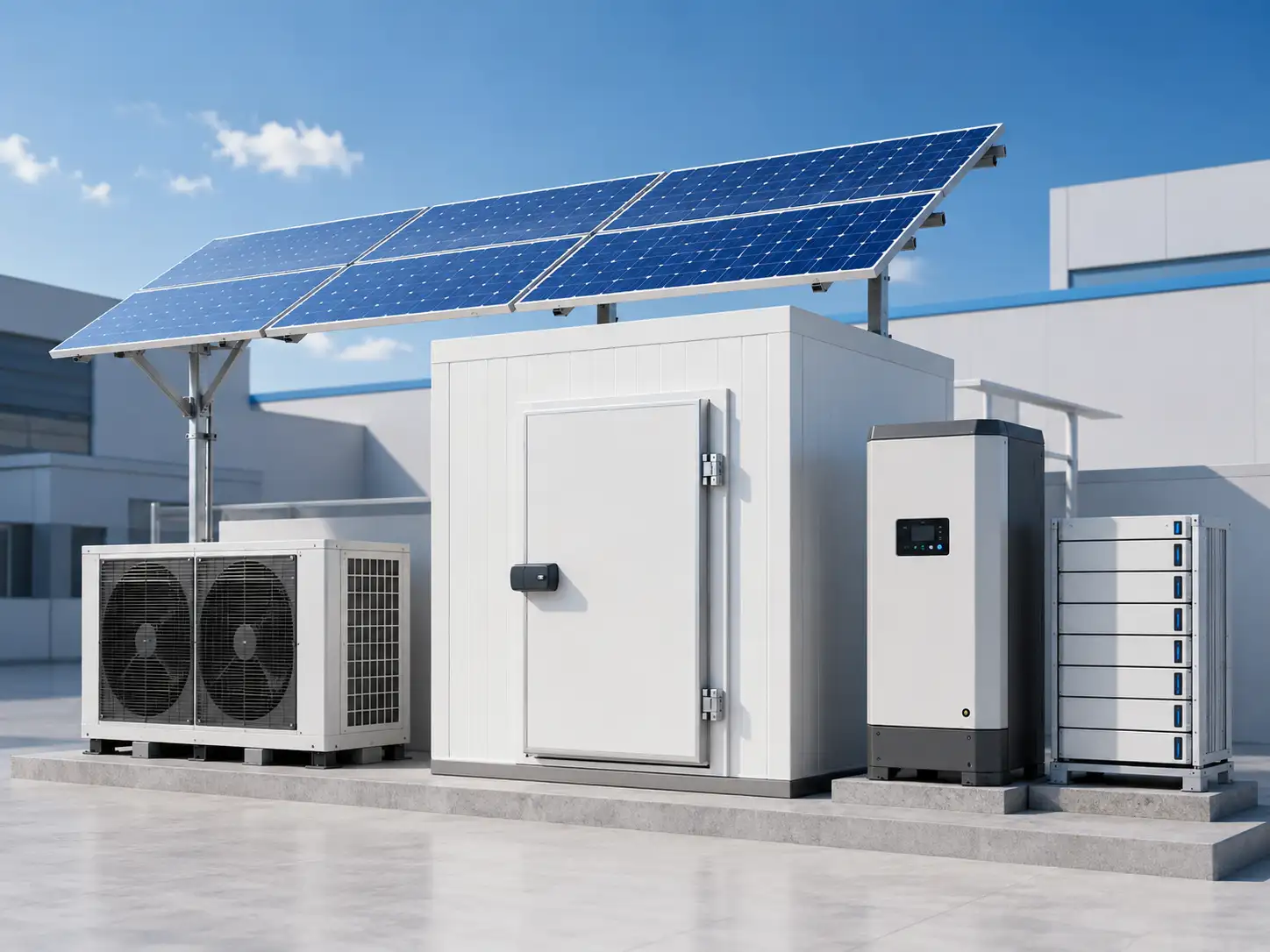
Cold Storage Powered by Solar Energy
Proper solar cold storage manufacturing starts with cooling load calculation, insulation selection, compressor sizing, backup planning, and solar power matching. Not every business has reliable grid power. And even those that do are looking at serious electricity bills when running cold storage through a UAE summer. A solar cold room runs fully or partly on solar energy — keeping produce, dairy, seafood, beverages, and flowers at the right temperature without depending entirely on mains power. Same cooling performance, less grid dependency. As solar cold room suppliers and manufacturers in UAE, ChillerRoom.ae designs systems built around your storage temperature, site conditions, and how you actually use the room — not a generic off-the-shelf spec. The setup can be solar-ready, hybrid, or fully solar-powered cold storage, depending on what your operation needs.
- Solar cold room design for commercial use
- Solar, grid, and generator backup options
- Right for farms, food suppliers, and remote sites
- Sized around your load, temperature, and usage
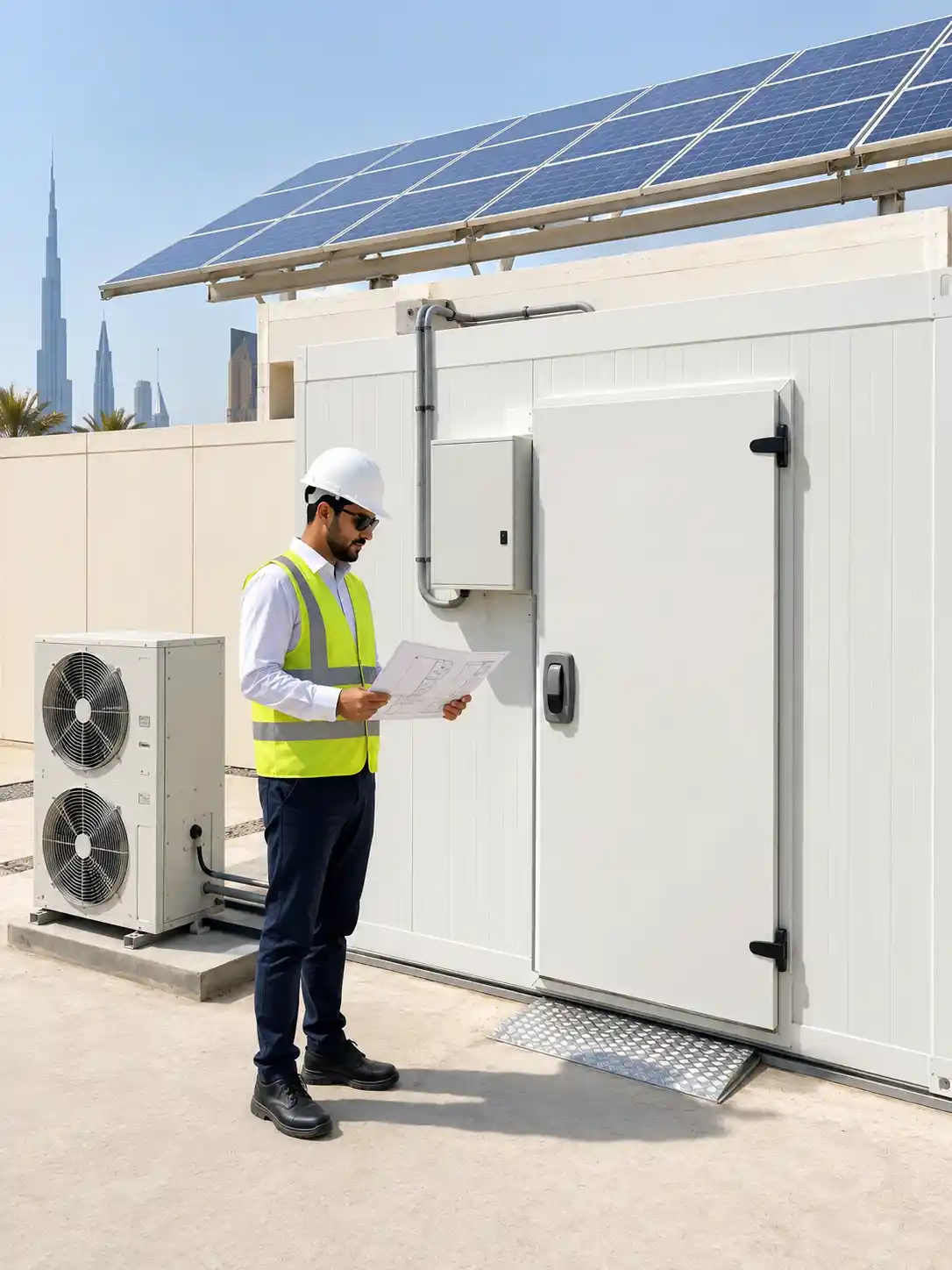
Solar Power + Cold Storage Planning
Proper solar cold storage manufacturing starts with cooling load calculation, insulation selection, compressor sizing, backup planning, and solar power matching. Adding solar panels to a cold room isn’t a solution — it’s just wiring. The cooling load, insulation, compressor capacity, backup hours, door frequency, and product type all have to be figured out together. UAE heat, humidity, and dust make that calculation more demanding than most standard specs account for. ChillerRoom.ae sizes the system around your room, your product, your temperature requirement, and your available solar area before anything gets recommended.
Built for Day and Night Operation
Solar panels work during daylight. Cold storage has to work around the clock. For most commercial setups — farms, seafood suppliers, dairy storage, frozen food businesses, remote sites — that means pairing solar with battery backup, grid connection, or generator support. Without it, one sunset is enough to put your stock at risk.
Solar Cold Room System Types
Solar-Ready Cold Room
For businesses that want a cold room now and want the option to connect solar power later.
Hybrid Solar Cold Room
For commercial users who want solar support with grid or generator backup for safer operation.
Solar Powered Cold Storage Container
For farms, remote sites, fisheries, events, and temporary cold storage requirements.
Solar Cold Room vs Normal Cold Room
| Feature | Solar Cold Room | Normal Cold Room |
|---|---|---|
| Power Source | Solar, hybrid, or solar-ready | Grid power or generator |
| Best Use | Farms, remote sites, energy-saving storage | Standard commercial cold storage |
| Backup Need | Battery, thermal storage, grid, or generator | Generator or grid backup |
| Running Cost | Can reduce grid power use | Depends mainly on electricity |
| Design Complexity | Higher because power and cooling must match | Simpler setup |
| UAE Suitability | Good when designed properly | Good for most commercial sites |
A solar cold room is not always the lowest-cost option at the beginning. But it can be a strong long-term choice for businesses that need lower electricity dependency, remote cooling, or sustainable cold storage.
Who Needs Solar Cold Storage in UAE?
Solar cold storage is useful for businesses that need reliable cooling but want lower grid dependency, better backup planning, or storage in areas where power access is limited.
Farms & Agriculture
For fruits, vegetables, herbs, dairy, and fresh produce, storage after harvesting.
Food Suppliers
For chilled products, beverages, packed food, and daily delivery stock.
Seafood & Fisheries
For fish, seafood, frozen products, and coastal storage operations.
Remote Sites
For camps, temporary facilities, and locations with limited grid power.
Cold Chain Businesses
For short-term holding, distribution points, and backup temperature-controlled storage.
Retail & Supermarkets
For chilled and frozen stock before display, packing, or customer delivery.
Solar Cold Storage Installation in UAE
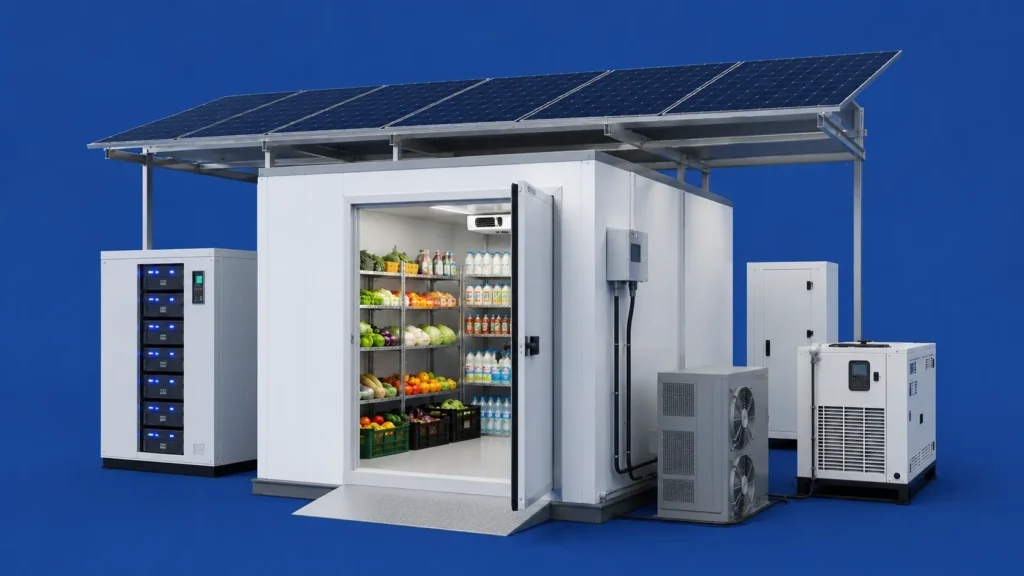
A proper solar cold storage installation starts with the storage requirement, not with the solar panel size. The room has to be planned around the product, required temperature, loading pattern, door usage, and backup hours before the power system is selected. ChillerRoom.ae helps UAE businesses plan solar cold rooms with the right balance of insulation, refrigeration capacity, solar support, backup power, and temperature monitoring. Our team checks the site condition, cold room size, product load, panel thickness, refrigeration requirement, electrical coordination, and backup planning before installation begins. The aim is to build a solar cold storage system that performs reliably during daily business use, not just during the first test run.
Temperature Planning for Solar Cold Rooms
Solar cold rooms can be designed for chilled, frozen, or custom storage requirements. The selected temperature affects the refrigeration load, solar capacity, backup size, and overall system cost.
+2°C to +8°C Chilled Storage
For dairy, beverages, flowers, selected medicines, and chilled food products.
-18°C to -25°C Frozen Storage
For frozen food, meat, poultry, seafood, and frozen supply operations.
0°C to +5°C Fresh Food Holding
For fruits, vegetables, prepared food, and short-term fresh product storage.
Custom Solar Cold Storage
For businesses that need a special temperature range, longer backup hours, or a containerised solar cold room.
Choosing the Right Solar Cold Room Setup
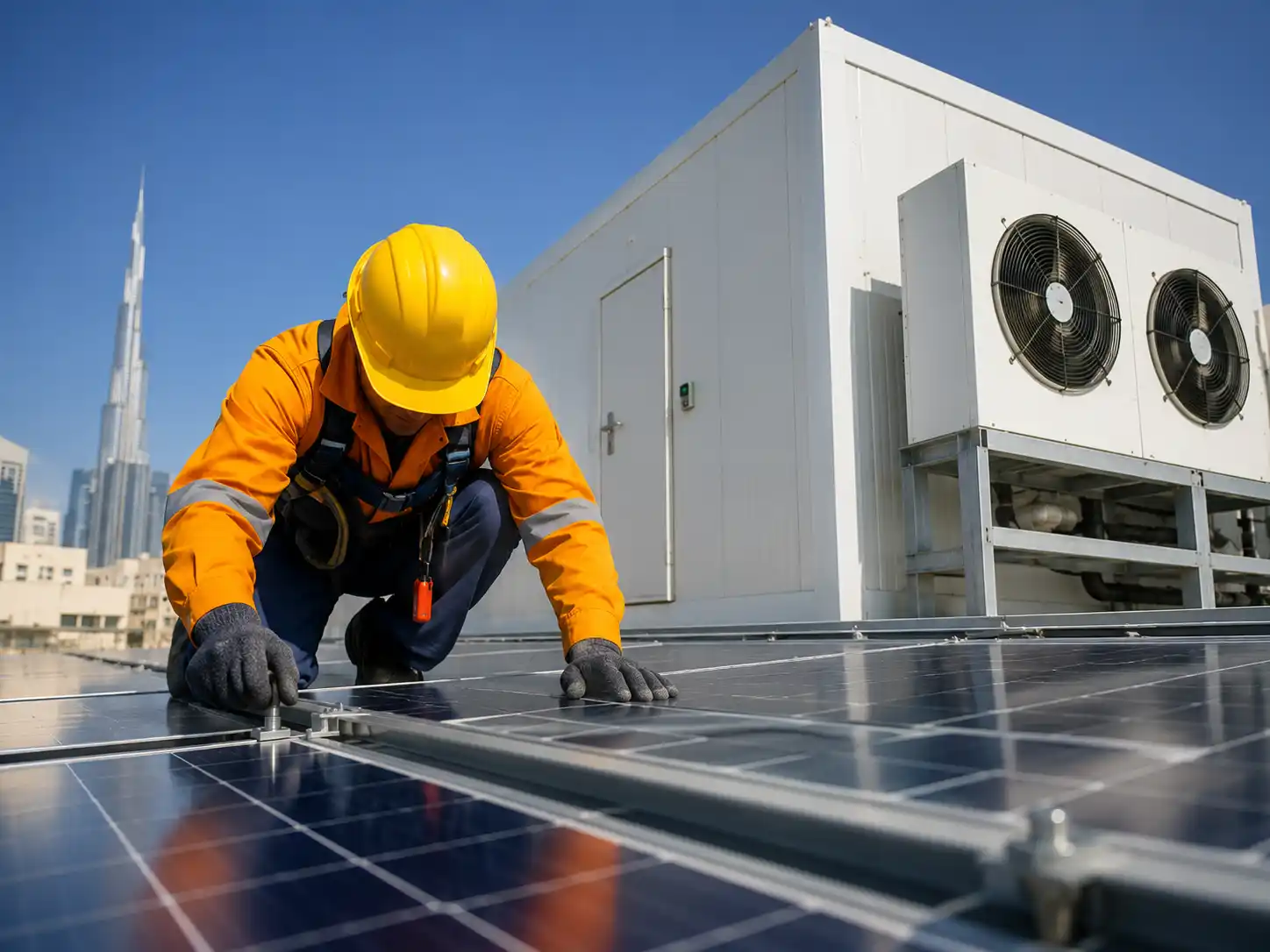
The right solar cold room depends on how your business uses the storage every day. A small farm may need a compact solar chiller room for fresh produce, while a logistics company may need a larger solar-powered cold storage container with stronger backup. Before selecting the system, the main details to check are the product type, storage temperature, daily loading, door opening frequency, backup hours, available solar panel space, grid or generator support, and future expansion requirements. This planning helps avoid unstable temperature, slow cooling recovery, oversized solar cost, undersized refrigeration capacity, and product loss during peak UAE heat.
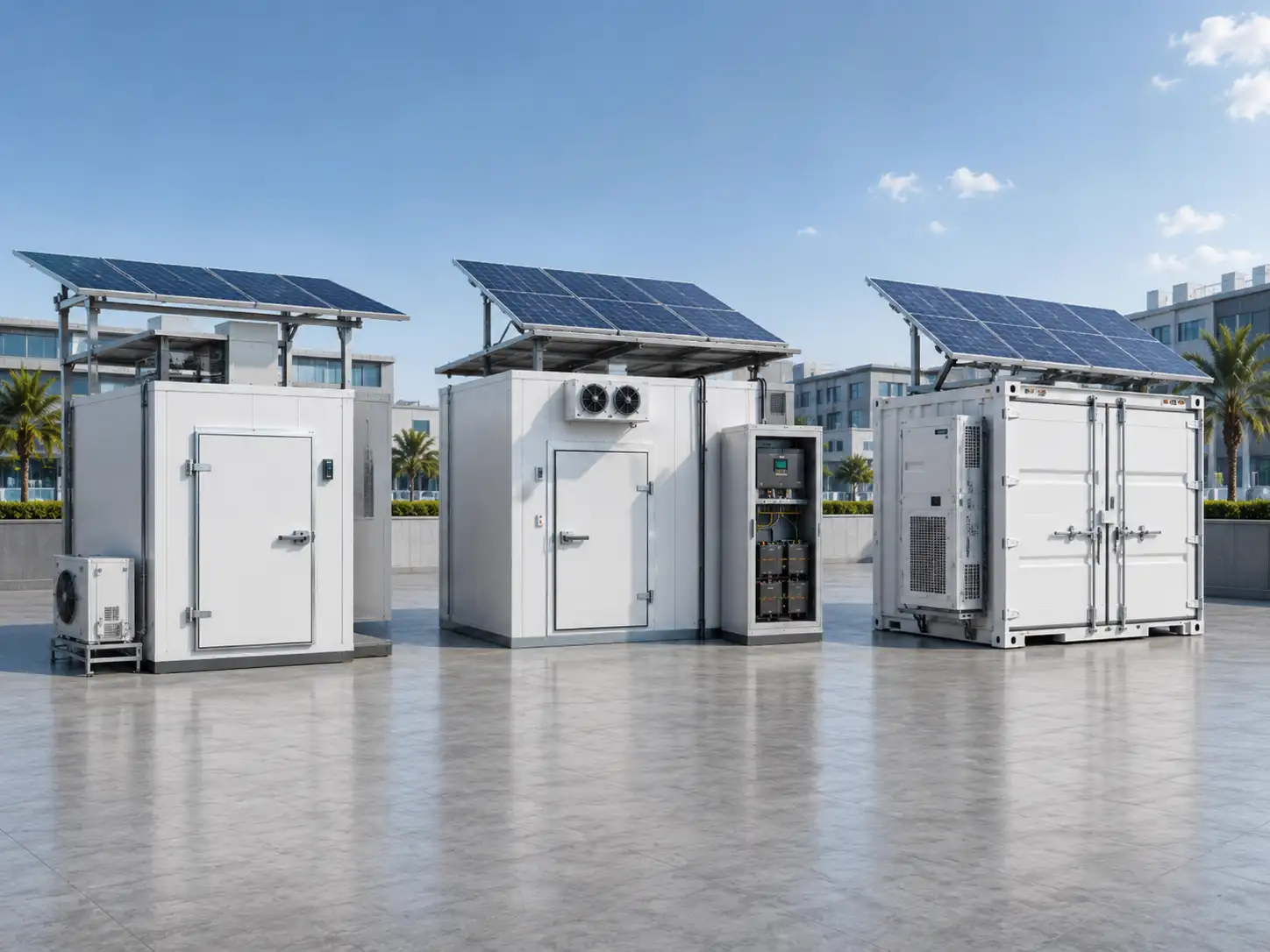
Why Backup Planning Matters
Solar cold rooms need strong backup planning because cold storage cannot stop when sunlight is low. A system may perform well during the day but struggle at night if the backup design is weak. Battery backup, thermal storage, grid support, or generator connection should be selected based on the product risk and required backup duration. Frozen storage usually needs more power than chilled storage, so freezer rooms must be planned more carefully. Reliable backup planning protects product quality, reduces spoilage risk, and helps the cold room work consistently in UAE weather.
Maintenance, Monitoring, and System Support
A solar cold room needs regular checking to keep both the cooling system and power system working properly. Refrigeration equipment, solar panels, electrical controls, evaporator fans, sensors, door gaskets, and backup systems all affect performance. ChillerRoom.ae provides cold room technical support, temperature checking, refrigeration inspection, airflow review, sensor calibration, compressor checks, and system improvement support for UAE businesses.
Solar Chiller Room for Chilled Storage
A solar chiller room is mainly used for positive-temperature chilled storage. It is suitable for fruits, vegetables, dairy, beverages, flowers, and prepared food that need cooling but not freezing. For broader chiller room solutions, visit solar chiller room support from ChillerRoom.ae.
Frequently Asked Questions
Yes, solar energy is a highly effective way to power cold storage, but it requires a specialised engineering approach. Because refrigeration is a “heavy” electrical load that must run consistently, you cannot simply plug a cold room into a standard solar setup.
A walk-in cold storage room powered fully or partly by solar energy. Instead of drawing entirely from the grid, it runs on solar panels — supported by insulated panels, purpose-matched refrigeration equipment, and usually some form of backup to cover nights or cloudy periods.
The design has to match the reality on the ground. UAE summers aren’t just hot — outside temperatures past 45°C, coastal humidity, dust, and constant door openings all add up to a much heavier strain than standard specs account for. A system built for cooler countries will struggle here. Panel thickness, condenser sizing, and refrigeration capacity need to be calculated for what the site actually experiences.
While people often use these terms to mean the same thing, the difference matters when specifying equipment. A chiller room is strictly for positive-temperature storage—think dairy, flowers, and fresh produce. A cold room is a broader category that includes both chillers and deep-freezers. To protect your investment, never accept a quote for a ‘solar cold room’ until the supplier confirms the exact temperature range they are building for.
Any product that spoils without temperature control — and where running that storage off the grid is costly, unreliable, or unavailable. Fresh produce, dairy, seafood, meat, flowers, and some pharmaceutical products are the common categories. Location drives a lot of the interest too: farms with no stable grid, remote distribution points, sites where diesel generation is the current alternative. Solar cold storage makes most sense where the grid problem and the cold storage problem exist at the same time.
It addresses a real problem. After harvest, spoilage often happens not because of bad produce but because there’s nowhere to hold it properly. Solar cold storage gives farms and collection points a way to extend shelf life without depending on stable grid power — which in some locations simply isn’t available.
There’s no standard price. Cold room size, target temperature, solar panel capacity, battery backup, refrigeration system, and site conditions all affect the figure. Anyone quoting without a site assessment and load calculation is estimating, not pricing. Get the assessment done first.
Sometimes, yes. But it’s not automatic. The existing refrigeration system’s electrical load, the insulation condition, and the available space for solar panels all need to be checked first. Some systems convert straightforwardly. Others need upgrades before solar power can support them reliably — especially in UAE summer conditions.
Yes, if the system includes battery backup, thermal storage, grid connection, or generator support. Without any of those, cooling won’t stay stable after sunset. How you handle overnight operation is one of the most important decisions in the system design — and it depends on how critical temperature continuity is for what you’re storing.
Farms, food suppliers, supermarkets, restaurants, fisheries, logistics companies, remote camps, and event storage providers all have use cases. Businesses comparing solar cold room suppliers and solar cold room manufacturers in UAE should focus on load calculation, insulation quality, backup planning, and after-sales support — not only the solar panel size.
Need Solar Cold Room Suppliers in UAE?
Tell us your product type, storage temperature, room size, location, and backup requirement. ChillerRoom.ae can help you plan a solar cold room, hybrid solar cold storage system, or solar-powered cold storage container for your UAE business.