
Supermarket Cold Storage Solutions UAE
Supermarkets lose stock for three reasons: heat gain through the door, the wrong zone for the product, and a condenser that can’t keep pace with Gulf summers. ChillerRoom.ae engineers supermarket cold storage that solves all three — for Dubai, Abu Dhabi & Sharjah.
Built Around What's Actually on Your Shelves
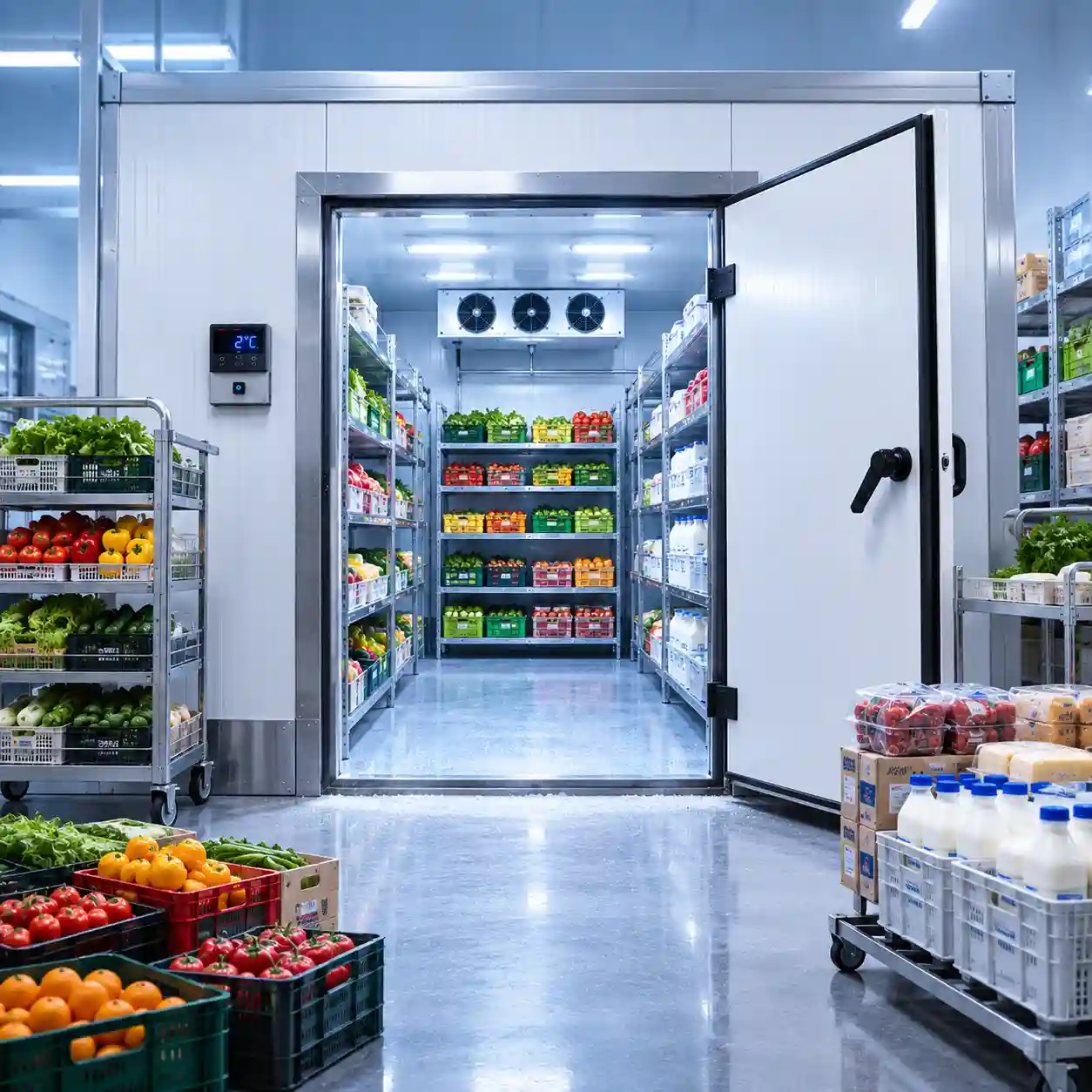
A supermarket cold room holds chilled dairy, frozen stock, fresh meat, and open display cases side by side — each with its own risk profile and legal minimum. ChillerRoom.ae designs back-of-house rooms and shopfront display units as one connected system, sized to your delivery volume rather than a standard chiller-freezer combo.
Chiller rooms run on 80–100mm PIR panelling for steady bulk holding; freezer rooms step up to 120–150mm to hold -18°C against Gulf heat gain. Display units are specified separately again, matched to what they need to show and how hard they need to work.
- Zoned by category
- Sized to real delivery volume
- Panel thickness matched to zone
- One point of accountability
Why Door Traffic Is the Real Enemy
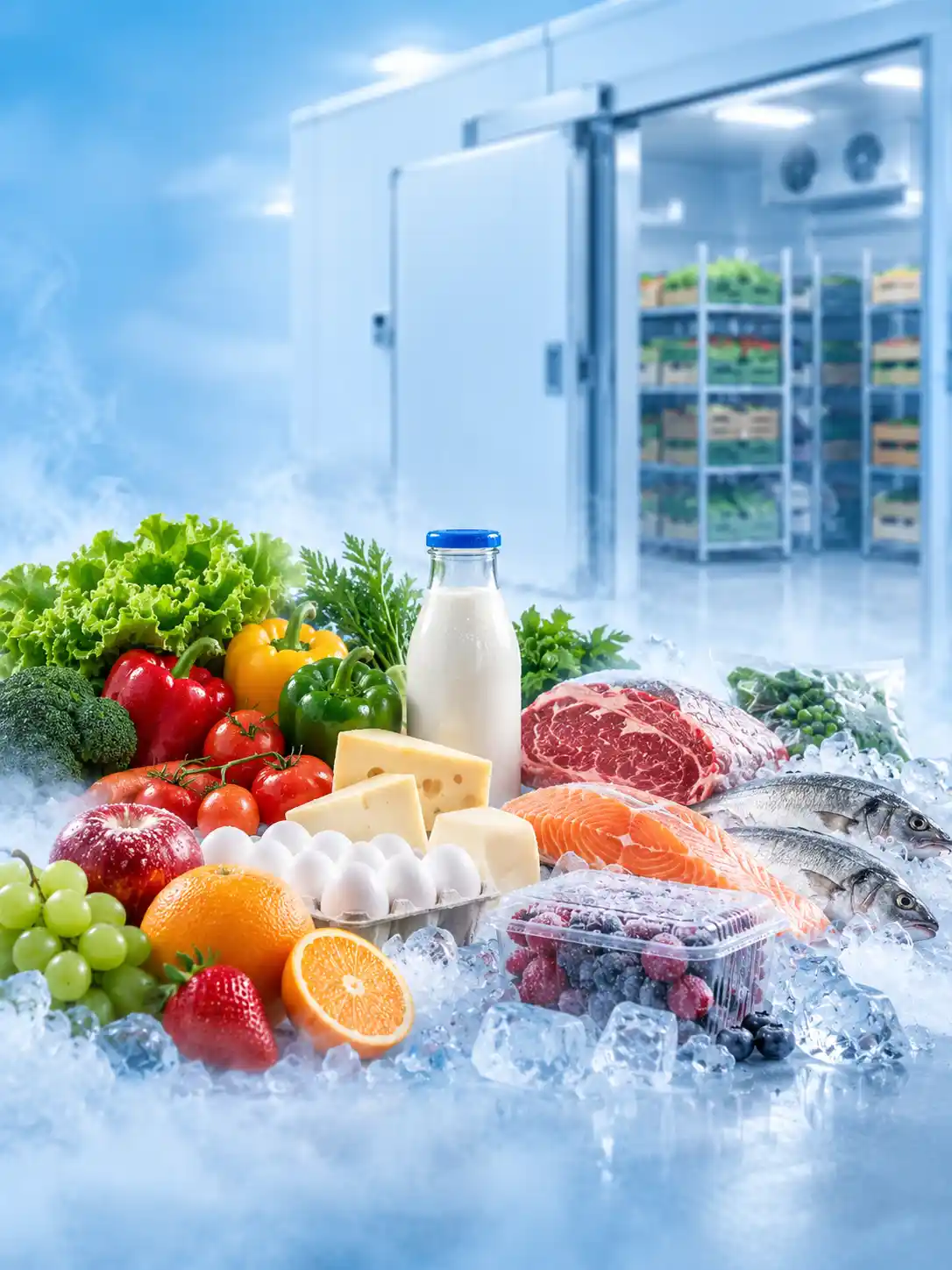
A supermarket cold room doesn’t fail from ambient heat alone — it fails from what comes through the door. Every time a walk-in opens, humid Gulf air rushes in, condenses on the coil, and forces the compressor to fight ice build-up on top of its normal load. Standard commercial units, sized for occasional access, aren’t built for a door that opens dozens of times an hour. ChillerRoom.ae specifies capacity with that traffic built in, not as an afterthought.
Keeping Categories Apart
Meat, dairy, and ready-to-eat stock can’t share a room without a separation plan. Raw protein and ready-to-eat food carry a genuine regulatory separation requirement, while dairy needs its own kind of isolation — butter and cheese absorb ambient odours fast, which is a shelf-life and quality issue rather than a legal one. We zone rooms by category from the design stage, so each product gets the separation and humidity band it actually needs.
Which Supermarket Cold Storage Setup Fits Your Store?
Store format changes what the cold room needs to do — the right build depends on footprint, category range, and how often stock turns over.
Independent Grocers & Minimarkets
Compact combo chiller-freezer rooms for tight back-of-house space, built to hold a full daily range without eating into the shop floor.
Mid-Size Supermarkets
Multi-zone walk-in rooms separating meat, dairy and produce, paired with display chillers sized to footfall and category visibility.
Hypermarkets & Retail Chains
Centralised multi-temperature facilities with a dedicated room per category, engineered for continuous operation across multiple outlets.
Built to Run at Retail Pace, Not Just Pass Inspection
A supermarket cold room doesn’t get a quiet week. Doors open constantly, stock rotates daily, and downtime turns into empty shelves within hours. We build every installation around that: condensers specified for monthly cleaning against Gulf dust rather than a quarterly cycle, door seals and strip curtains rated for continuous staff traffic, and a maintenance cadence that catches drift before it becomes a write-off — from scheduled inspections through to a rapid-response contract with a 2–4 hour callout window for larger, multi-zone sites.

Supermarket Cold Storage Temperature & Humidity Guide
| Product Category | Temperature | Humidity | Storage Type |
|---|---|---|---|
| High-risk chilled foods | ≤5°C | Variable | Walk-in chiller / display chiller |
| Fresh meat & poultry | -1°C to 2°C | 85–90% | Dedicated meat cold room |
| Fresh fish & seafood | 0°C to 2°C | 95–99% | Dedicated seafood cold room |
| Dairy | 2°C to 4°C | 65–80% | Walk-in chiller, odour-isolated |
| Temperate produce (leafy greens, root veg) | 0°C to 6°C | 85–95% | Vegetable cold storage |
| Tropical produce (banana, mango) | 12°C to 14°C | 85–90% | Fruit cold storage , separate warm zone |
| Frozen retail stock | -18°C or colder | N/A | Walk-in freezer |
Display units holding high-risk chilled product still need to meet the same ≤5°C ceiling as back-of-house storage — the unit type doesn’t change the food-safety requirement. Tropical fruit stored below 12°C suffers irreversible chilling injury, so it needs its own zone separate from temperate produce.
Commercial to Industrial-Scale Cold Storage
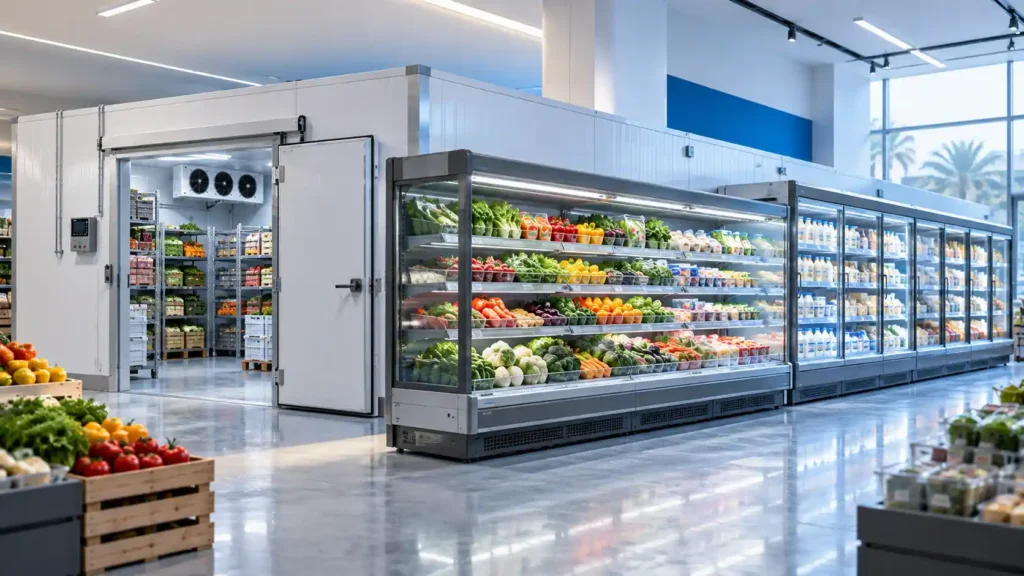
Supermarket cold storage spans a wide range — a single combo room behind an independent grocer draws a fraction of the power and floor space that a fully zoned hypermarket facility needs, and the compressor and refrigerant strategy should scale with it. ChillerRoom.ae specifies inverter-driven compressors and low-GWP refrigerants across every project size, since refrigeration is consistently one of the largest single running costs on a supermarket’s DEWA bill, whatever the site’s footprint.
Designed Around How Each Category Behaves
Not every product fails the same way when storage goes wrong — grouping by risk and behaviour, not just temperature, is what keeps a supermarket cold room compliant and efficient.
Bakery & Deli
Blast-chilled through the danger zone before moving into standard chilled holding.
Fish & Seafood
0°C to 2°C, near-saturation humidity, needs its own space away from other proteins.
Dairy
2°C to 4°C, isolated from strong-smelling stock to stop odour absorption.
Fresh Produce
Species-dependent, 85–95% humidity, ethylene-sensitive items kept apart from ethylene producers.
Frozen Retail
-18°C or colder, with sub-floor protection built in to stop ground freeze from lifting the slab over time.
Meat & Poultry
-1°C to 2°C, 85–90% humidity, held apart from ready-to-eat stock to prevent cross-contamination.
Four Ways We Engineer for UAE Retail Conditions
A cold room specified for a mild climate fails fast once Gulf summer heat and constant retail-floor traffic combine. Every ChillerRoom.ae supermarket installation is built around that combination from the compressor up.
Oversized Condensing Units
Rated for sustained 45°C+ rooftop heat, with a capacity buffer for retail-floor door traffic.
Sand & Dust-Resistant Coils
Coatings built for Gulf dust loading, so capacity doesn't quietly degrade between services.
PIR Fire-Rated Panels
UAE Civil Defense-compliant insulation that holds performance without adding fire risk to a customer-facing building.
Foodwatch-Ready Monitoring
Digital temperature logging built in from installation, aligned with Dubai Municipality's compliance platform.
Decentralised or Centralised — Which Cold Storage Model Fits?
| Factor | Decentralised (Independent Units) | Centralised (Parallel Rack) |
|---|---|---|
| Best suited to | Single stores, minimarkets | Multi-zone hypermarkets, chains |
| Redundancy | One unit failing affects only that room | Shared backup across zones |
| Footprint | Modular — easy to relocate or expand incrementally | Fixed engine room, higher upfront design |
| Running cost | Predictable, per-unit | Lower cost per m³ at scale |
| Monitoring | Standalone loggers per unit | Centralised IoT dashboard |
Supermarket Cold Room Installation in the UAE
Every supermarket cold storage project starts with a site survey, not a catalogue. We check what you’re storing, how much space you have, delivery frequency, and site access before specifying refrigeration capacity, insulation, zoning, doors, shelving and monitoring — the full system, matched to what’s actually moving through your store. Before install, your site should be ready with a level base, three-phase power, and clear access for the refrigeration unit.
Frequently Asked Questions
High-risk chilled food must be held at 5°C or below under Dubai Municipality and ADAFSA rules, and frozen stock should stay at -18°C or colder — regardless of whether it’s in a back-of-house room or a shopfront display unit.
Not ideally. Meat needs separation from ready-to-eat product, dairy needs isolation from strong-smelling stock, and produce needs its own humidity band. Combo and multi-zone layouts solve this without needing a dedicated room per category.
Both. Compact combo chiller-freezer rooms are standard for independent grocers and minimarkets, alongside full multi-zone facilities for hypermarket chains.
A typical turnkey supermarket cold room installation runs 2 to 4 weeks from site survey to handover, depending on scale and site readiness.
For a single small store, a modular unit is often the right call. Once you’re running multiple categories or multiple outlets, a custom-zoned system earns back its cost through lower energy use per m³ and fewer compliance blind spots.
A walk-in chiller is back-of-house bulk storage; a display chiller is the customer-facing unit on the shop floor. Both need to hold high-risk product at 5°C or below — the display unit just has to do it while staying open to the aisle.
Need Supermarket Cold Storage in UAE?
Tell us your category mix, storage volume, and site location. ChillerRoom.ae will design, manufacture, and install supermarket cold storage matched to your operation — from a single combo room to a fully zoned hypermarket facility — across Dubai, Abu Dhabi, and Sharjah.