PUF Panel Cold Storage in UAE: Why Insulation Matters in Cold Rooms
Senior Refrigeration Engineer · ChillerRoom.ae
Updated 2026 · Estimated read time: 10–15 min
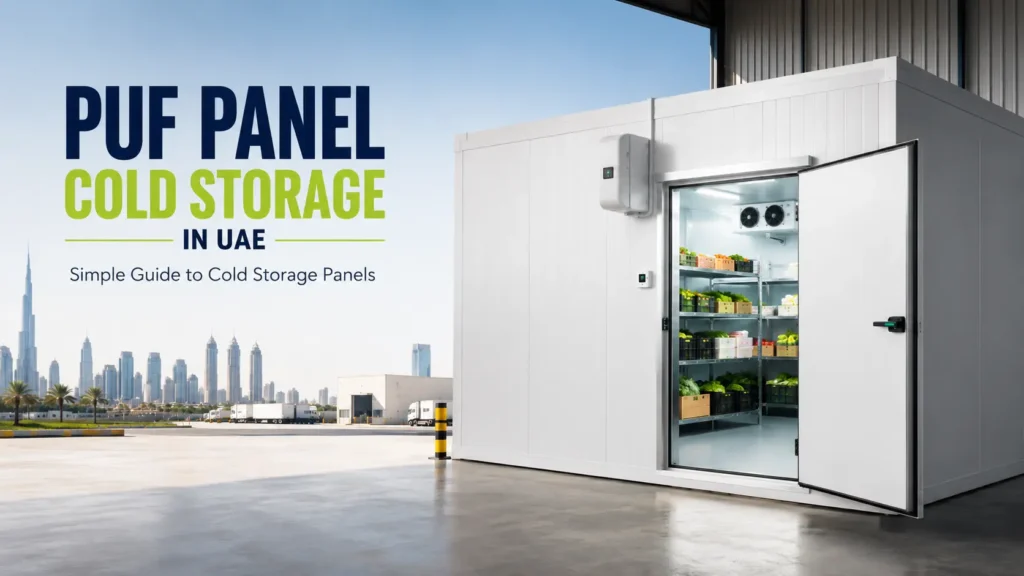
In most cold room projects, the first discussion is usually about the refrigeration system — capacity, brand, temperature range, and pull-down time.
But the insulated panel system is what decides how much cooling the room can actually retain during daily operation.
That is where PUF panel cold storage becomes important.
In the UAE, cold rooms face heat, humidity, busy work areas, and doors opening throughout the day. If the panels are not right, outside heat keeps entering the room. The cooling unit then has to work harder just to maintain the same temperature.
Over time, this can lead to higher power bills, unstable cooling, more equipment stress, and storage problems.
A cold room PUF panel is not just a partition or wall material; it is part of the thermal barrier that protects the stored products from outside heat.
For UAE businesses that store food, meat, seafood, dairy, or other temperature-sensitive products, ChillerRoom.ae designs cold storage systems with the right insulation, refrigeration, and installation plan.
Table of Contents
Quick Answer: What Is PUF Panel Cold Storage?
A PUF panel cold storage room is built with insulated panels that help keep the inside temperature stable. Instead of using normal walls, the room is made with sandwich panels filled with polyurethane foam.
That foam is the important part. It slows down heat from outside, which helps the refrigeration unit maintain the required temperature.
In a normal chiller room, PUF panels are usually fixed on the walls and ceiling. For freezer rooms, the floor also needs extra attention because the room runs at a much lower temperature.
The panels are locked and sealed together during installation. When this is done properly, the cold room becomes a tight, insulated space. When it is not done properly, warm air can enter through gaps, and the cooling system starts working harder.
In short, the cooling unit brings the temperature down. The PUF panels help keep it there.
Why PUF Panels Are Used in Cold Storage
Cold storage is not only about installing a cooling machine. The full room must be designed to maintain temperature.
PUF panels help reduce heat entry from outside. This means the compressor does not need to run continuously just to fight external heat. A well-insulated room cools more evenly, holds temperature for longer, and supports better product storage.
PUF panel cold storage is commonly used for:
- Restaurants and cloud kitchens
- Hotels and catering units
- Supermarkets and grocery stores
- Meat and seafood storage
- Dairy and frozen food storage
- Food processing units
- Logistics and distribution warehouses
- Pharmaceutical and medical storage areas
When insulation is planned correctly, the cold room works as a complete system, not just a box with a cooling unit.
How Cold Room PUF Panels Work
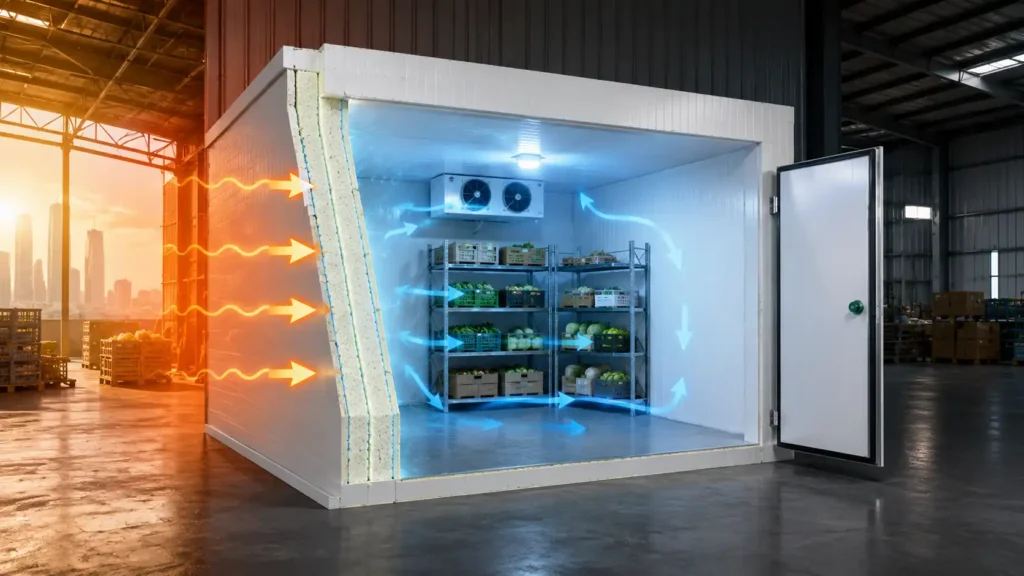
A cold room is always fighting the outside heat. The job of a PUF panel is to slow that heat down before it reaches the storage area.
In UAE conditions, this is a big deal. A cold room may be placed near a busy loading door, inside a warm warehouse, beside a kitchen, or under a roof that gets hot during the day. Every time the door opens, warm air enters. If the panels or joints are weak, even more heat slips in.
PUF panels reduce this problem by forming an insulated shell around the room. The foam core slows heat movement, while the metal surface gives the room a clean, solid finish.
Still, insulation only works well when the installation is done properly. The joints, corners, door frame, floor line, and sealant must all be tight. A small opening can bring in warm air and moisture, which can later lead to sweating, ice formation, and longer compressor running time.
With the right panel thickness and proper sealing, the cold room can maintain a steadier temperature during daily operation.
PUF Panel Cold Room vs Normal Room Construction
A normal block wall or partition is not suitable for serious cold storage. It may look strong, but it does not provide the same insulation performance as a purpose-built cold room panel system.
| Feature | Normal Room | PUF Panel Cold Room |
|---|---|---|
| Insulation | Low or inconsistent | Designed for temperature control |
| Installation | Slower civil work | Faster modular assembly |
| Temperature stability | Harder to maintain | Better cooling retention |
| Hygiene | Depends on the surface finish | Smooth washable surfaces |
| Future modification | Difficult | Easier with modular panels |
| Cooling load | Usually higher | Lower when designed correctly |
For cold storage, the insulated room envelope matters as much as the refrigeration unit. A weak envelope leads to more compressor load, higher energy use, and uneven temperature.
Best Thickness for PUF Panel Cold Storage

There is no single best thickness for every cold room. The right thickness depends on the target temperature, room size, product load, door opening frequency, and UAE site conditions.
As a simple planning guide:
| Application | Common Temperature Range | Suggested Panel Thickness |
|---|---|---|
| Dry or partition areas | Ambient | 30mm–50mm |
| Chiller room / cold room | 0°C to +8°C | 80mm–100mm |
| Freezer room | -18°C to -25°C | 120mm–150mm |
| Deep freezer/blast freezer | -35°C and below | 170mm–200mm |
For many UAE cold storage projects, choosing the cheapest thin panel can become costly later. The room may still cool, but the system may run longer, struggle during peak heat, or lose temperature faster when doors open.
A chiller room and freezer room should not be planned with the same panel thickness. A freezer room usually needs stronger insulation because the temperature difference between inside and outside is much higher.
PUF, PIR, and EPS Panels: What UAE Businesses Should Know
Not every insulated panel is suitable for cold storage. This is where many buyers get confused.
Some suppliers may offer PUF panels, some may suggest PIR panels, and cheaper options like EPS may also appear during comparison. The right choice depends on what the cold room will store, how low the temperature needs to go, and what approvals the project must meet.
PUF panels are commonly used for chiller rooms, freezer rooms, and modular cold storage because they offer strong insulation and practical installation.
PIR panels are usually considered when fire performance is more important. They are often preferred for projects where Civil Defense, consultant, or insurance approval requires a higher-rated panel system. For UAE projects, panel selection should also be checked against the UAE Fire and Life Safety Code of Practice and the specific approval requirements of the site.
EPS panels may reduce the initial cost, but they are not ideal for demanding cold storage projects, especially freezer rooms or high-use commercial facilities.
For UAE businesses, the better question is not “Which panel is cheapest?” It should be “Which panel is suitable for my temperature, site, approval, cleaning, and long-term energy cost?”
Why Installation Quality Matters
Even a good panel can fail if installation is poor.
Cold room panels must be joined tightly and sealed properly. Any small gap becomes a path for warm air and moisture. Over time, this can cause condensation, ice build-up, temperature fluctuation, and higher compressor load.
Important installation details include:
- Proper panel alignment
- Tight cam-lock connection
- Sealed wall and ceiling joints
- Correct corner flashing
- Insulated flooring where required
- Proper door frame sealing
- Good drainage planning
- Correct evaporator and airflow placement
- Easy access for maintenance
For good performance, every part of the room has to support the insulation. When joints are loose or sealing is weak, the refrigeration system has to work harder to maintain the required temperature.
Hygiene and Cleaning in PUF Panel Cold Storage
For food storage, the cold room has to be easy to clean after real daily use, not just look neat after installation.
In a restaurant, supermarket, seafood shop, or meat storage area, the room gets busy quickly. Cartons are moved in and out. Staff open the door many times. Water may be used for cleaning. Sometimes small spills, packaging waste, or food particles collect near the floor and corners.
PUF panels are useful because the inner surface is usually smooth and easier to clean than a normal painted wall. But the panel alone does not keep the room hygienic. The way the room is finished makes a big difference.
Corners, trims, wall joints, ceiling joints, floor edges, drains, and door gaskets should be planned carefully. These are the places where dirt and moisture usually start collecting when the work is not done neatly.
For food, meat, seafood, dairy, and ready-to-eat storage, check these points during planning:
- Internal panel surfaces that can be wiped and washed easily
- Wall and ceiling joints finished without rough gaps
- Food-safe surface finish where the storage use requires it
- Floor slope that helps water move toward the drain
- Drainage placed away from stored products
- Door gaskets that are easy to clean and inspect
- Corner trims fitted neatly without open spaces
- A simple cleaning routine after the cold room is handed over
For UAE restaurants, hotels, butcher shops, seafood suppliers, supermarkets, and food processing units, these details matter in daily operations. A cold room that is finished properly is easier for the team to clean, inspect, and manage over the long term. Does not depend on the panel core alone.
For food storage, the panel surface, coating, sealants, drainage, and cleaning routine are just as important as the insulation core.
A good cold room should have:
- Smooth, washable internal surfaces
- Properly sealed joints
- Food-safe surface finish where required
- Correct floor slope and drainage
- Clean door gaskets
- No open gaps where moisture or dirt can collect
- Regular cleaning and maintenance schedule
This is especially important for restaurants, hotels, meat storage, seafood storage, supermarkets, and food processing units in the UAE.
Freezer Room Flooring Needs Extra Planning
For freezer rooms, the floor needs more attention than a normal chiller room.
A freezer room is not only cold on the walls and ceiling. The floor also faces a continuously low temperature. If the floor is not planned correctly, the system may lose cooling through the slab, or the room may face moisture and structural issues over time.
For larger or permanent freezer rooms, the floor may also need a vapor barrier, floor insulation, and frost protection planning.
This does not mean every small freezer room needs the same heavy floor system. The right solution depends on the freezer size, temperature, usage, site conditions, and whether the room is temporary, modular, or permanent.
Cold Room PUF Panel Price: What Affects the Cost?
The cold room PUF panel price depends on the full project requirement, not only the panel sheet.
The cost can change based on:
- Panel thickness
- Panel density
- Wall, ceiling, and floor area
- Chiller or freezer temperature
- PUF or PIR core selection
- Inner and outer sheet finish
- Food-safe or special coating
- Door type and size
- Flooring requirement
- Refrigeration capacity
- Site access and installation complexity
Prices change a lot from one project to another. A small kitchen chiller, a supermarket backroom cold room, and a warehouse freezer do not use the same panel thickness, flooring, door system, or refrigeration capacity.
Before giving a clear cold room PUF panel price, the room size, product load, target temperature, site location, and daily usage need to be checked. This gives a more realistic cost than quoting only by panel sheet size.
Where PUF Panel Cold Storage Is Used in the UAE
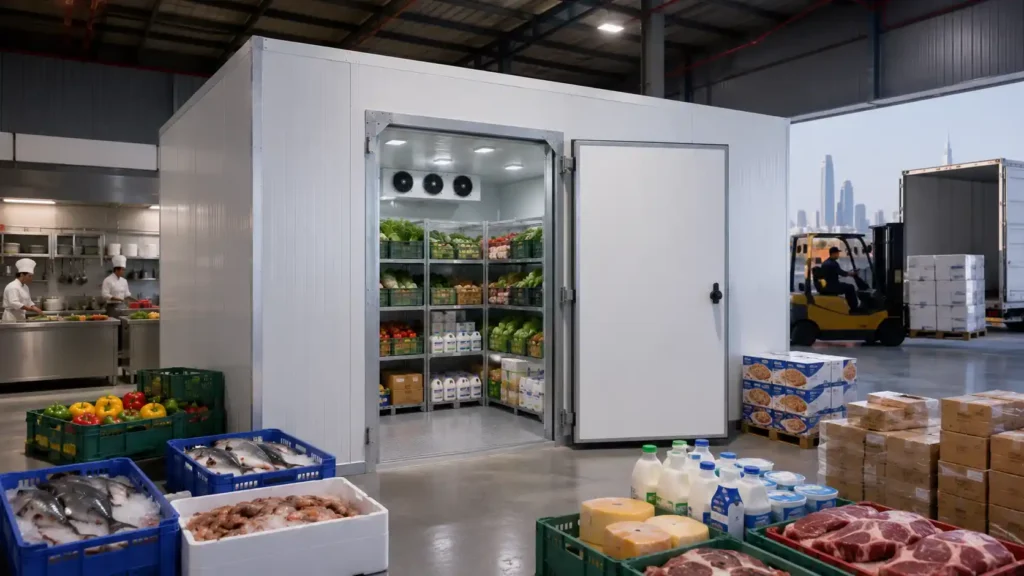
PUF panel cold storage is useful for businesses that cannot depend on regular refrigerators or small freezers anymore. Once stock volume increases, a proper cold room gives more space, better access, and more stable temperature control.
In the UAE, these rooms are commonly used in places like:
- Restaurants and hotels for daily kitchen stock, dairy, meat, seafood, and prepared ingredients
- Supermarkets and grocery stores for backroom chiller rooms and freezer rooms
- Meat and seafood suppliers for chilled meat, frozen meat, fish, prawns, and poultry
- Food storage businesses for vegetables, fruits, bakery items, beverages, and packaged food
- Catering and central kitchens for bulk storage before cooking, packing, or dispatch
- Logistics and distribution companies for short-term or long-term cold storage before delivery
- Pharma and healthcare storage for medicines and other temperature-sensitive items
- Food processing units and warehouses for production, storage, and larger cold room requirements
The design will not be the same for every business. A seafood freezer, a hotel chiller, and a pharma storage room all need different temperature settings, airflow planning, panel thickness, door usage, and refrigeration capacity.
How PUF Panels Help Reduce Electricity Use
Electricity cost is one of the biggest concerns in cold storage.
When insulation is weak, heat enters the room faster. The compressor runs longer. The condenser works harder. The room may take more time to reach the set temperature. This increases electricity use and equipment wear.
Good PUF panel cold storage reduces this load by slowing heat entry. The refrigeration system can cycle more normally, and stored products face fewer temperature swings.
This does not mean panels alone save energy. The full system must be designed properly. Panel thickness, refrigeration capacity, condenser location, door usage, airflow, and maintenance all work together.
Common Mistakes When Choosing Cold Room PUF Panels
Many cold room problems start before installation. They happen during planning.
Avoid these mistakes:
Choosing panels only by the lowest price
Cheap panels may reduce the initial cost but increase the long-term running cost.
Using the same thickness for all rooms
A chiller room and a freezer room need different insulation planning.
Ignoring door opening frequency
Busy kitchens, supermarkets, and warehouses need better sealing and airflow planning.
Skipping floor planning in freezer rooms
Freezer rooms need proper floor insulation and moisture control based on the site.
Poor joint sealing
Small gaps can create big temperature and moisture problems.
Not checking fire and approval requirements
Panel core and fire rating should match the project requirements.
Forgetting maintenance access
Refrigeration units, drains, and panels should be accessible for service.
Cold Room Planning Checklist for PUF Panel Cold Storage
Before ordering panels or asking for cold room PUF panel prices, it is better to define the room properly.
| Planning Point | What to Decide |
|---|---|
| Product type | Food, meat, seafood, dairy, pharma, frozen goods |
| Target temperature | Chilled, frozen, deep frozen, or custom |
| Panel thickness | 80mm, 100mm, 120mm, 150mm, or higher |
| Panel type | PUF, PIR, or other approved insulated panel |
| Surface finish | Pre-painted GI, stainless steel, food-safe coating |
| Door type | Hinged, sliding, freezer door, or rapid access |
| Floor requirement | Normal floor, insulated floor, or freezer floor system |
| Refrigeration unit | Capacity based on heat load and product load |
| Door traffic | Low, medium, or high usage |
| Site location | Indoor, outdoor, warehouse, kitchen, rooftop, or loading area |
| Maintenance access | Space for condenser, evaporator, drainage, and service |
This checklist helps avoid a generic cold room design. The final system should match the product, site, and daily operation.
Why UAE Climate Changes the Design
Cold storage design in the UAE cannot simply copy that of mild-weather countries.
High ambient temperature, coastal humidity, dust, and heavy daily operation place more stress on cold rooms. Condensers can collect dust faster. Doors may allow humid air inside. Evaporators may ice up if moisture repeatedly enters. Panel joints may face expansion and contraction over time.
That is why UAE cold storage projects need:
- Proper insulation thickness
- Good vapor sealing
- Strong door gaskets
- Air curtains or strip curtains are needed
- Correct condenser placement
- Easy maintenance access
- Regular coil cleaning
- Reliable drainage
- Temperature monitoring
A cold room that works well in a cooler country may not perform the same way in Dubai, Abu Dhabi, Sharjah, or other UAE locations without climate-specific design.
Why Choose ChillerRoom.ae for PUF Panel Cold Storage?
ChillerRoom.ae designs cold storage systems based on the product, temperature, site conditions, and daily usage patterns. We do not look at panels as a separate item. We plan them as part of the full cold room system.
As one of the best chiller room manufacturers in UAE for cold storage solutions, ChillerRoom.ae supports businesses with custom chiller rooms, freezer rooms, walk-in cold rooms, and commercial cold storage systems across Dubai, Abu Dhabi, Sharjah, and other UAE locations.
Our team can help with:
- Cold room design
- PUF panel selection
- Freezer room panel planning
- Cold storage installation
- Refrigeration unit sizing
- Door and airflow planning
- Maintenance access planning
- UAE climate-based system design
The aim is simple: stable cooling, practical installation, and long-term reliability.
Final Thoughts
PUF panel cold storage may look simple from the outside, but it plays a major role in daily cooling performance.
The right panel thickness, proper sealing, correct installation, suitable surface finish, and well-sized refrigeration system can help protect stored products, reduce cooling stress, and control running costs.
For UAE businesses, insulation should never be treated as an afterthought. It is the foundation of the cold room.
If you are planning a new chiller room, freezer room, or commercial cold storage project, ChillerRoom.ae can help you choose the right PUF panel cold room design for your product, temperature, and site.
Frequently Asked Questions
PUF panel cold storage is a cold room or freezer room built with polyurethane foam insulated panels. These panels reduce heat transfer and help maintain a stable temperature inside the storage area.
For chiller rooms, 80mm to 100mm panels are commonly used. For freezer rooms, 120mm to 150mm panels are usually preferred. Deep freezer or blast freezer rooms may need thicker panels based on the temperature requirement.
Cold room PUF panel price depends on panel thickness, room size, surface finish, temperature requirement, door type, flooring, refrigeration capacity, and installation site conditions.
Yes, PUF panels can be used for freezer rooms when the correct thickness, sealing, flooring, and refrigeration system are selected. Freezer rooms need stronger insulation planning than normal chiller rooms.
PUF panels are commonly used for cold rooms because they offer strong insulation. PIR panels are similar but generally provide better fire performance, so they may be preferred for projects with stricter fire-rating or compliance requirements.
Standard PUF panels should not be described as fireproof. Some PUF panels may have flame-retardant properties, but PUF is still a combustible foam. For stricter fire-rating requirements, PIR, Rockwool, or other approved fire-rated panel options may be considered based on project approval needs.
Cold rooms need insulated panels to reduce outside heat from entering the room. Without proper insulation, the cooling system works harder, electricity use increases, and temperature stability becomes difficult.
PUF panels can help reduce cooling load by keeping cold air inside and slowing heat transfer. Actual electricity savings depend on the full system design, including refrigeration capacity, door usage, condenser condition, and maintenance.
Yes. ChillerRoom.ae designs and installs PUF panel cold rooms, chiller rooms, freezer rooms, and commercial cold storage systems for UAE businesses.