Modular Cold Room Guide: Design, Price & Uses in the UAE
Senior Refrigeration Engineer · Chiller Room Manufacturers in UAE
Updated 2026 · Estimated read time: 10–20 min
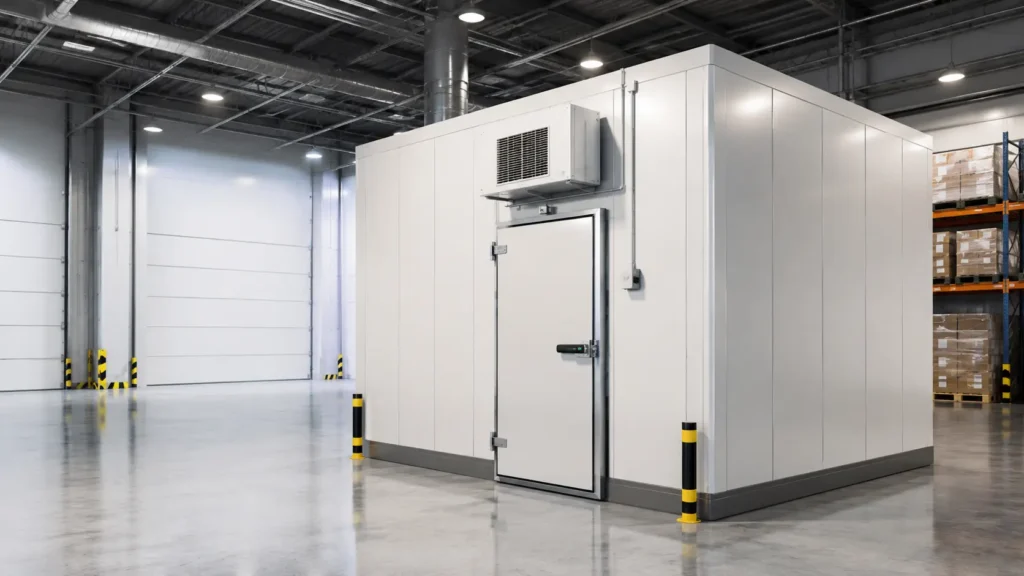
Table of Contents
A modular cold room is built using insulated panels that are prepared in advance and assembled at the customer’s site. The panels usually form the walls and ceiling, while the floor setup depends on the required temperature and the existing site conditions.
Once the room structure is ready, it is fitted with the refrigeration unit, insulated door, temperature controller, lighting, and other parts needed for chilled or frozen storage.
This type of cold room is often useful when a business needs to add storage inside an existing restaurant, warehouse, supermarket, or production area. Since the room is assembled in sections, some systems can also be enlarged, rearranged, or moved later. However, that depends on the panel system, flooring, ceiling support, and refrigeration setup used in the original installation.
In simple terms, a modular cold room is more than an insulated box. The panels, cooling equipment, doors, airflow, and controls all need to work together for the room to maintain the required temperature.
Quick Answer: What Is a Modular Cold Room?
A modular cold room is a prefabricated temperature-controlled chamber assembled from insulated panel sections at the project site.
It can be configured as a chilled room, modular freezer room, or multi-compartment cold storage area. Its dimensions, insulation, refrigeration capacity, and controls are selected according to the products being stored, the required temperature, and the way the room will be used.
Key Takeaways
- Modular cold rooms use factory-manufactured insulated panels.
- They can be configured for chilled or frozen storage.
- The terms modular and prefabricated are often used interchangeably by suppliers.
- Not every modular system is automatically suitable for relocation or later expansion.
- Cooling capacity must be calculated from the complete operating load.
- Modular cold room price depends on much more than room dimensions.
- UAE conditions require careful planning for heat, humidity, dust, and door traffic.
How Does a Modular Cold Room Work?
A modular cold room works by combining a thermally insulated enclosure with refrigeration equipment designed to remove heat from inside the room.
The insulated panels reduce heat transfer from the surrounding area. The refrigeration system then removes heat entering through the panels, floor, doors, products, people, lights, and normal daily operation.
Four main elements work together.
Insulated panel enclosure
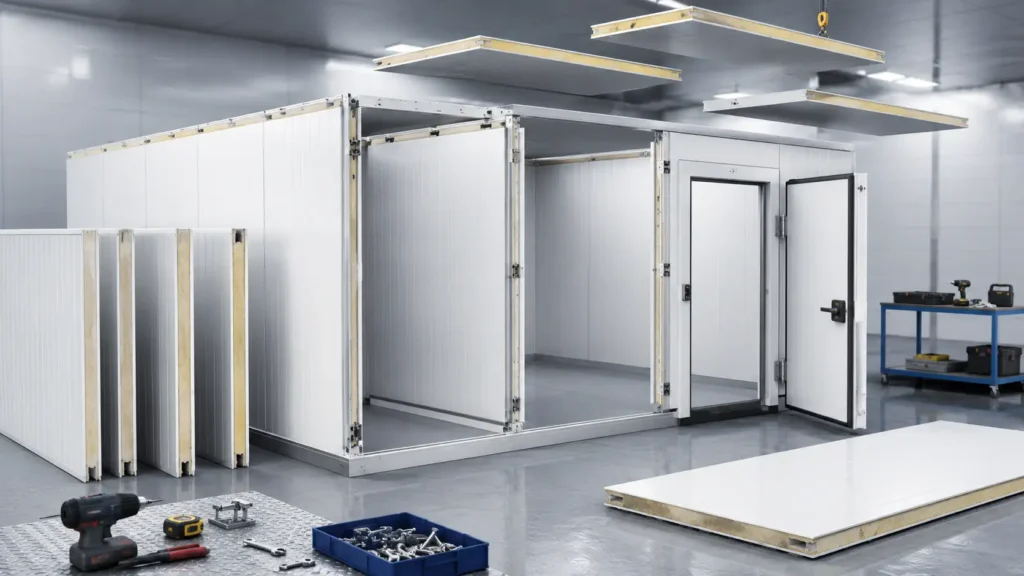
The walls and ceiling are normally assembled from sandwich panels. These panels contain an insulating foam core between protective metal surfaces.
Common panel insulation materials include:
- PUR or PUF: Polyurethane foam
- PIR: Polyisocyanurate foam
PUR, PU, and PUF are commonly used market terms for polyurethane insulation. PIR is a related but different insulation material.
Modular panels may use tongue-and-groove connections, cam-lock fasteners or other joining systems. The joints must be correctly aligned and sealed to control air leakage, moisture entry and unwanted heat transfer.
Manufacturers offer panels in different thicknesses, with commercial products commonly available from approximately 60 mm to 150 mm. However, thickness alone should not be used to select a panel.
The correct panel specification also depends on:
- Required internal temperature
- Surrounding ambient conditions
- Thermal performance
- Panel span and room height
- Joint construction
- Surface finish
- Fire-performance requirements
- Whether the room is indoors or outdoors
The supplied research includes commercial modular panel specifications across several thicknesses, but these are product options rather than universal design recommendations.
Refrigeration system
The refrigeration system absorbs heat inside the room and releases it outside.
Smaller modular rooms may use a monoblock unit installed through one of the panels. Larger or more demanding systems commonly use a split arrangement with an evaporator inside the room and a separate condensing unit outside it.
The refrigeration capacity should be calculated using the actual operating conditions rather than room dimensions alone.
A room receiving warm products several times a day will have a different cooling requirement from a similar-sized room used only for storing products that are already chilled.
Air circulation and temperature control
The evaporator circulates cooled air through the storage area.
Stock should be arranged so that it does not block the air entering or leaving the evaporator. Poor airflow can create warmer areas even when the temperature sensor appears to show the correct value.
A basic control system starts and stops the refrigeration equipment according to the temperature set point. Depending on the application, the room may also include:
- High- and low-temperature alarms
- Door-open alarms
- Data logging
- Remote monitoring
- Multiple temperature sensors
- Humidity monitoring
- Equipment fault notifications
Door and floor system
The cold room door must close firmly and maintain an effective seal.
Door size, opening frequency, trolley movement, and staff traffic all affect the amount of warm air entering the room.
Floor construction depends on the operating temperature, existing slab, room position, and expected loading.
A mild chilled room installed over a suitable existing slab may not always require a separate panel floor. A freezer room, however, normally requires an engineered insulated floor or insulated slab system.
Sub-floor frost protection may also be needed for some freezer installations, depending on the operating temperature, ground conditions, and building construction.
Are Modular and Prefabricated Cold Rooms the Same?
The terms modular cold room, prefabricated cold room, and prefab cold room are often used interchangeably in the commercial market.
There is still a useful practical distinction:
- Prefabricated generally means that the main components are manufactured before arriving at the site.
- Modular generally describes a system assembled from repeatable sections that may be easier to extend, rearrange, or dismantle.
This is not a universal classification. Different suppliers may use the terms differently.
A buyer should therefore confirm the proposed construction system rather than relying only on the product name.
| Feature | Modular panel system | General prefabricated cold storage |
|---|---|---|
| Manufacturing | Components are made before site installation | Components are made before site installation |
| Assembly | Often uses repeatable panel sections | May use standard or project-specific panels |
| Panel joints | May use cam-lock, tongue-and-groove or similar connections | May use panel joints, concealed fasteners or structural fixing |
| Modification | May support extension or reconfiguration | Depends on the original construction |
| Relocation | Possible with some purpose-designed systems | May be difficult or impractical |
| Structural support | Smaller rooms may be self-supporting within design limits | Larger facilities may require structural steel |
| Typical scale | Small and medium commercial rooms | From compact rooms to large cold storage buildings |
A prefabricated cold room can still be modular. Likewise, a room marketed as modular may not be designed for repeated dismantling.
The joint system, floor, ceiling support, refrigeration pipework, and structural arrangement should all be checked before assuming the room can be moved.
Modular Cold Room vs Modular Freezer Room
The same panel-based construction approach can be used for chilled and frozen applications. However, a modular freezer room usually requires a more demanding specification.
| Feature | Modular chilled room | Modular freezer room |
|---|---|---|
| Example temperature range | Often around 0°C to +8°C, depending on the product | Commonly −18°C or below |
| Typical products | Dairy, produce, beverages, fresh food and selected medicines | Frozen food, seafood, meat, ice cream and frozen ingredients |
| Panel selection | Based on chilled operating conditions | Usually requires greater insulation performance |
| Floor | Depends on the temperature and existing slab | Engineered insulated floor or insulated slab normally required |
| Frost protection | Usually not required for above-freezing rooms | May be required below the floor |
| Door specification | Insulated hinged or sliding door | Low-temperature door with suitable seals and frame details |
| Defrost | Selected according to operating conditions | Requires more careful defrost and drainage planning |
| Main design concern | Warm-air entry and product loading | Frost, moisture entry, floor heat transfer and temperature recovery |
These are example operating ranges, not fixed definitions.
There is no single standard temperature for every modular cold room. The correct set point depends on the product being stored.
A freezer room should not be created by simply lowering the controller setting on a chilled-room system. The enclosure, refrigeration equipment, floor, doors, controls, and defrost arrangement must all be suitable for sub-zero operation.
Main Benefits of Modular Cold Storage
Faster enclosure assembly
Because the panels are manufactured before arriving at the site, the enclosure can normally be assembled with less site construction than a masonry-built room.
That does not mean every complete cold room can be operational within a fixed number of days. The full schedule also depends on:
- Site preparation
- Panel production
- Refrigeration installation
- Electrical supply
- Drainage
- Floor construction
- Testing and commissioning
- Access and approval requirements
Custom dimensions
A modular cold storage room can be planned around an available commercial space.
Its dimensions, height, and door position can be adjusted for the site, subject to panel-manufacturing and structural limitations.
This is useful where a standard factory-sized cabinet or refrigerated container does not fit the required workflow.
Reduced masonry work
The enclosure can often be created without constructing permanent block walls.
This may be useful inside existing restaurants, warehouses, supermarkets, and production units where major civil work would interrupt business operations.
Some site preparation may still be required, including floor levelling, drainage, electrical work or equipment supports.
Potential for future modification
Some modular rooms use reusable panel connections that allow sections to be removed or added.
This potential should be confirmed before ordering. The room should be specifically designed for later extension if future expansion is expected.
Expanding the enclosure may also require changes to:
- Refrigeration capacity
- Evaporator position
- Air circulation
- Door location
- Electrical supply
- Drainage
- Sensor placement
- Floor insulation
Adding panels does not automatically mean the existing refrigeration equipment can cool the larger space.
Suitable for some leased premises
A modular system may be attractive for businesses operating from rented premises because it can require less permanent building work.
However, relocation is not guaranteed.
The room’s panel joints, floor, ceiling, seals, door system and refrigeration installation must be checked before dismantling. Panels can also be damaged during removal, handling, or reassembly.
Cleanable interior surfaces
Metal-faced cold room panels generally have smooth interior surfaces that are easier to clean than unfinished blockwork.
This supports good hygiene management, but it does not automatically make the room compliant with a particular food or pharmaceutical standard.
Hygiene also depends on:
- Floor-to-wall junctions
- Door condition
- Drainage
- Shelving
- Cleaning procedures
- Pest control
- Temperature monitoring
- Product-handling practices
Where Are Modular Cold Rooms Used?
Modular systems can support a wide range of commercial and industrial applications.
Restaurants and commercial kitchens
Restaurants, hotels, cloud kitchens and catering businesses use modular rooms for chilled ingredients, dairy products, vegetables, meat and frozen food.
The room should be planned around delivery schedules, kitchen workflow, and door-opening frequency.
Supermarkets and retail stores
Supermarkets can use modular cold storage for chilled and frozen back-of-house inventory.
Storage layout should provide enough airflow and practical access without overcrowding the room.
Food production
Food processors, bakeries, meat suppliers, and central kitchens may use separate rooms for raw materials, prepared items, chilled products, and frozen stock.
Different product groups may need separate temperature zones or operating controls.
Agriculture and floriculture
Farms, produce distributors, and flower businesses may use modular rooms to remove field heat or hold products before distribution.
Temperature is only one consideration. Some products also require controlled humidity, suitable airflow, and careful product loading.
Pharmaceutical and healthcare facilities
A modular room can form part of a controlled medicine-storage system, but maintaining a set temperature alone does not establish pharmaceutical compliance.
Depending on the application, additional requirements may include:
- Temperature mapping
- Calibrated sensors
- Continuous records
- Alarm procedures
- Backup arrangements
- Qualification or validation
- Controlled access
- Documented operating procedures
For regulated pharmaceutical applications, refer to the WHO guidance on qualifying temperature-controlled storage areas.
Logistics and distribution
Logistics operators may use modular cold storage for temporary holding, order preparation, cross-docking, or additional seasonal capacity.
The room must be designed around the volume and temperature of incoming goods—not just the maximum quantity stored inside.
When Is a Modular System a Good Choice?
A modular cold room may suit a project that requires:
- Chilled or frozen storage inside an existing building
- Custom dimensions
- Less masonry construction
- A compact commercial walk-in room
- Separate chilled and frozen compartments
- Future extension is planned from the design stage
- Additional seasonal storage
- A room inside the leased premises
- Faster enclosure assembly
- A cleanable insulated interior
The final decision should be based on product requirements and daily operation rather than the word “modular” alone.
When May Another Construction Method Be Better?
Modular panel rooms are not the best option for every cold storage project.
A large warehouse may require a structural cold storage envelope rather than a smaller self-supporting panel room.
Another approach may be more suitable where the project involves:
- High-bay pallet racking
- A very large room spans
- Heavy ceiling loads
- Automated storage systems
- Wide forklift routes
- Multiple loading docks
- Large industrial temperature zones
- Substantial external wind or roof loads
- Complex fire or structural requirements
Large prefabricated cold storage facilities may use insulated panels fixed to an independent steel framework. This provides greater structural flexibility for large footprints and high rooms.
Main Components of a Modular Cold Room
| Component | Attribute | Possible project options |
|---|---|---|
| Insulated panels | Core material | PUR/PUF polyurethane or PIR |
| Insulated panels | Thickness | Selected according to thermal and structural requirements |
| Panel surface | Finish | Pre-painted metal, stainless steel or another specified finish |
| Refrigeration | Configuration | Monoblock or split system |
| Temperature | Chilled storage | Product-specific, often within approximately 0°C to +8°C |
| Temperature | Frozen storage | Commonly −18°C or below |
| Door | Type | Hinged, sliding or product-access door |
| Floor | Construction | Existing insulated slab, panel floor or engineered freezer floor |
| Controls | Basic function | Digital temperature controller |
| Monitoring | Options | Alarms, data logging and remote monitoring |
| Lighting | Internal fitting | Low-heat, moisture-resistant light |
| Safety | Door access | Internal emergency release |
| Drainage | Function | Condensate, defrost and cleaning-water management |
| Internal storage | Layout | Shelving, crates, trolleys or pallets |
The table provides common project attributes rather than a fixed specification. Each value should be selected after reviewing the site and product requirements.
How Should Modular Cold Storage Be Planned for the UAE?
A cold room in the UAE may face high ambient temperatures, humidity, dust, and intensive commercial operation.
These conditions should be considered during equipment selection and site planning.
Calculate the complete cooling load
The required refrigeration capacity depends on several heat sources:
- Heat passes through the panels
- Heat passes through the floor and ceiling
- Warm air enters when the door opens
- Incoming product temperature
- Quantity of product loaded each day
- People working inside
- Lights and internal equipment
- Defrost requirements
- Required pull-down time
- Heat around the condensing unit
Room dimensions are only one part of the calculation.
For example, two rooms of equal size may need different refrigeration capacities if one receives large quantities of warm products while the other stores goods that are already cold.
Choose insulation for the complete application
The correct insulation specification depends on:
- Internal room temperature
- Ambient temperature
- Indoor or outdoor installation
- Exposure to direct heat
- Product load
- Door use
- Required energy performance
- Panel dimensions
- Fire requirements
A 100 mm panel from one system may not have the same joint design, foam density, thermal performance, or fire classification as another 100 mm panel.
Provide ventilation around the condensing unit
The condensing unit needs enough airflow to reject heat.
Installing it in a confined or poorly ventilated space can increase operating pressure and reduce cooling performance.
The equipment location should provide:
- Suitable airflow
- Clearance around the coil
- Access for cleaning
- Access for repairs
- Protection from blockage
- Safe electrical access
Control warm-air and moisture entry
Warm, humid air can enter through:
- Open doors
- Damaged gaskets
- Poorly sealed panel joints
- Unsealed pipe openings
- Drainage penetrations
- Cable penetrations
Moisture entry may lead to condensation, frost, ice formation, and longer compressor operation.
Careful sealing and door maintenance are therefore important for both chilled and frozen rooms.
Plan around door traffic
A busy commercial kitchen may open its cold room door many times each hour. A reserve-storage room may be opened only occasionally.
The designer should consider:
- Number of door openings
- Door dimensions
- The time the door remains open
- Trolley or pallet movement
- Door-closing method
- Product loading schedule
Strip curtains or other air-control measures may help in busy rooms, but they do not replace correct equipment sizing.
Keep equipment accessible
The evaporator, condensing unit, drain, controller, and electrical components must remain accessible after installation.
A layout that saves a small amount of space but prevents safe servicing may increase future maintenance time and cost.
What Affects Modular Cold Room Price?
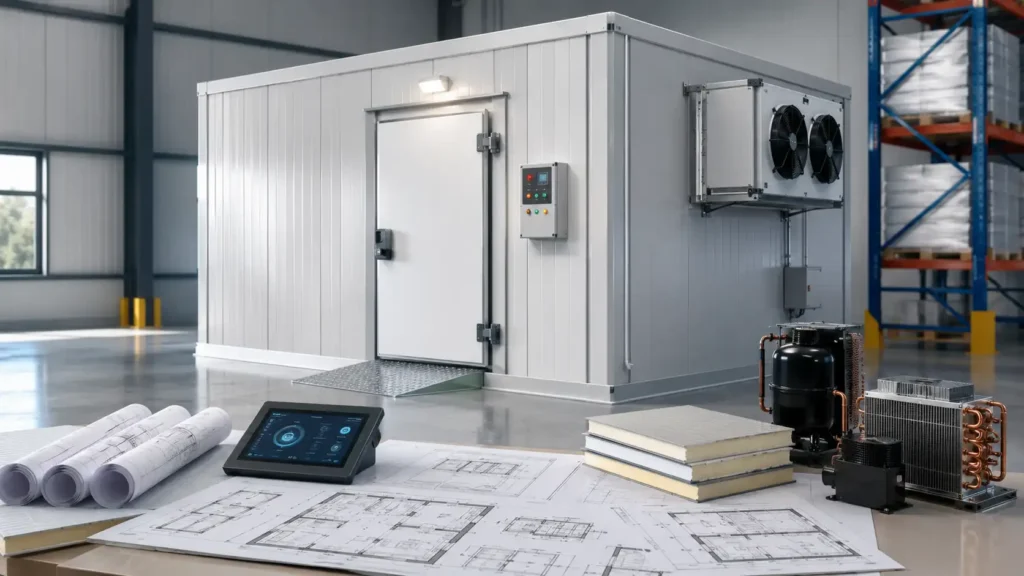
There is no single standard modular cold room price.
Two rooms with similar external dimensions can have very different costs because their operating requirements are different.
| Price factor | Effect on the project |
|---|---|
| Room dimensions | Affect panel quantity and internal volume |
| Room height | Increases enclosure area and cooled volume |
| Operating temperature | Freezer specifications generally require more insulation and equipment |
| Panel material | Core, thickness, finish and joint design affect cost |
| Product type | Different products have different cooling requirements |
| Incoming product temperature | Warm products increase the refrigeration load |
| Daily product loading | Higher turnover may require greater capacity |
| Door specification | Large, sliding or multiple doors affect cost and heat entry |
| Floor construction | Freezer floors and heavy-duty finishes increase the scope |
| Refrigeration equipment | Capacity and equipment configuration affect price |
| Monitoring | Alarms, data loggers and remote systems add functionality |
| Outdoor installation | May require weather protection and additional structural work |
| Site access | Restricted access can increase installation time |
| Electrical work | Power supply and control requirements vary by site |
| Drainage | Condensate and defrost drainage may require site modification |
| Backup requirement | Standby systems or redundancy increases project cost |
A small modular freezer room can cost more per cubic metre than a larger chilled room because of the lower operating temperature, insulation, floor and equipment requirements.
Comparing quotations only by square metre or cubic metre can therefore be misleading.
How Should You Compare Quotations?
A proper comparison should confirm whether each supplier has included the same scope.
Check the following:
- Internal usable dimensions
- Clear internal height
- Designed operating temperature
- Assumed ambient conditions
- Product type
- Incoming product temperature
- Daily product quantity
- Panel core and specification
- Wall, ceiling, and floor construction
- Door type and dimensions
- Refrigeration capacity
- Monoblock or split arrangement
- Electrical work
- Drainage and defrost provisions
- Temperature controls
- Alarms or monitoring
- Installation
- Testing and commissioning
- Warranty
- Exclusions
A low quotation may exclude essential work such as flooring, power supply, drainage, commissioning, or adequate refrigeration capacity.
An itemised technical proposal makes the comparison more useful than a total price alone.
How Do You Choose the Right Modular Cold Room?
Start with the products and workflow before choosing the room dimensions.
The following questions should be answered:
- What will be stored?
- What temperature does the product require?
- Is humidity control important?
- Is the incoming product already chilled?
- How much product enters each day?
- How quickly must the product cool?
- How long will products remain inside?
- How frequently will the door open?
- Will the room use shelving, trolleys or pallets?
- Is the room indoors or outdoors?
- What is the available power supply?
- Is the property owned or leased?
- Is future expansion expected?
- Are alarms or temperature records required?
- Is backup refrigeration required?
These details connect the storage requirement with the panel specification, refrigeration capacity, airflow, doors, and controls.
Can a Modular Cold Room Be Expanded?
Some modular rooms can be extended by adding or rearranging compatible panels.
This is only practical when the original room and panel system were designed to support modification.
Expansion may require changes to:
- Refrigeration capacity
- Evaporator quantity or position
- Air circulation
- Floor insulation
- Door arrangement
- Electrical load
- Drainage
- Temperature sensors
- Control settings
The possibility of future expansion should be discussed before the first room is designed.
Can a Modular Cold Room Be Relocated?
Some purpose-designed systems can be dismantled and installed at another site.
Relocation depends on:
- Type of panel joint
- Condition of the panels
- Floor construction
- Ceiling support
- Condition of gaskets and seals
- Refrigeration pipework
- Electrical installation
- Access at both sites
The new location must also be inspected. A refrigeration system selected for one room position may not perform the same way at a hotter, less ventilated, or more heavily used site.
Relocation should therefore be considered a possible feature—not an automatic feature of every prefab cold room.
Can Modular Cold Storage Be Installed Outdoors?
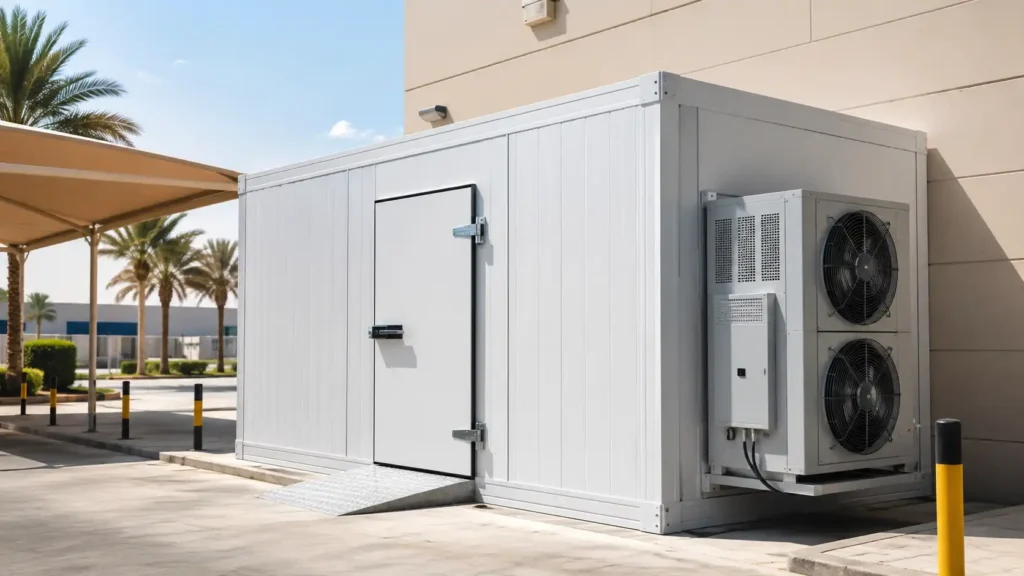
Yes, but a standard indoor room should not automatically be placed outside.
An outdoor installation may need:
- A level structural base
- Weather-resistant panel finishes
- Roof protection
- External flashing
- Protection from direct sun
- Drainage around the room
- Sealed electrical connections
- Wind assessment
- Safe equipment access
- Ventilation around the condenser
- Protection from water entry
The enclosure and supporting structure must be suitable for the actual outdoor conditions.
Modular Cold Room Planning from ChillerRoom.ae
ChillerRoom.ae plans cold storage systems around the product, required temperature, storage volume, site conditions, and daily workflow.
Our approach considers the insulated enclosure, refrigeration capacity, floor, doors, controls, and airflow as one connected system.
Businesses searching for the best chiller room manufacturers in UAE should compare engineering, insulation, equipment selection, installation quality and after-sales support—not just the initial quotation.
At ChillerRoom.ae, we work to earn our place among the best chiller room manufacturers in UAE by providing practical cold storage solutions for commercial and industrial applications.
For project design, manufacturing, and installation, visit our cold room manufacturers in UAE service page.
Frequently Asked Questions
A modular cold room is a temperature-controlled storage chamber assembled from factory-made insulated panels. It can be configured for chilled, frozen or multi-temperature storage according to the product and project requirements.
The terms are often used interchangeably. Prefabricated usually means the components were manufactured before site installation, while modular generally suggests a system made from repeatable sections. The supplier should confirm the exact construction.
Modular cold storage is a chilled or frozen storage system made from insulated panel sections. It can range from a small commercial walk-in room to a larger multi-compartment installation.
There is no single standard temperature. Many chilled rooms operate within approximately 0°C to +8°C, while freezer rooms commonly operate at −18°C or below. The correct set point depends on the product.
A modular freezer room is a panel-built room designed for sub-zero storage. It normally requires suitable low-temperature equipment, greater insulation performance, an engineered insulated floor and proper defrost management.
Price depends on room dimensions, temperature, insulation, refrigeration capacity, doors, flooring, controls, site conditions, electrical work, drainage and installation requirements.
It may reduce masonry work and shorten enclosure assembly, but it is not automatically cheaper. The comparison should include equipment capacity, floor construction, energy performance, installation and long-term operating requirements.
Some systems can be expanded if they were designed for modification. The refrigeration capacity, airflow, floor, controls and electrical load must also be reviewed before increasing the room size.
Some modular systems can be dismantled and moved. This depends on the panel connections, floor, ceiling, seals, refrigeration pipework and condition of the components.
Some above-freezing rooms may use a suitable existing insulated slab. Freezer rooms normally require an engineered insulated floor or insulated slab system, with frost protection where necessary.
Ask about the design temperature, product load, assumed ambient conditions, panel specification, cooling-load calculation, equipment capacity, floor, doors, controls, installation, commissioning, warranty and exclusions.
Conclusion
A modular cold room provides a flexible way to create chilled or frozen storage using factory-manufactured insulated panels.
Its main value is the ability to match the enclosure to the available space, product requirements and operating workflow. Some systems may also support future extension or relocation, but these features should be confirmed during the design stage.
Reliable performance depends on more than the panels. The refrigeration system, cooling load, floor, door use, airflow, controls and UAE site conditions must all be considered together.
Before selecting a system, define what will be stored, how much product enters each day, the required temperature and how the room will be used. That information provides a stronger basis for choosing the right modular cold storage system than room dimensions or price alone.