Blast Chiller UAE: The Complete Guide for UAE Hotels, Restaurants & Food Businesses
Senior Refrigeration Engineer · Chiller Room UAE
Updated 2026 · Estimated read time: 20–25 min
Quick Answers: Blast Chiller UAE
What does a blast chiller UAE do?
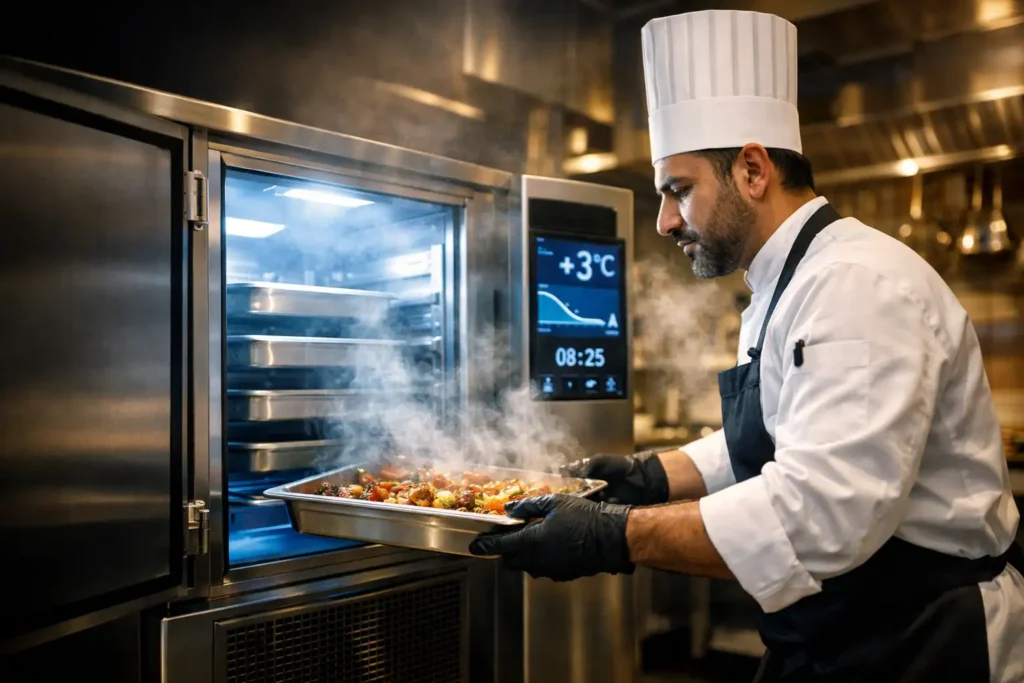
Rapidly cools hot cooked food to +3°C within 90 minutes, passing through the danger zone safely.
Is a blast chiller required in UAE kitchens?
Yes — for any professional kitchen following HACCP and UAE food safety regulations, rapid cooling is mandatory.
Can a walk-in chiller replace a blast chiller?
No. A walk-in chiller stores cold food; it cannot safely cool hot food fast enough.
What’s the difference between blast chilling and blast freezing?
- Blast chilling: cools to +3°C (short-term storage)
- Blast freezing: cools to −18°C (long-term storage)
How long does blast chilling take?
Typically under 90 minutes, depending on food type and batch size.
Who needs a blast chiller in UAE?
Hotels, restaurants, cloud kitchens, caterers, supermarkets, and food manufacturers.
Does it improve food quality?
Yes — it preserves texture, moisture, and flavour by preventing large ice crystal formation.
Can I put hot food directly inside?
Yes — that’s exactly what it’s designed for.
Key Takeaways
- A blast chiller UAE is essential for food safety compliance, not just convenience.
- It moves food quickly through the +63°C to +8°C danger zone, preventing bacterial growth.
- Walk-in chillers and blast chillers serve different roles — you need both in a proper cold chain.
- It reduces food waste, extends shelf life, and improves kitchen efficiency.
- It protects your refrigeration system by keeping heat out of your walk-in chiller.
- Proper use (especially correct probe placement) is critical for accurate results.
- UAE conditions (high ambient heat) make correct sizing and specification essential.
- Investing in a blast chiller often costs less than the risks of not having one — including food safety violations, spoilage, and equipment failure.
Introduction: Why Every UAE Food Business Needs a Blast Chiller
Food safety is not optional in the UAE. Whether you run a restaurant in Dubai, a hotel kitchen in Abu Dhabi, or a catering company in Sharjah, the law requires you to cool cooked food rapidly and safely before it goes into storage. In a country where summer temperatures regularly reach 40°C, the margin for error is small — and the consequences of getting it wrong are serious.
A blast chiller UAE is the equipment that solves this problem. It cools hot food quickly, safely, and in full compliance with UAE food safety regulations — without damaging the quality of what you have cooked.
At Chiller Room Manufacturers in UAE, we are proud to be the leading blast chiller room suppliers in Dubai and across the UAE. We supply, install, and support blast chiller commercial systems for hotels, restaurants, catering companies, supermarkets, and food manufacturers. Our range covers blast freezer units, chiller freezer combinations, and large-scale industrial blast chiller systems — all specified for UAE conditions.
This guide covers everything you need to know: how blast chilling works, what it does for your business, how it compares to other refrigeration options, and how to choose the right unit. You can also go straight to our blast chiller solutions page to see what is available.
What Is a Blast Chiller? A Plain English Explanation
A blast chiller UAE is a commercial refrigeration unit with one specific job: to cool hot cooked food as fast as possible.
Standard refrigerators and walk-in cold rooms are built for storage — they maintain food that is already cold. They are not designed to receive hot food, and doing so creates serious food safety and equipment risks. A blast chiller UAE is different. It uses high-speed fans to force cold air around the food at high velocity, pulling heat away from all surfaces at once and dropping the core temperature rapidly.
The target is to move food through what is called the bacterial danger zone — between +8°C and +63°C — as fast as possible. Bacteria multiply fastest inside this range. The longer the food sits there, the higher the risk. A blast chiller gets food below +8°C in under 90 minutes, eliminating that risk entirely.
A blast freezer takes this further, reducing food all the way to −18°C for long-term frozen storage — typically within approximately 240 minutes. A blast chiller freezer combination unit does both in one machine, giving kitchens maximum flexibility. Both are very different from a standard chiller freezer(a conventional combination refrigerator-freezer used for storage), which only holds food at a temperature — it does not actively rapid-cool it.
To understand how storage temperatures work across different refrigeration types, read our guide to chiller room temperatures in UAE.
🔧 Engineer’s Field Insight
In Dubai, we see a common mistake in smaller restaurant kitchens: the team lets cooked food sit on the counter for 30 to 45 minutes before putting it in the walk-in chiller. They think they are protecting the walk-in from the heat load. What they are actually doing is leaving food in the danger zone for almost an hour. A blast chiller UAE eliminates that completely — food goes straight in at cooking temperature and comes out safe.
How Does a Blast Chiller Work? Step-by-Step
The process is straightforward. Here is what happens from start to finish:
- Load. Place hot cooked food straight from the kitchen into the blast chiller immediately after cooking. Do not allow it to cool on the counter first — that time is wasted and dangerous.
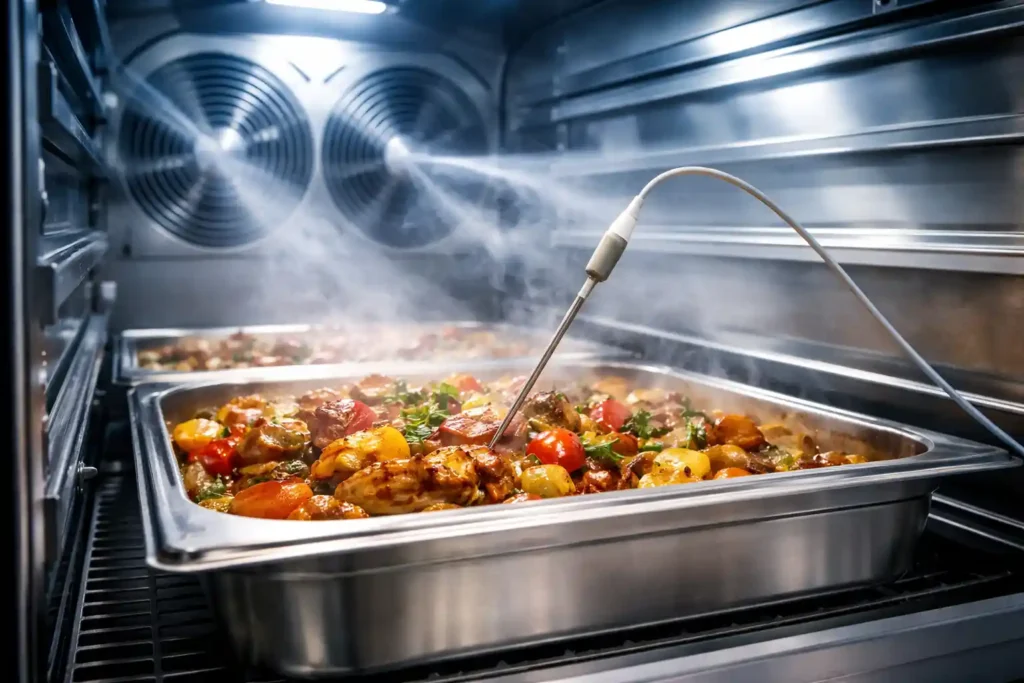
- Probe. Insert the temperature probe into the thickest or deepest part of the food — not the surface. The machine tracks the food’s core temperature, not just the air around it.
- Run. High-speed fans circulate cold air across every surface of the food simultaneously. The refrigeration system runs at full power, removing heat from the food rapidly and evenly.
- Chill or freeze. For blast chilling: the food core reaches +3°C within 90 minutes. For blast freezing: the food core reaches −18°C within approximately 240 minutes. These are the HACCP-compliant time-temperature targets.
- Hold. Once the target temperature is reached, the unit switches to a holding mode and keeps food at that temperature until you are ready to move it.
- Transfer. Food moves to a walk-in chiller or cold room for storage. The blast chiller’s job is now done — it is a processing unit, not a storage unit.
This process is especially important in the UAE’s climate. With outdoor temperatures above 40°C in summer, a kitchen that lacks a blast chiller UAE is working against the environment every single service. Our chiller room and freezer room guide for UAE explains how different refrigeration units fit into a complete cold chain.
🔧 Engineer’s Field Insight
Probe placement is one of the most common installation mistakes we see across UAE kitchens. If the probe goes into the edge of the food rather than the centre, the machine reads a safe temperature when the core is still warm and in the danger zone. We train every kitchen team on correct probe technique during commissioning — it is a five-minute lesson that protects every batch you will ever chill.
Key Advantages of a Blast Chiller UAE for Your Business
A blast chiller UAE is not just about compliance. It changes how your kitchen operates and what your business can do. Here are the six core benefits:
1. UAE Food Safety Compliance
The UAE Food Safety Law (Federal Law No. 10 of 2015) and guidelines from Abu Dhabi Food Control Authority (ADAFSA) and Dubai Municipality require commercial kitchens to follow HACCP-based cooling controls. A blast chiller commercial unit is the standard method for meeting the HACCP rapid-cooling requirement. Without one, your kitchen may not pass a food safety inspection.
2. Bacteria Cannot Multiply in Time
Food spends the least possible time in the bacterial danger zone (+8°C to +63°C) when blast-chilled. A walk-in chiller or standard fridge can take four to six hours to cool a large pot of food, during which bacteria may have multiplied to dangerous levels. A blast chiller UAE does the same job in 90 minutes or less, every single time.
3. Food Stays Fresh for Longer
Blast-chilled food stored at +1°C to +3°C typically lasts three to five days, depending on the food type. High-risk products such as fish and seafood may have a shorter window. Blast-frozen food held at −18°C can last three to twelve months. This reduces waste significantly and allows kitchens to prepare ahead without throwing food away.
4. Better Food Quality — No Ice Damage
When food cools slowly, large ice crystals form inside the food’s cells, breaking down the structure and causing moisture loss on reheating. A blast chiller freezer cools so quickly that only tiny ice crystals form — the cell structure stays intact. Reheated food retains its original texture, colour, and flavour.
5. Your Kitchen Can Work Further Ahead
With a commercial food chiller blast unit in your kitchen, your team can cook large batches during quiet periods, chill them safely, and reheat to order during service. This removes the pressure of live cooking during a busy service, reduces errors, and improves consistency across every dish.
6. Your Walk-In Chiller Works Better
Hot food placed directly into a walk-in chiller raises the room temperature, puts other stored products at risk, and forces the compressor to work much harder — which increases energy costs and shortens the equipment’s lifespan. A blast chiller UAE handles the hot-to-cold transition outside the walk-in, protecting your stored stock and your refrigeration equipment.
For energy-saving tips across your full refrigeration setup, read our guide: how to reduce chiller room electricity costs in UAE.
🔧 Engineer’s Field Insight
We have attended walk-in chiller compressor failures in several Dubai hotels where no blast chillers were installed. In every case, the kitchen team was loading hot trays directly into the walk-in after service. The compressor was running at maximum effort to recover temperature — and eventually failed. In most cases, the cost of installing a blast chiller would have been a fraction of the emergency repair and downtime cost.
Blast Chiller vs Blast Freezer vs Walk-In Chiller: What Is the Difference?
These three types of refrigeration equipment are often confused. They work together in a professional kitchen — but each one has a specific job. Here is a clear side-by-side comparison:
| Factor | Blast Chiller | Blast Freezer | Walk-In Chiller |
| Primary purpose | Rapidly cool hot food to +3°C | Rapidly freeze food to −18°C | Hold already-cold food |
| Speed | Hot to safe in 90 minutes | Hot to frozen in ~240 minutes | Not designed to cool hot food |
| Best for | Daily cook-chill production | Long-term frozen storage | Bulk ingredient storage |
| Food safety | Eliminates danger zone risk | Eliminates danger zone risk | Risk if hot food is placed inside |
| Works together? | Yes — pairs with walk-in chiller | Yes — pairs with walk-in chiller | Yes — receives blast-chilled food |
To know more about the Blast Freezer: Blast Freezer UAE: The Practical 2026 Guide
The key point: a blast chiller and a walk-in chiller are not alternatives to each other. They are different tools in the same cold chain. The blast chiller handles the hot food; the walk-in stores the result.
For further reading on how these units fit together, see our guides: Chiller Room vs Freezer Room Guide UAE and Cold Room vs Chiller Room UAE.
How to Choose the Right Refrigeration System for Your UAE Business
Not every business needs the same solution. Use this guide to match your situation to the right equipment. If you are unsure, our team at ChillerRoom.ae will assess your kitchen and recommend the correct setup — at no cost.
| Your Situation | Right Solution |
| You run a small café, food truck, or cloud kitchen with limited space | Portable Chiller — compact, mobile, easy to install |
| You cook food for commercial service and need HACCP-compliant rapid cooling | Blast Chiller UAE — the only correct tool for hot food cooling |
| You need to store large volumes of ingredients or finished goods at a cold temperature | Walk-In Chiller — stable bulk storage, sized to your capacity |
| Your kitchen layout is non-standard, or you need a custom cold room design | Blast Freezer Commercial — fast freeze without quality loss |
| Your kitchen layout is non-standard or you need a custom cold room design | Customised Chiller — designed around your exact floor plan |
| You run a hotel, hospital, or central production kitchen at high volume | Industrial Blast Chiller + Walk-In Chiller used together |
Explore our full range: Blast Chiller UAE · Walk-In Chiller · Portable Chiller · Customised Chiller.
🔧 Engineer’s Field Insight
The most common sizing mistake we see in UAE is choosing a blast chiller based on the number of trays it holds rather than the actual weight and type of food being chilled. A unit rated for 20 kg of bread rolls will not perform the same way with 20 kg of dense beef casserole. We always calculate the thermal load — the actual heat that needs to be removed from each batch — before recommending a unit. If your supplier is quoting tray counts without asking about your food types, ask again.
Blast Chiller for Hotels, Restaurants & Catering in UAE
The UAE has one of the most demanding hospitality and food service markets in the world. High covers, high standards, and strict regulations make a blast chiller commercial unit essential across every type of food operation.
Hotels and Banqueting Kitchens
A UAE hotel serving hundreds of covers across multiple restaurants, banquet halls, and in-room dining needs a kitchen that can produce food safely at scale. An industrial blast chiller allows the team to cook large batches — stocks, proteins, sauces, desserts — and chill them rapidly after each production run. Food is stored safely and reheated on demand across multiple service points. This is how modern hotel kitchens manage volume without compromising food safety or quality. A blast chiller UAE is central to that system.
Restaurants and Cafes
For a restaurant running two or three sittings a day, a blast chiller commercial unit changes the pressure on the kitchen. Prep-ahead cooking means sauces, proteins, and desserts can be made in advance, chilled safely, and finished to order during service. The team reheats and plates rather than cooking everything from scratch under pressure. The result is better consistency, less stress, and lower food cost.
Catering and Event Companies
Caterers across the UAE transport food to event venues, offices, schools, and hospitals. Without a blast chiller freezer, every cook-transport-serve workflow carries food safety risk. With one, food is cooked, blast-chilled, transported at the correct temperature, and reheated on site — entirely within HACCP-compliant parameters. This is especially important for large-scale events and institutional contracts where food safety documentation is required.
Cloud Kitchens and Food Delivery
The cloud kitchen sector in Dubai and across the UAE is built on high-volume batch cooking. A commercial food chiller blast unit is central to making that model work efficiently and safely. It allows rapid turnover between production batches, extends the usable life of prepared food, and ensures every delivery meets food safety standards — without slowing down the operation.
Industrial Blast Chiller: Applications Beyond the Restaurant Kitchen
While the food service industry is the primary user of blast chiller UAE technology, industrial blast chiller systems serve important roles in other sectors too.
Food Manufacturing and Central Production Kitchens
Food manufacturers and large catering production kitchens in the UAE process food at high volumes continuously. Industrial blast chiller systems for these operations are significantly larger than restaurant-grade units — designed for roll-in trolley loading and built to handle multiple back-to-back cycles without performance loss.
Supermarkets and Food Retail
In-store bakeries, deli counters, and prepared food sections in UAE supermarkets use blast chiller commercial units to rapidly cool baked goods, cooked meats, and ready meals before display. This extends shelf life and ensures products remain within food safety standards throughout the retail day.
Bakeries and Confectionery
Bakers in the UAE face a specific challenge: the humidity. When baked goods cool slowly in open air, condensation forms — softening pastry crusts, causing chocolate bloom, and degrading product appearance. A chiller freezer blast unit cools baked products quickly and in a controlled environment, preserving crust, texture, and appearance.
Pharmaceutical Manufacturing
Certain pharmaceutical manufacturing processes — such as gel capsule production, active ingredient stabilisation, and coating processes — use industrial blast chiller equipment for rapid temperature reduction during production. It is important to note that this is different from vaccine and medicine storage, which requires fully validated pharmaceutical-grade cold rooms. For UAE pharma cold chain solutions, see our pharma cold storage and medical chiller guide.
Fresh Flowers and Produce
Cut flowers and fresh produce in the UAE are stored in chiller rooms at +2°C to +5°C to slow deterioration — not blast-frozen. Rapid pre-cooling of incoming stock on arrival helps extend vase life for flowers and shelf life for fresh produce. Our flower chiller UAE and fruit ripening cold storage UAE pages explain the specific requirements for these sectors.
UAE-Specific Considerations When Buying a Blast Chiller
The Heat Factor
The UAE’s ambient temperature frequently exceeds 40°C in summer. This matters for two reasons. First, a blast chiller’s refrigeration system works harder in hot ambient conditions, which means a unit sized for a European kitchen may underperform in a UAE kitchen without proper specification. Second, any delay between cooking and blast chilling is riskier in a hot kitchen than in a cool one. Food must go straight into the blast chiller UAE unit immediately after cooking, with no counter time.
HACCP Digital Logging
Most quality blast chiller commercial units include a digital data logger that automatically records the time, date, starting temperature, and end temperature for every chilling cycle. This documentation is exactly what UAE food safety inspectors look for. Manual records are permitted but harder to maintain consistently. Digital logging is one of the most practical reasons to choose a quality unit over a basic one.
Common Mistakes UAE Kitchens Make
- Putting hot food into a walk-in chiller. This is a food safety violation, and it damages the walk-in’s compressor over time.
- Buying a unit that is too small. Volume grows. A unit that fits your operation today may bottleneck you within a year. Size for your realistic peak, not your current average.
- Placing the probe incorrectly. The temperature probe must go into the centre or thickest part of the food — never the surface or edge. The surface cools quickly; the core can remain in the danger zone even when the outside reads safe.
- Neglecting maintenance. Blocked air filters reduce cooling speed and increase energy consumption. Clean filters regularly and service the unit on schedule.
- Buying from a supplier without UAE after-sales support. If your unit breaks down during a busy service, you need a local technician — not an overseas support line.
Also read: Why Chiller Rooms Fail in UAE — many of the same operational errors apply to blast chiller systems.
Why Choose ChillerRoom.ae as Your Blast Chiller Supplier in UAE?
There are many refrigeration suppliers in the UAE. Here is what makes ChillerRoom.ae the right choice when it comes to blast chiller UAE solutions:
- UAE experience. We understand the specific demands of UAE commercial kitchens — the climate, the food safety regulations, the layout constraints, and what inspectors look for.
- Full product range. From compact commercial food chiller blast units for small restaurants to large industrial blast chiller systems for hotels and production kitchens.
- Correct sizing. We calculate your actual thermal load — based on food types, batch weights, and production volume — before recommending a unit.
- HACCP-ready systems. Every blast chiller commercial unit we supply includes digital temperature logging for your compliance records.
- Full installation and training. We handle installation, commissioning, probe calibration, and staff training — not just the equipment.
- UAE-based after-sales support. Our service team is local. When something needs attention, we respond quickly.
- Complete cold chain capability. We also supply walk-in chillers, portable chillers, and customised cold rooms — so we can design your entire refrigeration setup, not just one piece of it.
Explore all our refrigeration services in UAE. Also read: Cold Room UAE — Full Guide and Walk-In Chiller UAE Business Guide.
Frequently Asked Questions: Blast Chiller UAE
The purpose of a blast chiller UAE is to cool hot cooked food from +70°C to +3°C or below in under 90 minutes. It does this by circulating high-velocity cold air around the food, pushing it through the bacterial danger zone (+8°C to +63°C) as quickly as possible. This prevents bacterial growth, meets HACCP food safety requirements, and preserves food quality for safe storage.
A standard chiller freezer or walk-in chiller is a storage unit — it keeps already-cold food at a safe holding temperature. A blast chiller is an active processing unit — it rapidly removes heat from freshly cooked food. A walk-in chiller can take four to six hours to cool a hot dish; a blast chiller does it in 90 minutes. For UAE businesses, both are typically needed: the blast chiller handles the hot food, and the walk-in stores the result. Read more in our walk-in chiller business guide for UAE.
In blast chill mode, a blast chiller commercial unit reduces the food’s core temperature to +3°C within 90 minutes. In blast freeze mode, a blast freezer commercial unit brings food to −18°C within approximately 240 minutes. Exact times depend on the food type, portion size, and density, as well as the capacity of the industrial blast chiller unit used.
Load hot food immediately after cooking. Insert the temperature probe into the thickest part of the food. Select the blast chill or blast freeze programme. The blast chiller UAE unit runs until the food reaches the target temperature, logs the cycle data, then holds the food at temperature. Transfer the food to a walk-in chiller or cold room for storage.
Neither. A blast chiller is a rapid-cooling processing unit — not a storage appliance. After the chilling or freezing cycle, food is transferred to a storage unit such as a walk-in chiller or chiller freezer. A blast chiller freezer combination unit can cool food to either +3°C or −18°C in a single machine, but it is still a processing tool, not a long-term storage solution.
ChillerRoom.ae supplies countertop units for small kitchens, reach-in cabinets, undercounter models, roll-in units for trolley-based production kitchens, and high-capacity industrial blast chiller systems for hotels and central production facilities. We also build customised chiller solutions for kitchens with specific layouts or capacity requirements.
A commercial food chiller blast unit is designed for restaurant or hotel kitchen use — typically processing 10 to 40 kg per cycle. An industrial blast chiller is built for high-volume continuous operation in central kitchens, food factories, or large institutions — often processing 60 kg or more per cycle. The blast chilling principle is the same in both; the difference is capacity, airflow, and build quality for heavy daily use.
If you prepare food in advance, run any kind of cook-chill system, or serve more than 50 covers per service, then yes — a blast chiller freezer is strongly recommended. UAE food safety regulations require rapid cooling of cooked food before storage. A blast chiller UAE unit is the most reliable way to meet that requirement while also improving your kitchen workflow and reducing food waste.
The blast chilling process is the same everywhere, but the UAE’s climate creates additional demands on the equipment. With ambient temperatures above 40°C in summer, the refrigeration system must work harder to achieve the same cooling results. This is why specifying your blast chiller UAE unit correctly for UAE conditions is critical. A unit rated for European ambient temperatures may underperform here without correct specification.
Some pharmaceutical manufacturing processes — such as gel capsule production, active ingredient stabilisation, and certain coating processes — do use industrial blast chiller equipment for controlled rapid cooling during production. However, blast chillers are not suitable for vaccine storage or finished medicine storage, which requires fully validated pharmaceutical cold chain systems. See our pharma cold storage and medical chiller guide for UAE-specific guidance.
Conclusion: Get the Right Blast Chiller UAE Solution for Your Business
A blast chiller UAE is not a luxury addition to a commercial kitchen. It is the equipment that keeps your food safe, your business compliant, your team less stressed, and your walk-in chiller working properly. It is the foundation of a professional cook-chill operation — and in the UAE’s climate and regulatory environment, it is essential.
Whether you need a compact blast chiller commercial unit for a restaurant in Dubai, a high-capacity blast freezer commercial system for a hotel kitchen in Abu Dhabi, or a fully custom industrial blast chiller setup for a central production facility — ChillerRoom.ae has the experience, product range, and UAE-based support to deliver the right solution.
We are the UAE’s trusted blast chiller suppliers in Dubai and beyond. Talk to our team, and we will size the right system for your operation, install it correctly, and support it for the long term.