Commercial Cold Storage in UAE: Choose the Right Cold Storage Facility
📅 May 2026 ⏱ 15 min read
✍️ Senior Refrigeration Engineer | Chillerroom.ae
Table of Contents
Quick Answers
- What is cold storage in UAE?
Cold storage in UAE refers to temperature-controlled cold storage facilities designed to store perishable goods like food, pharmaceuticals, and chemicals in extreme 45°C+ conditions. - What industries need cold storage in UAE?
Food & beverage, supermarkets, pharmaceuticals, hospitality, logistics, and agriculture rely on cold storage warehouses and cold chain storage systems. - What temperature ranges are used?
+2°C to +8°C for fresh and pharma, -18°C to -25°C for frozen storage, and up to -40°C for deep freeze cold storage. - What types of cold storage solutions are available?
Walk-in cold storage, cold storage warehouse, modular cold storage container, and temperature-controlled cold storage facilities. - How long does installation take?
Most walk-in cold storage and modular cold storage solutions can be installed within 3–7 days. - What regulations apply in UAE?
Cold storage facilities must comply with Dubai Municipality, HACCP, and MOHAP GSDP standards. - What is cold chain storage?
Cold chain storage ensures products remain within controlled temperatures during storage, transport, and distribution. - Why is climate-specific design important?
Cold storage in UAE must be engineered for extreme heat to prevent system failure and reduce energy costs.
Key Takeaways
- Cold storage in UAE is essential infrastructure for any business handling perishable or sensitive products.
- Temperature-controlled cold storage ensures product safety, compliance, and shelf-life extension.
- Walk-in cold storage and cold storage warehouse systems must be designed for 45°C+ ambient conditions.
- Cold chain storage is critical for logistics, ensuring uninterrupted temperature control.
- Compliance with UAE regulations (Dubai Municipality, HACCP, MOHAP) is mandatory.
- Cold storage automation improves monitoring and efficiency and reduces operational risks.
- Modular cold storage container solutions offer flexibility and fast deployment.
- Investing in energy-efficient cold storage solutions reduces long-term operational costs.
- Proper system design directly impacts reliability, efficiency, and ROI.
- Choosing the right cold storage UAE provider ensures scalability and business growth.
I’ve spoken to a lot of business owners across the UAE who assumed cold storage was just a matter of buying the right box and plugging it in. It rarely works out that way. Whether you’re managing a hotel kitchen in Dubai Marina, running a pharmaceutical warehouse in Abu Dhabi’s industrial zone, or distributing flowers out of Sharjah — cold storage in UAE throws up challenges you won’t find in any European or American spec sheet. This guide covers what actually matters: which system fits your operation, what compliance genuinely demands, where energy bills quietly bleed, and what makes cold rooms fail here more than almost anywhere else.
Why Cold Storage in UAE Is a Different Challenge
Here’s something worth saying plainly: when ambient temperatures climb past 45°C in July and August, a cold storage room isn’t just keeping things cool — it’s fighting the surrounding environment around the clock, with no off-season and no relief. Systems designed for Europe or North America are built on assumptions that simply don’t hold here. We’ve seen well-specified imported systems struggle badly within their first UAE summer.
Heat is only half the problem. Coastal cities like Dubai and Abu Dhabi can push relative humidity past 90% in late summer. That combination — extreme heat and heavy moisture — attacks insulation joints, degrades door seals faster than most people expect, and causes condensation to build up in spots that are genuinely hard to catch early. The short version: cold storage has to be built for UAE, not adapted from somewhere cooler and hoping for the best.
Types of Cold Storage Solutions in UAE
Cold storage is not a single product. Depending on your industry, volume, temperature requirements, and site constraints, the right solution can look very different. Here is a clear breakdown of the main categories used across the UAE today.
Walk-In Chiller
Permanent cold rooms for restaurants, supermarkets, hotels, and food production. Typical range: 0°C to +5°C.
Explore →Blast Chiller
Rapid cooling from cooking temperatures to +3°C within 90 minutes. Essential for HACCP compliance.
Explore →Portable Chiller
Flexible cold storage for events, construction, and temporary operations where permanent setup isn’t needed.
Explore →Customised Chiller
Bespoke cold rooms built to exact size, temperature, humidity, and load requirements.
Explore →Which Industries Need Cold Storage in UAE?
Cold storage in UAE touches more sectors than most people realise. Food is the obvious one, but the industries that depend on reliable temperature control go well beyond kitchens and supermarkets. Here’s how the main ones break down — and what each of them typically needs.
| Industry | Temperature Range | Primary Cold Storage Type |
|---|---|---|
| Hotels & Restaurants | 0°C to +4°C | Walk-In Chiller + Blast Chiller |
| Pharmaceutical / Medical | +2°C to +8°C (GDP-compliant) | Customised & Validated Chiller |
| Supermarkets & Retail | 0°C to +5°C | Walk-In Chiller |
| Floriculture & Flowers | +2°C to +8°C | Walk-In Chiller |
| Seafood & Meat Processing | −1°C to +2°C | Customised Cold Room |
| Logistics & Cold Chain | Variable | Portable + Large Walk-In |
| Events & Catering | 0°C to +5°C | Portable Chiller |
| Food Manufacturing | −18°C to +4°C | Blast Chiller + Freezer |
How to Choose the Right Cold Storage System
There’s a version of this decision that looks simple: get three quotes, pick the middle one, and move on. In our experience, that approach tends to generate expensive problems within 12–18 months. An undersized system, wrong insulation spec, or a poorly sited condensing unit will cost you far more in spoiled stock and emergency callouts than anything you saved upfront. Here’s the framework we’d actually use.
- Nail down your temperature range before anything else. This sounds obvious, but it’s where things go wrong most often. Dairy sits happily at 2°C–4°C. Fresh meat wants −1°C to +2°C. Vaccines need +2°C to +8°C with documentation proving it stayed there. Getting this wrong means spoilage at best, regulatory failure at worst.
- Do an honest thermal load calculation. How many staff will open that door, and how often? Are the products going in warm or already chilled? What’s the wall exposure like? Every one of these feeds into the heat load your refrigeration has to handle continuously. Guess wrong, and you’ll be chasing temperature all day.
- Don’t accept standard insulation for a non-standard climate. The 80mm PIR panels that are fine in a mild climate are often marginal here — especially where any wall gets direct sun for hours, or where ambient temperatures regularly push above 40°C. Ask your engineer to model the actual insulation thickness your site needs. Not just what’s on the standard price list.
- Think about power before day one, not after the first outage. Voltage fluctuations, summer demand pressures, and the sheer cost of running refrigeration through a UAE summer are real operational factors. Backup power options and surge protection aren’t premium extras in this climate — they’re basic risk management.
- Know your regulatory obligations before you sign anything. Food operations need HACCP alignment built in from the start. Pharma businesses need GDP-validated rooms with full qualification documentation. Some healthcare settings have additional requirements on top. These aren’t things you can retrofit cheaply later — they need to be in the design from day one.
Worth flagging: The most predictable mistake we see is businesses sizing a cold room for today and calling us two years later because they’ve outgrown it. Building in 15–20% extra capacity upfront is nearly always cheaper than a retrofit — and far less disruptive to your operation when it actually matters.
Pharmaceutical Cold Storage in UAE
Pharma cold storage in the UAE isn’t just about keeping things cold — it’s about proving they stayed cold. MoHAP and ESMA set requirements for how temperature-controlled storage must be designed, monitored, and audited. A standard chiller room, however well built, won’t meet them.
The word that separates pharma cold storage from everything else is validation. It’s not enough to build a room that holds +2°C to +8°C — you have to prove it, through documented testing at every point in the room’s volume, under worst-case conditions, with a traceable record of every sensor reading. That process runs through IQ (Installation Qualification), OQ (Operational Qualification), and PQ (Performance Qualification). It takes time, and it takes people who’ve done it before.
Key Requirements for Pharma Cold Storage in UAE
GDP compliance means continuous monitoring with calibrated sensors, alarm systems that have themselves been validated, written SOPs for what happens when something goes out of range, and documentation that can survive a regulator’s scrutiny. For insulin, vaccines, and biologics — products where a few extra degrees for a few hours can render an entire batch useless or dangerous — this isn’t overcaution. It’s the standard.
Running a pharmacy, medical warehouse, or hospital dispensary? Before signing anything, ask your prospective installer for pharma sites they’ve completed and validated — and ask to see the paperwork. A team that’s done it properly won’t hesitate. One that hasn’t usually redirected the conversation.
Reducing Energy Costs in Your UAE Cold Storage
Ask any facility manager what their cold storage costs are, and watch the hesitation. Most people know it’s significant — they just don’t know precisely how significant, or why. Cold storage consistently ranks among the biggest energy users in commercial buildings. In the UAE, where summer cooling loads are extreme, and electricity isn’t cheap, the gap between a well-specified system and a poorly-specified one can run into thousands of dirhams a month.
The Six Biggest Energy Drains in Cold Storage
- Insulation that’s too thin or degraded over time — This is the biggest one. Heat creeping through the panels forces your compressor to compensate continuously. In a UAE summer, inadequate insulation doesn’t just waste energy — it can mean the system stops holding temperature altogether during peak heat hours.
- Doors that stay open too long, or too often — A walk-in chiller door open for 30 seconds in August admits a serious volume of hot, humid air. In busy operations where staff is constantly moving in and out, door management can become the single biggest energy drain in the building.
- Condenser coils caked in dust — UAE dust settles fast, and condenser coils collect it efficiently. We’ve measured efficiency losses of 10–30% in systems that simply haven’t been cleaned for a few months. It’s one of the cheapest problems in refrigeration to fix, and one of the most consistently ignored.
- Compressors that are too big for the space — counterintuitive, but an oversized compressor short-cycling on and off actually uses more energy than a correctly sized one running steadily. Getting sizing right isn’t just about peak capacity — it’s about how the system runs day to day.
- Worn or cracked door seals — A degraded door gasket leaks air continuously, even when the door looks firmly shut. New seals are inexpensive. What they save you in energy costs typically covers the replacement cost within a few weeks.
- Running colder than you actually need — If your product spec allows +4°C and you’ve set the room to +1°C to be cautious, you’re paying a real energy premium for nothing. Every unnecessary degree of overcooling has a cost. Set it correctly; monitor it properly.
For more in-depth guidance on cutting your cold room electricity bills, read our dedicated guide: Reduce Chiller Room Electricity Costs in UAE →
Blast Chilling: The Cold Storage Step UAE Kitchens Miss
Here’s a gap we see constantly. A business invests properly in walk-in cold storage in UAE, then puts freshly cooked food straight in and wonders why they’re failing hygiene audits. A blast chiller isn’t a replacement for a cold room — it’s what has to happen before food reaches it. Under HACCP, it’s not a suggestion.
The science is straightforward. Once food drops below 60°C and before it reaches 5°C, it’s in the temperature window where bacteria multiply rapidly — this is the danger zone as defined by Dubai Municipality food safety standards. A walk-in chiller, even a well-designed one, can take several hours to pull a large batch of hot food safely through that window. A blast chiller does it in under 90 minutes. In any professional UAE kitchen operating under Dubai Municipality or ADAFSA requirements, that speed isn’t a preference — it’s the standard.
Blast freezing is a different thing entirely — pushing core temperature down to −18°C for long-term storage. Whether you need blast chilling or blast freezing comes down to your storage timeline and what the product can handle. Chilling to +3°C preserves texture better; freezing to −18°C gives you significantly more time. Either way, both are vastly better than putting hot food anywhere near a standard chiller.
Read more: Our complete guide to blast chilling — Blast Chiller UAE: The Complete Guide for Hotels, Restaurants & Food Businesses →
Cold Room vs Chiller Room: What’s the Difference?
These two terms get used interchangeably in the UAE market constantly — including by people who really should know better. When you’re comparing quotes, it matters that everyone is talking about the same thing. Here’s the actual distinction:
A cold room is the umbrella term — any insulated, temperature-controlled enclosure, whether above or below freezing. A chiller room specifically operates above 0°C, with a broad operating range of 0°C to +10°C depending on the application. For fresh food, the tighter food-safe target is usually 0°C to +5°C; pharmaceuticals and flowers may sit at the higher end of that range. The +10°C ceiling is the technical upper limit of positive-temperature refrigeration, not a food storage recommendation. A freezer room goes below 0°C, usually −18°C to −25°C for long-term frozen storage. Same structural concept, very different engineering requirements.
When collecting quotes, make sure every supplier is pricing the same type of system. It sounds obvious, but mismatched specs cause real headaches once you’re mid-project. For the full breakdown: Cold Room vs Chiller Room: Full Comparison →
Why Cold Storage Systems Fail in UAE
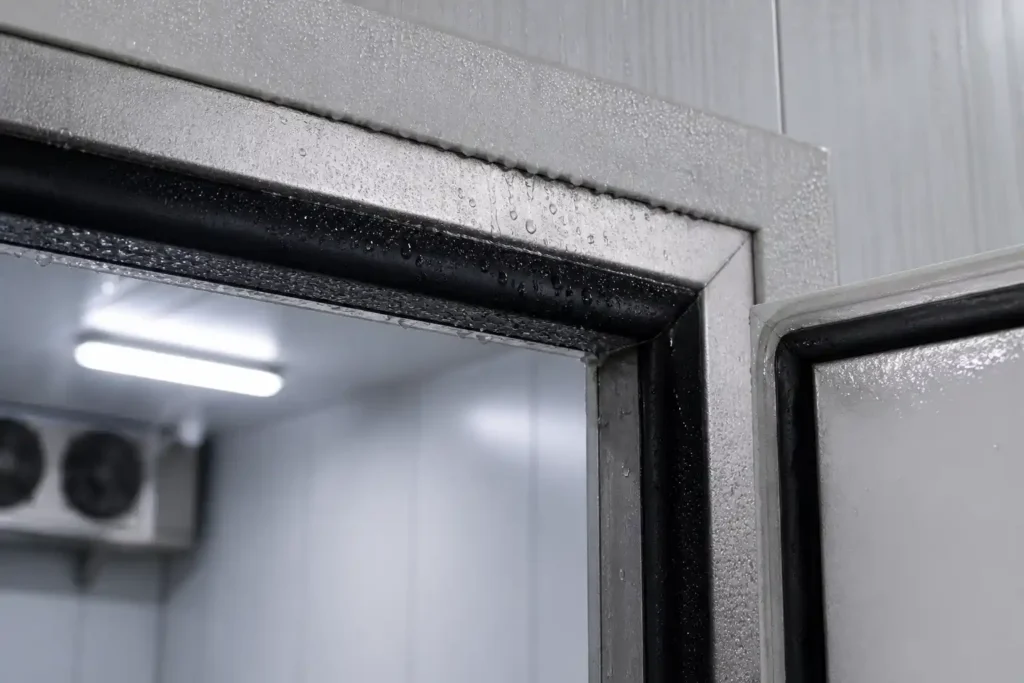
We get called in to look at failing cold storage systems with some regularity. More often than not, the business isn’t the problem — the system just wasn’t built for where it’s operating. The UAE’s climate is punishing in ways that generic refrigeration specifications don’t account for. These are the four failure modes we come across most:
1. Undersized Refrigeration Capacity
Load calculations built on European climate data consistently get this wrong for the UAE. At 45°C ambient, a condensing unit is rejecting heat against a much smaller temperature differential than it was designed for — which means it runs harder, runs longer, and still may not keep up. A system that was correctly sized for 25°C ambient can be completely overwhelmed at 45°C.
2. Inadequate Insulation for Local Conditions
The 80mm PIR panels that are standard specification in mild climates are often genuinely marginal in the UAE — particularly for freezer rooms or any room with an external wall facing direct sun for most of the day. We’ve seen correctly specified compressors struggling to maintain temperature simply because the insulation wasn’t thick enough for the actual ambient conditions.
3. Neglected Preventive Maintenance
UAE desert dust is remarkably efficient at coating condenser coils and degrading heat rejection performance. Without monthly cleaning through the summer, efficiency drops fast. The majority of emergency callouts we attend that aren’t electrical faults trace directly back to a condenser that hasn’t been serviced in the past six months or more.
4. Poor Installation Quality
A cold room can look finished on handover day and still have problems that won’t show up for months — panel joints not properly sealed, a door frame a fraction out of level, drainage that wasn’t insulated. None of these is individually catastrophic. Together, across 18 months of UAE summer operation, they become expensive. Cold storage should be commissioned by people who specialise in refrigeration — not handed to a general contractor who’s done a few before.
Further Reading: Related Guides
These guides go deeper into specific areas — written by our engineers based on what they actually encounter on UAE sites:
How to Reduce Chiller Room Electricity Costs in UAE
Walk-In Chiller UAE: 13 Powerful Ways to Boost Efficiency
Frequently Asked Questions: Cold Storage in UAE
It really depends on what’s going on. Fresh produce and dairy are comfortable at 2°C–4°C. Meat and seafood need to sit closer to 0°C — typically −1°C to +2°C. Pharmaceuticals like vaccines and insulin require +2°C to +8°C, with documentation. Flowers usually want +4°C to +8°C. Long-term frozen storage drops to −18°C to −25°C. Don’t guess on this — get it confirmed by someone who actually knows your product type.
It varies a lot. A small walk-in chiller for a restaurant kitchen might start around AED 15,000–25,000 depending on spec. Larger industrial cold storage, blast chillers with proper capacity, or anything requiring pharmaceutical validation costs considerably more. Any quote you receive without a site visit is essentially an educated guess — and those guesses tend to cause problems later on. Insist on an actual survey before accepting any number.
In practical terms, yes. Dubai Municipality and ADAFSA both apply HACCP standards requiring cooked food to pass through the bacterial danger zone — 60°C down to 5°C under Dubai Municipality’s actual standards — within time limits, a walk-in chiller simply can’t meet for bulk quantities. It’s not laid out as one single piece of legislation, but any professional kitchen being audited that isn’t blast chilling cooked food will have a serious problem.
For a straightforward walk-in chiller using prefabricated panels, once materials are confirmed and on site, installation usually runs 3–7 days. Custom builds, larger footprints, or tricky access situations take longer — typically 2–4 weeks for more complex configurations. Pharmaceutical rooms add a commissioning and qualification phase on top of installation, which can take several more weeks. Factor that into your project timeline from the start.
Technically yes, and some businesses do run container-based portable units for years. But they’re not as energy efficient as a purpose-built room, they’re harder to validate for regulated industries, and they don’t perform the same way through a UAE summer. If you know this is a long-term need, the economics of a proper walk-in usually make more sense within a couple of years.
Bare minimum: condenser coils cleaned monthly — more often if you’re in a dusty industrial area. Door seals are checked every quarter. Refrigerant levels are verified twice a year. Full system service once a year. For UAE conditions specifically, we’d push for engineer visits every month through summer. Most of the cold room failures we’re called out to deal with aren’t sudden breakdowns — they’re maintenance problems that have been quietly developing for months before anything obvious gave way.
Trusted Cold Storage Experts in UAE
When it comes to reliable and high-performance cold storage in UAE, ChillerRoom stands out as one of the best chiller room manufacturers in the region. Businesses across the food, pharmaceutical, retail, and logistics sectors trust our expertise in delivering cold storage warehouse systems, walk-in cold storage, and temperature-controlled cold storage solutions built for extreme UAE conditions.
Our commitment to quality, compliance, and long-term efficiency has made us a preferred partner for companies that cannot afford failure in their cold chain storage operations. From modular cold storage container systems to fully customised cold storage facilities with advanced cold storage automation, we deliver solutions that are engineered to perform and scale.
If you’re looking to invest in dependable cold storage in UAE infrastructure, partner with a team that understands both the technical and operational demands of your business.
Start Your Cold Storage Project Today
Small walk-in chiller, blast freezer, pharma-grade validated cold room, or a full industrial cold storage facility — our team has delivered engineered solutions across Dubai, Abu Dhabi, and Sharjah. Tell us your requirement and get a clear, practical recommendation.