
Ice Cream Cold Room Manufacturers UAE
Every fluctuation inside an ice cream cold room reshapes the ice crystals in the product — turning a smooth scoop grainy within days. ChillerRoom.ae designs and manufactures ice cream cold rooms built to hold a constant −25°C to −30°C across Dubai, Abu Dhabi, Sharjah, and the wider UAE, so texture is never left to chance.
Why Ice Cream Breaks Down in a Standard Freezer
Ice cream is a fragile structure of ice crystals, air, and fat. Every time a door opens or a compressor cycles, the smallest crystals melt and refreeze onto larger ones — turning smooth product grainy over time.
The UAE’s legal maximum for frozen storage is −18°C. That’s a food-safety ceiling, not a texture standard — ice cream stays legally compliant there, but heat-shock cycling continues with every disturbance.
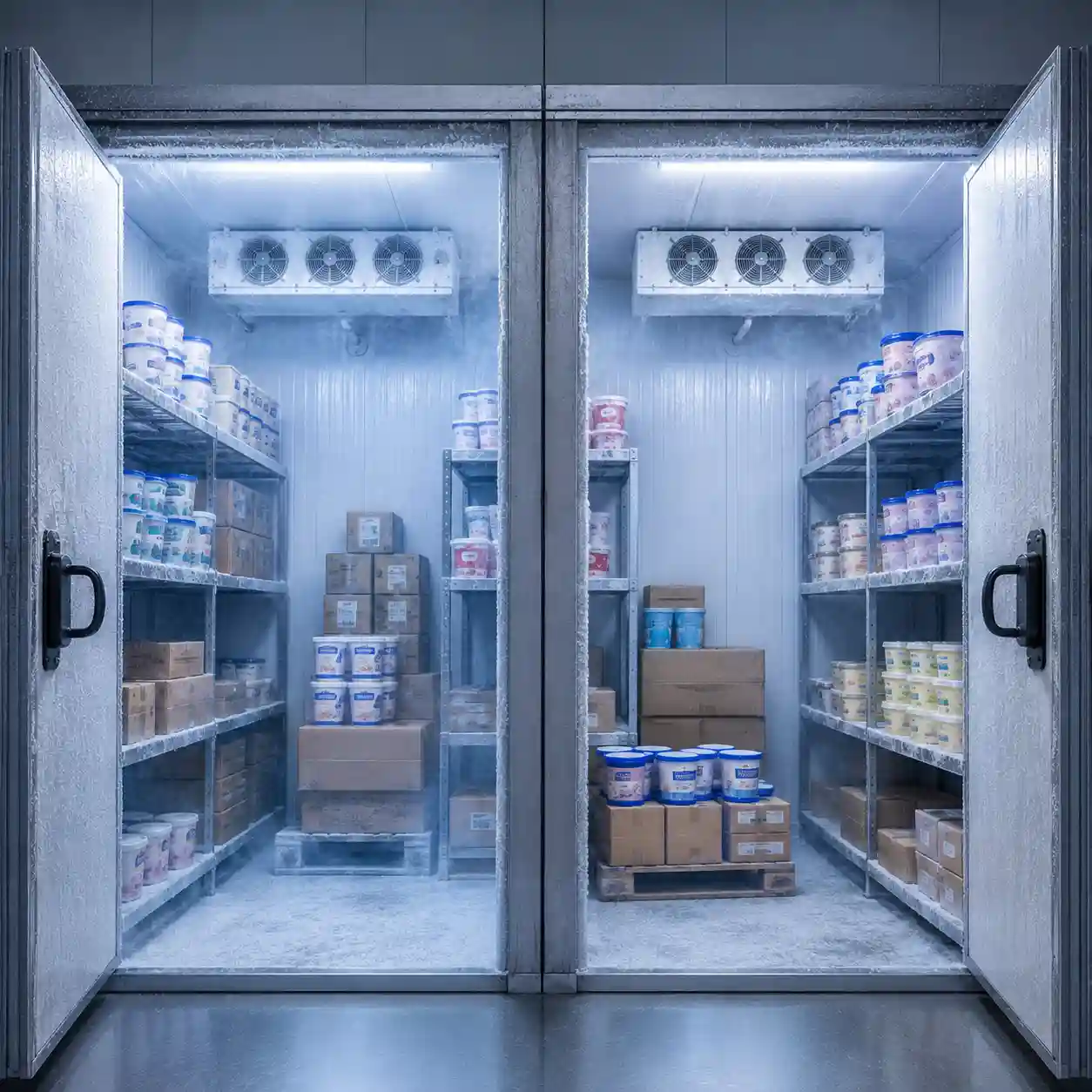
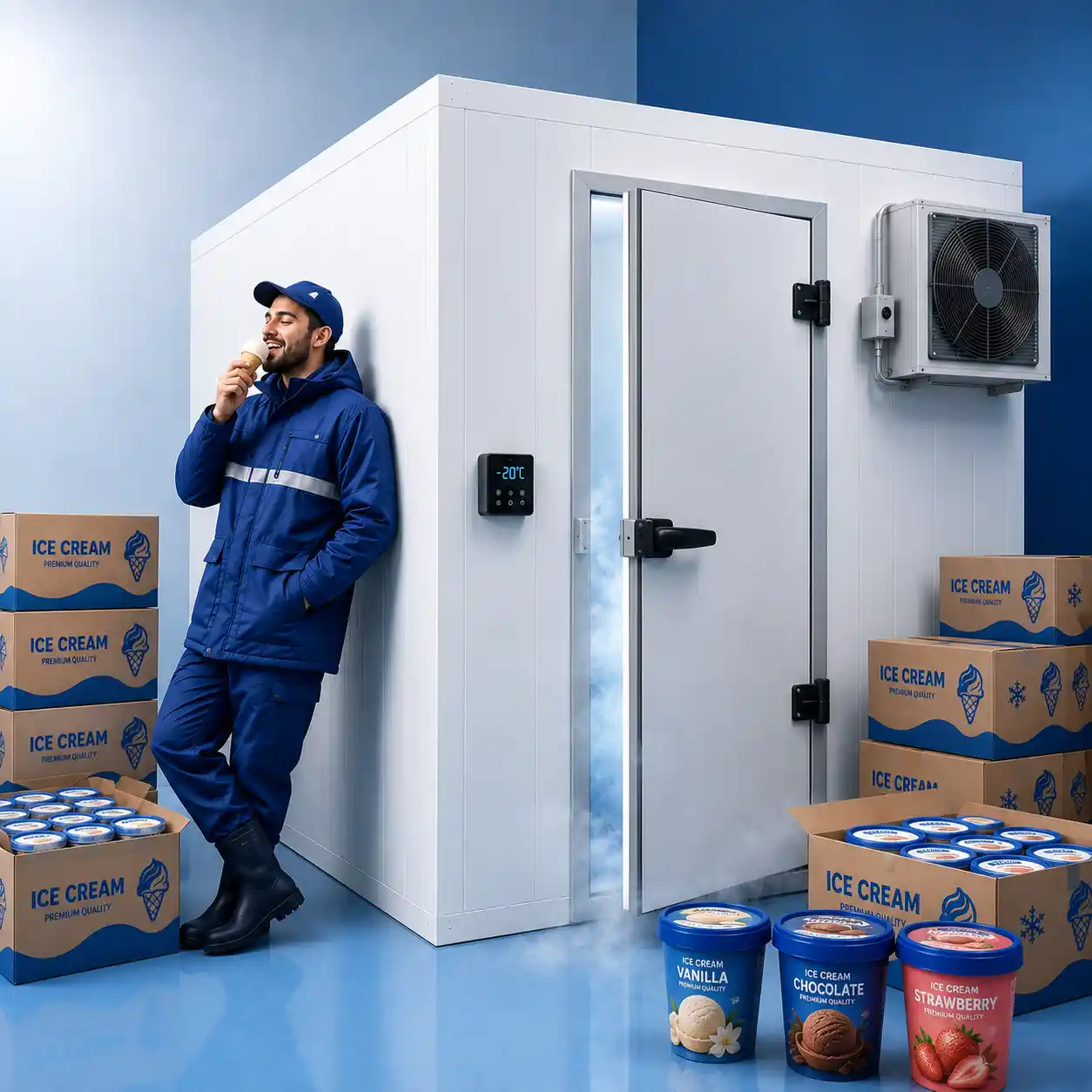
Built to Stay Below the Point Where Texture Changes
An ice cream cold room isn’t a standard freezer room set colder — it’s engineered from the ground up to hold the product close to its glass transition point, where the unfrozen liquid inside becomes too viscous for water to migrate between crystals. ChillerRoom.ae designs every ice cream cold room around that principle, so the room resists temperature swings rather than simply reaching a low number once and drifting afterwards.
- Constant −25°C to −30°C, not just "frozen"
- 120mm–150mm PIR insulation for Gulf heat
- Hot gas defrost clears coils in 5–15 minutes, not 40
- Heated doors and pressure valves stop freezing shut

Why the Number Alone Isn't Enough
Two rooms can both read −25°C and still perform completely differently. What damages ice cream isn’t the average reading — it’s how far that reading swings during everyday disturbances, from stock loading to routine defrost cycles. A well-engineered cold room holds its set point through disturbance, not just at rest, and that’s the real difference between a room that protects texture and one that slowly wears it down.
The Other Variable Most Rooms Get Wrong
Humidity that’s too low pulls moisture out of packaging and speeds up freezer burn on any exposed product. Humidity that’s too high does the opposite — it builds frost on coils and shelving, cutting airflow and forcing the compressor to work harder than it should. ChillerRoom.ae targets relative humidity around 40–50% for ice cream storage, balancing packaging protection against frost buildup.
Every Stage of the Ice Cream Cold Chain
Ice cream moves through very different environments between production and the counter, and each stage puts a different demand on the room. ChillerRoom.ae builds around that demand rather than fitting every customer into one template.
Manufacturing & Production
Bulk storage for finished product, paired with rapid-hardening chambers that lock in texture straight off the production line.
Distribution & Logistics
Palletised, high-turnover cold storage built for forklift access and continuous loading — sized for 3PL providers moving stock daily.
Restaurants & Hospitality
Space-efficient walk-in freezer rooms for parlours, cafés, hotels, and supermarkets — matched to daily footfall rather than industrial volume.
Ice Cream Cold Room vs. Standard −18°C Freezer Room
An existing freezer room built for meat, poultry, or general frozen goods will keep ice cream frozen — it won’t keep it stable. The two builds diverge at almost every point in the specification.
| Ice Cream Cold Room | Standard Freezer Room | |
|---|---|---|
| Operating temperature | −25°C to −30°C | −18°C |
| Typical product | Ice cream, gelato, sorbet, frozen desserts | Meat, poultry, seafood, general frozen goods |
| Insulation | 120mm–150mm PIR/PUR | Thinner — not built for the same temperature differential |
| Defrost priority | Hot gas — protects against texture-damaging temperature swings | Electric defrost commonly acceptable |
| Underfloor heating | Required for continuous sub-zero operation | Situational |
| Risk if under-specified | Migratory recrystallization — grainy, unsellable texture | Freezer burn, slower quality decline |
What Goes Into an Ice Cream Cold Room
An ice cream cold room performs only as well as its individual components work together. Insulation, refrigeration, doors, heating, defrost, and monitoring each affect temperature stability and long-term product quality.
Insulated Panels
High-density PIR panels, 120mm to 150mm thick, resist heat transfer against 45°C+ ambient and hold −25°C to −30°C with minimal energy loss.
Hot Gas Defrost
Redirected compressor heat clears evaporator coils in 5–15 minutes instead of 40, keeping internal temperature stable through every defrost cycle.
Floor Heating
Glycol or electric heating beneath the slab keeps ground moisture from freezing, protecting the foundation from frost heave over years of operation.
Digital Monitoring
Continuous temperature logging and alarms track performance in real time, supporting Dubai's FoodWatch compliance requirements and enabling faster fault response across the site.
Cold Room Doors
Heated door frames and pressure-relief valves stop gaskets freezing shut and prevent the vacuum that builds as warm air contracts inside.
Refrigeration System
Low-GWP R448A and R449A refrigerant blends replace older, less efficient R404A systems, delivering stronger cooling capacity with reduced compressor strain.
Ice Cream Cold Room Technical Specifications
The full build specification for procurement and technical reference, alongside the component breakdown above.
| Component | Specification |
|---|---|
| Insulation panels | High-density PUR or PIR, 120mm–150mm, cam-lock jointed with sealed vapour barriers |
| Flooring | Insulated, non-slip flooring rated for pallet trucks and racking loads |
| Door system | Insulated hinged or sliding doors with 220V silicone frame heaters and heated pressure-relief valves |
| Refrigerant | R448A / R449A — see UAE-specific reasoning below |
| Defrost system | Hot gas defrost — 5–15 minutes, versus 20–40 for electric resistive defrost |
| Humidity | Maintained around 40–50% to limit frost buildup without over-drying product |
| Monitoring | Digital temperature logging, aligned with Dubai’s FoodWatch requirements |
From Design to Operational Room
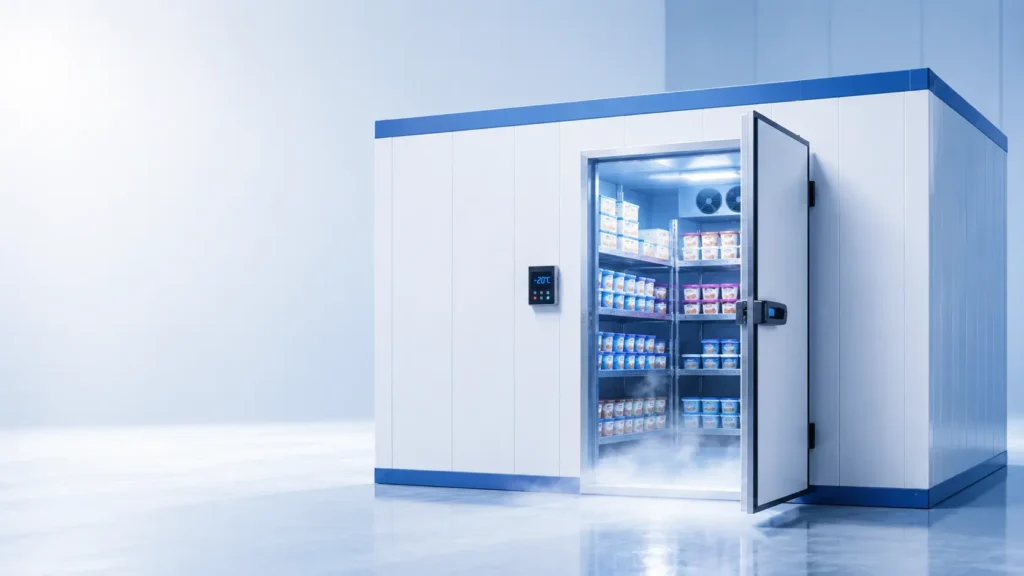
Once the cooling load calculation and design are confirmed, ChillerRoom.ae handles the full installation on site — panel erection, door alignment, refrigeration piping, evaporator and condenser placement, electrical controls, defrost configuration, and pressure testing. Every unit is commissioned and temperature-verified before handover, with key components positioned for easy access when routine service is needed. This page covers ice cream cold rooms specifically, built for −25°C to −30°C storage. For general frozen goods at −18°C, visit our freezer room manufacturers in UAE page. For chilled storage above 0°C, see our cold room manufacturers in UAE page.
Four Ways We Engineer for UAE Heat
A cold room built for a mild climate fails fast once Gulf summer heat arrives. Every ChillerRoom.ae ice cream cold room is engineered around local heat, dust, and humidity from day one.
High-Ambient Cooling
R448A and R449A hold their critical temperature above 83°C, giving real headroom against Dubai's 70°C summer condensing temperatures — where R404A struggles.
Dust & Sand Resistance
Condenser placement and cleaning access are planned around Gulf sandstorms, so clogged fins never spike pressures or strain the compressor.
Frost Heave Defence
Desert soil beneath the slab holds moisture that freezes and expands. Underfloor heating keeps the ground stable, preventing structural damage over time.
Backup Power Systems
Generator and UPS integration protect stock through power interruptions, critical at −25°C where even a short warm-up accelerates quality loss.
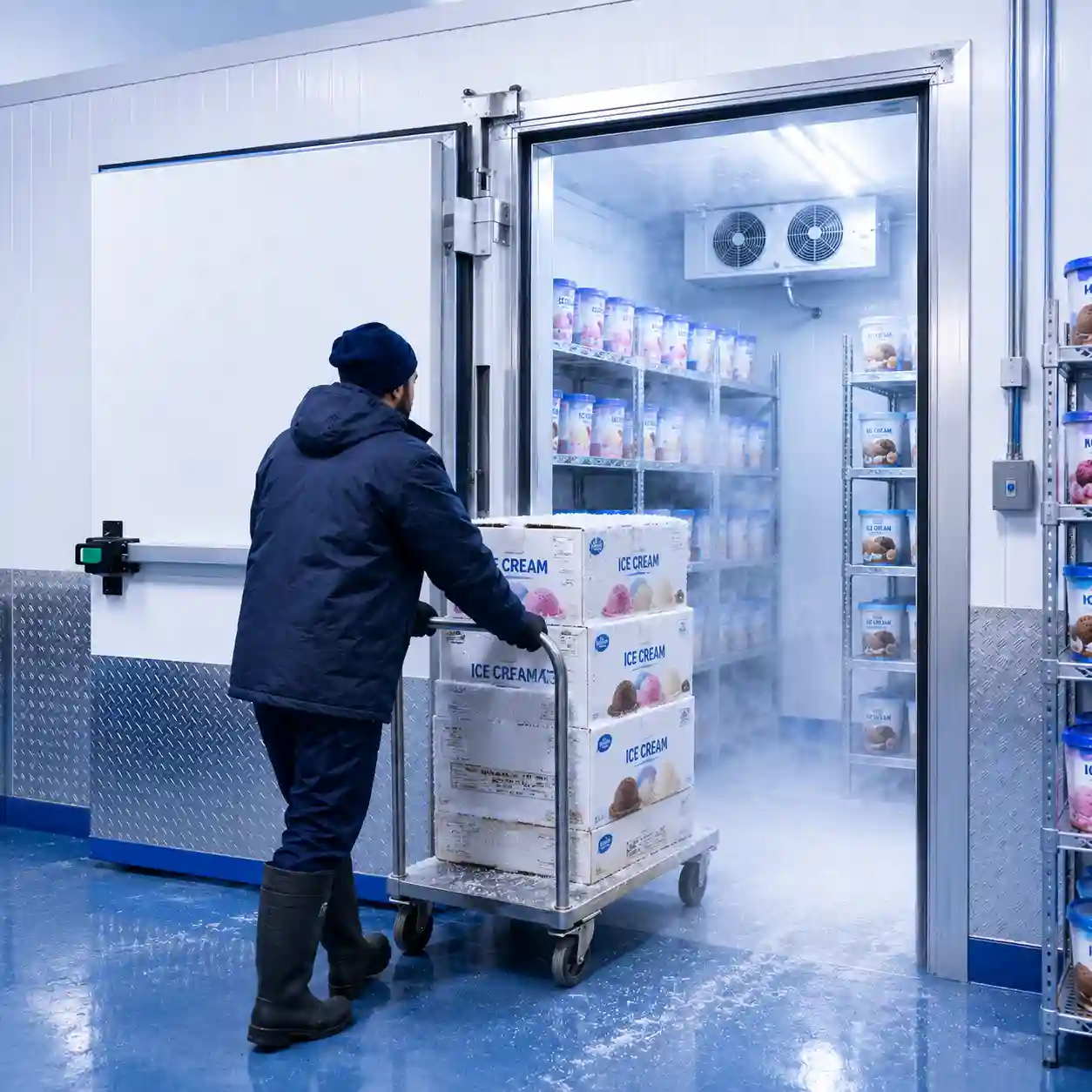
Built to Keep Running Through Peak Demand
Ice cream demand in the UAE peaks with the heat — exactly when a cold room is under the most strain and has the least room for error. Components rarely fail outright; they drift quietly, and a warmer room or softer scoop is often the first sign something’s wrong. ChillerRoom.ae recommends a maintenance programme for every installation: scheduled temperature and humidity checks, seasonal servicing ahead of peak demand, and prompt attention to any deviation before it reaches the stock.
Engineered to Recover Fast, Not Just Run Cold
Ice cream cold rooms in the UAE rarely stay undisturbed. On a busy day, the door may open again and again while staff move trays, tubs, or bulk stock in and out. Every opening lets warm air in, and the room has to recover fast.
When the system isn’t planned well, small problems appear — frost near the door, ice buildup, longer recovery time, and higher electricity use. ChillerRoom.ae reviews door placement, airflow, insulation, refrigeration capacity, and outdoor unit access before finalising the ice cream cold room design.
Frequently Asked Questions
A constant −25°C to −30°C for standard bulk storage. The UAE’s legal maximum for frozen food generally is −18°C, but that’s a food-safety ceiling, not a quality standard for ice cream specifically.
No — both terms describe the same build: a deep-freeze environment engineered to hold −25°C to −30°C. The terms are used interchangeably across the industry.
If it’s built for general frozen goods at −18°C, it will keep ice cream frozen but not texturally stable — expect gradual quality loss from repeated heat-shock cycling.
It comes down to throughput and site, not a fixed template — a proper cooling load calculation, factoring in product volume, door-opening frequency, and site conditions, determines the right build.
Cost depends on size, insulation spec, refrigeration capacity, and site conditions. ChillerRoom.ae provides a cooling load calculation and itemised quote once we know your storage volume and location.
Yes — ChillerRoom.ae designs, manufactures, and installs ice cream cold rooms across all three emirates and the wider UAE, for manufacturers, distributors, and hospitality and retail businesses alike.
Freshly churned ice cream is blast-frozen at −35°C to −40°C immediately after production to lock in fine ice crystals, before moving into standard −25°C to −30°C bulk storage. ChillerRoom.ae builds dedicated hardening rooms alongside standard storage for manufacturers who need both.
Ready to Build Your Ice Cream Cold Room?
Tell us your storage volume, throughput, and site location. ChillerRoom.ae will design, manufacture, and install an ice cream cold room engineered for UAE conditions — from compact walk-ins to industrial multi-room facilities — across Dubai, Abu Dhabi, Sharjah, and the wider UAE.