Cold Storage for Fruits and Vegetables in UAE: The Complete Guide
Senior Refrigeration Engineer · ChillerRoom.ae
Updated 2026 · Estimated read time: 08–15 min
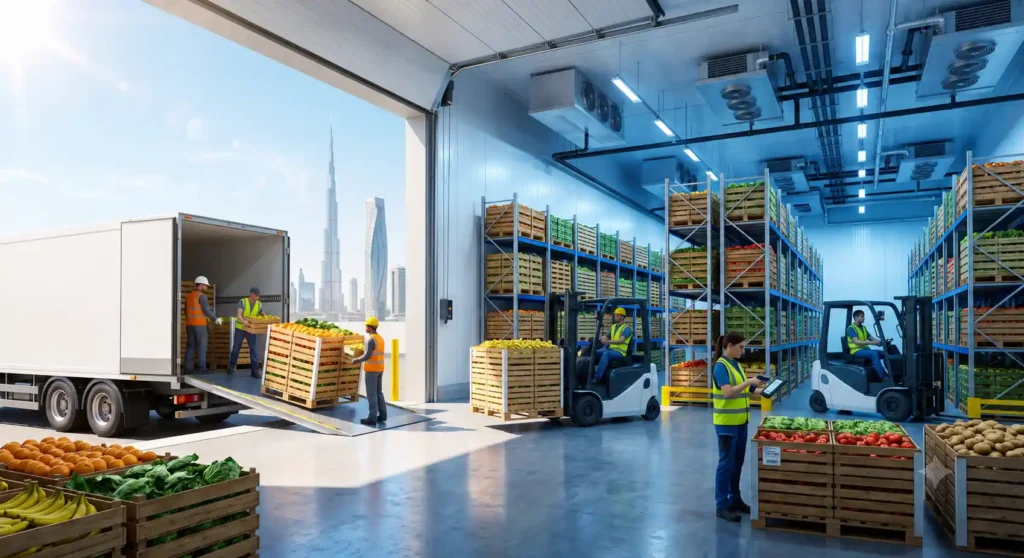
Quick answer: Cold storage for fruits and vegetables keeps produce fresh by holding it at the right temperature (usually 0–15 °C) and the right relative humidity (65–98%, depending on the crop), while controlling airflow and ethylene gas. In a climate as hot as the UAE’s, a properly engineered cold room is what stands between produce that lasts a few days and produce that stays market-ready for weeks — or, for crops like apples and potatoes, months.
If you handle fresh produce anywhere in Dubai, Abu Dhabi, or Sharjah — as an importer, a wholesaler, a supermarket buyer, a hotel kitchen, or a farm — you already know the frustration. A pallet looks perfect on Monday, and half of it is soft, spotted, or wilting by Thursday. The temperature reading on the wall said everything was fine. So what went wrong?
Usually, the answer is that temperature was only part of the story. Fruits and vegetables are still alive after harvest. They breathe, they sweat out moisture, and many of them quietly release a ripening gas called ethylene that spoils whatever is sitting next to them. Get any one of those factors wrong, and you get shrinkage, mould, or chilling injury — even inside a cold room that’s technically “cold enough.” Get all of them right, and you protect both quality and your margin at the same time.
This guide breaks down exactly what each type of produce needs and how to build cold storage around those needs. At ChillerRoom.ae, we design and manufacture cold rooms tuned to these conditions every day, so we’ve written this the way we’d actually explain it to a client sitting across the table.
Table of Contents
Why Cold Storage Matters so much in the UAE
Start with the obvious problem: heat. Summer here regularly pushes past 40 °C, and heat is hard on fresh produce. The warmer it gets, the faster produce breathes, and the faster bacteria and fungi take hold. A tomato that would hold for two weeks somewhere temperate can go off in a matter of days once it’s sat in a hot delivery van or a back-of-house storeroom.
What a cold room does is slow all of that down. It lowers how fast the produce respires, holds back bacteria and mould, keeps moisture from escaping, and delays the enzyme activity that softens fruit and fades its colour. You’re not really stopping decay. You’re buying time. And in a market that leans this heavily on imported produce coming through the ports and wholesale hubs of Dubai, Abu Dhabi, and Sharjah, time is money. Good refrigeration also takes the pressure off the supply chain. Instead of selling produce cheaply before it turns, a business can hold stock through a seasonal glut and release it later, when prices and demand have come back up.
So cold storage for fruits and vegetables isn’t a luxury add-on here. In this climate, it’s the baseline infrastructure that makes a produce business viable at all.
Ideal Temperature and Humidity for Fruits and Vegetables
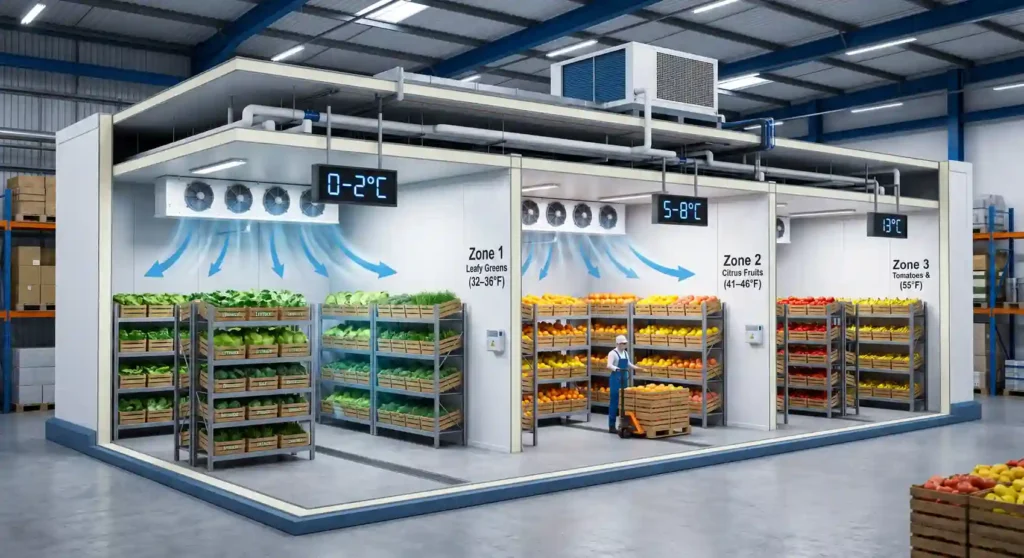
Here’s where a lot of operators go wrong: they treat “cold” as one setting. It isn’t. Produce sorts into three broad temperature bands, and mixing them carelessly is how you damage half your stock.
At the cold end, most leafy greens and temperate fruits want to sit right around 0 °C. In the middle, citrus and subtropical fruits prefer something gentler, roughly 5–9 °C. And at the warm end sit the chilling-sensitive crops — bananas, tomatoes, cucumbers — which actually suffer damage below about 10 °C. Put a banana in a fridge that’s perfect for lettuce, and you’ll ruin it.
These are the practical commercial values we design around, reconciled from horticultural references — including published postharvest storage guidelines — and real cold-room experience.
The table below pulls the working ranges together in one place. These are the practical commercial values we design around, reconciled from horticultural references and real cold-room experience.
| Produce | Temperature | Relative Humidity | Typical shelf life |
|---|---|---|---|
| Apples | −1 to 4 °C | 90–95% | 4–12 months (controlled atmosphere) |
| Pears | −1 to 2 °C | 90–95% | up to 4 months |
| Grapes | −0.5 to 0 °C | 90–95% | 1–6 months |
| Oranges & citrus | 4–8 °C to 4–9 °C | 85–90% | several weeks |
| Mango | 10–13 °C | 85–90% | 2–4 weeks |
| Avocado (Hass) | 4–5 °C | 85–90% | up to 4 weeks |
| Banana (green storage) | 13–15 °C | 90–95% | — |
| Watermelon (whole, commercial) | 8–10 °C | 85–90% | up to 2–3 weeks |
| Tomatoes | 10–13 °C | 85–90% | 2–3 weeks |
| Leafy greens | 0–2 °C | 95–98% | days to 2 weeks |
| Broccoli & cauliflower | 0–4 °C | 90–100% | 7–14 days |
| Carrots & root vegetables | 0–4 °C | 90–95% | several months |
| Potatoes (table) | 3–4 °C | 90–95% | 6–11 months |
| Onions | 0–4 °C | 65–70% | 6–9 months |
| Mushrooms | 0–4 °C | 85–95% | 8–11 days |
| Dry fruits & nuts | 0–5 °C (or freeze at −18 °C) | below 65% | up to 12 months |
Keep this table handy — it’s the quickest sanity check when you’re planning what goes in which room.
Cold Storage for Vegetables
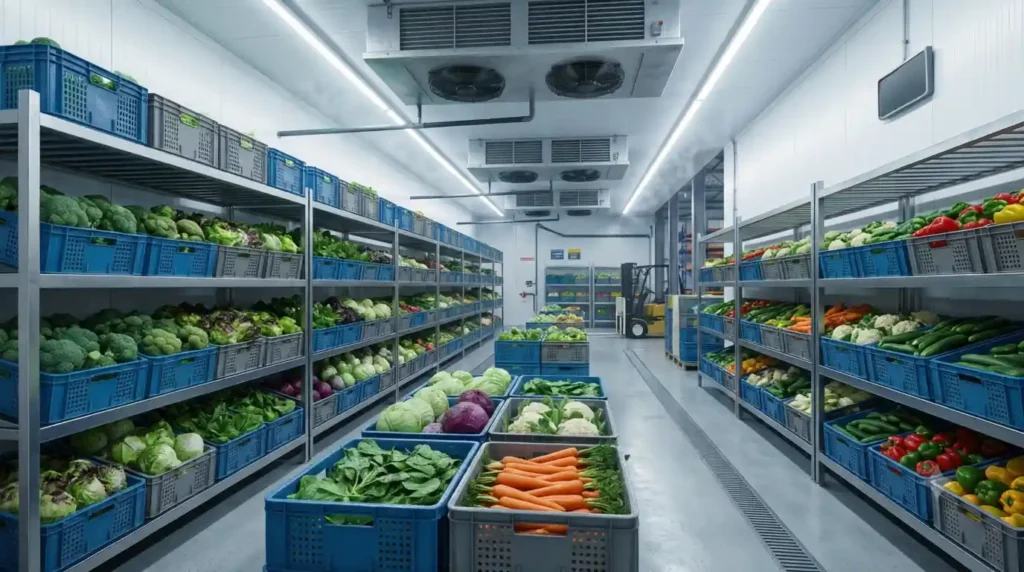
Most vegetables like it cold and humid, and that combination trips people up because our instinct is to keep storage dry. Vegetables are mostly water, and once they lose it, they wilt, so the goal is to keep moisture in the produce and out of the air’s way of escaping.
Leafy greens — lettuce, spinach, kale — are the thirstiest. They want 0–2 °C and humidity all the way up to 98%. Let that humidity slip, and they’ll be limp by the next day. The cruciferous vegetables — broccoli, cauliflower, cabbage — are a tougher bunch, and they hold up really well close to freezing. Carrots, beets, radishes, and other root vegetables will keep for months at 0–4 °C. One thing worth knowing with those: trim the leafy tops off before you store them. Left on, the tops keep drawing moisture out of the root long after it’s been pulled from the ground.
Across the board, store vegetables unwashed in perforated, breathable crates. Washing traps surface water that turns into a mould nursery, and sealed containers trap condensation. You want air moving gently around everything.
Small cold storage for vegetables
Not everyone needs a distribution warehouse, and it’s a common mistake to over-buy refrigeration you’ll never fill. A neighbourhood produce shop, a farm-to-table restaurant, or a small grower usually just needs a compact walk-in room or a monoblock unit sized for daily rotation.
That’s exactly the kind of small cold storage for vegetables ChillerRoom.ae builds — matched to your actual throughput, insulated with high-density PU or PIR panels so it holds temperature without running your electricity bill through the roof. Right-sizing here matters more than people expect; an oversized room cycles inefficiently and struggles to hold humidity, while a right-sized one stays stable and cheap to run.
Cold Storage for Fruits
Fruits follow the same three-band logic as the temperature ranges above. Temperate fruits — apples, pears, grapes, cherries — are the champions of cold storage, tolerating −1 to 2 °C and lasting the longest of any category. Subtropical and tropical fruits like citrus, mangoes, and avocados are the sensitive ones; drop them too low, and they develop chilling injury, so they want a milder 2–10 °C. And the truly delicate, sensitive fruits — bananas above all — need to stay warm at 12–15 °C.
Whatever the fruit, the humidity of 85–95% is constant. Fruit that dries out shrivels and loses saleable weight, and weight loss is straight lost revenue for anyone selling by the kilo. This is why serious cold storage for fruits pairs refrigeration with humidity control rather than treating them as separate problems.
Banana Cold Storage and Banana Ripening Cold Storage
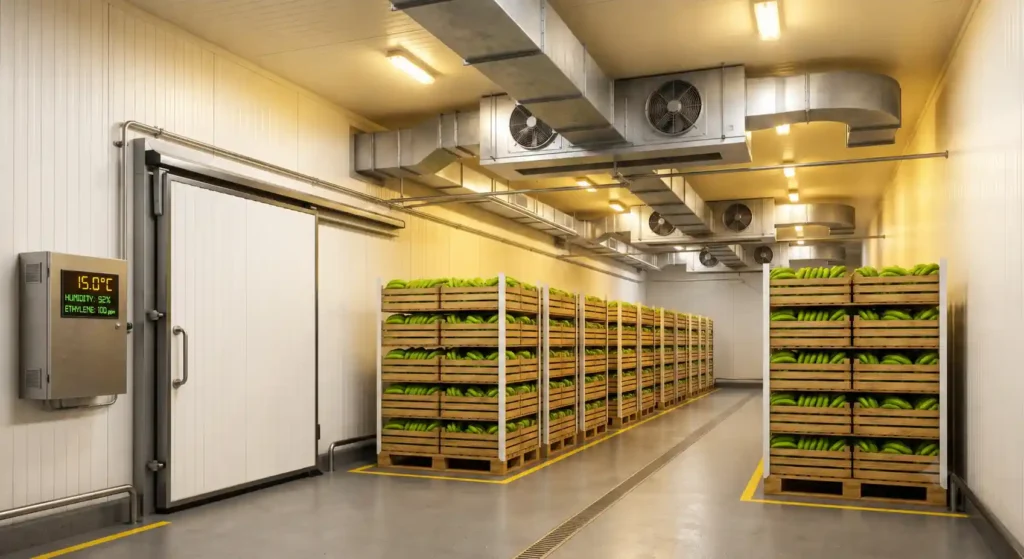
Bananas deserve their own section because they’re genuinely a two-stage crop, and it’s one of the most specialised jobs in the whole produce cold chain.
Bananas are harvested green and shipped green. To turn them yellow and ready for sale, you need banana ripening cold storage — a sealed chamber where ethylene gas is injected at 100–150 ppm for the first 24–48 hours. During ripening, the fruit’s pulp is held around 14–18 °C at 85–95% humidity, with strong air exchange (25–30 changes an hour) to clear out the carbon dioxide the fruit produces and keep the colour breaking evenly across the whole batch. Too cold and ripening stalls; too warm and you get poor texture and blotchy colour.
Once the fruit reaches the colour you want, it moves into banana cold storage proper, held at 13–15 °C to keep it in that marketable state. The golden rule: never take bananas below 13 °C. Colder than that, and they suffer chilling injury — the peel greys, and the natural ripening process simply shuts down. A dedicated ripening-and-storage chamber is one of the higher-value cold rooms we build, precisely because getting the gas, temperature, and airflow right is not something a basic walk-in cooler can do.
Tomato Cold Storage
Tomatoes are the poster child for “the fridge is too cold.” Proper tomato cold storage sits at 10–13 °C with 85–90% humidity. Almost everyone gets this wrong. People do it at home, and — more worryingly — it happens in some commercial storerooms too, where tomatoes sit at a standard chill of 2–5 °C. That’s cold enough to cause chilling injury. The cell membranes start to break down, the flesh goes mealy and mushy, and the aroma compounds that actually make a tomato taste like a tomato just disappear. What you’re left with looks fine on the shelf but tastes like nothing. Watch your airflow as well, and keep it even, or you’ll get warm, humid pockets where mould gets a foothold.
Potato Cold Storage
Potato cold storage runs at 3–10 °C and 90–95% humidity, always in the dark. The exact temperature depends on what the potatoes are for: table potatoes headed for retail keep best at 3–4 °C, while processing potatoes destined for fries and chips are held warmer at 8–10 °C. That warmer range matters — store potatoes for processing too cold, and their starch converts to sugar, which then browns badly during frying.
There’s also a step people skip: curing. Freshly harvested tubers should sit at 15–20 °C with high humidity for 10–14 days first, which heals harvest wounds and thickens the skin, before you gradually cool them down to storage temperature. Rush straight to the cold, and you lock in damage.
Onion Cold Storage
Onions break the high-humidity rule completely, and this is where a lot of shared cold rooms go wrong. Keep onions in cold storage at 0–4 °C, but bring the humidity right down to 65–70%. Damp air makes them rot and sprout, so the same moisture that keeps your lettuce alive is what finishes off your onions. Get it right, though, and well-cured pungent onions will hold for six to nine months.
One more thing: keep onions well away from potatoes and apples. Onions absorb moisture and swap ethylene with those crops, and the interaction spoils everything involved. If you’re storing all three, they belong in separate zones.
Mushroom Cold Storage
Mushroom cold storage calls for 0–4 °C at 85–95% humidity, with rapid pre-cooling right after harvest to pull out the “field heat” that respiration generates. Do it properly, and you stretch a mushroom’s shelf life from a fragile few days out to 8–11 days — a huge difference for a crop that’s notoriously quick to spoil.
Broccoli Cold Storage
For broccoli cold storage, aim for 0 °C and a very high humidity of 90–100%, cooling the heads with water immediately after harvest to lock in crispness and vitamin content. Critically, keep broccoli away from ethylene-producing fruits like apples and pears — that ethylene turns the tight green florets yellow fast, and yellow broccoli is unsellable.
Avocado and Watermelon Cold Storage
Avocado cold storage depends entirely on ripeness. Green, unripe fruit holds at 5–13 °C, while eating-ripe fruit needs to come down to 2–4 °C, both at 85–90% humidity. The non-negotiable here is a steady cold chain — avocados hate temperature swings, and fluctuations bring on chilling injury quickly. For long export runs, controlled-atmosphere storage slows respiration further and buys extra weeks.
Watermelon is simpler but counterintuitive. For commercial handling, whole watermelons are held at a steady 8–10 °C — cold enough to slow spoilage, but not so cold that it triggers the pitting and off-flavours you get when intact fruit drops much lower. The moment a watermelon is cut, though, that changes: cut watermelon must be refrigerated immediately at 1–3 °C and used within a few days before the exposed flesh spoils.
Dry Fruit, Nuts, Seeds, Grains, and Pulses
Everything above wanted moisture. This group wants the opposite. Dry commodities spoil in humidity, so the whole approach flips.
For Dry fruit cold storage and cold storage nuts — including pine nuts cold storage — keep humidity below 65% and refrigerate at 0–5 °C, or freeze at −18 °C for long-term storage. The reason to go cold with nuts is their high oil content: those natural oils turn rancid at room temperature, and refrigeration or freezing is the only thing that reliably stops it. High-fat varieties like pine nuts, macadamias, and Brazil nuts are the quickest to go off, so they benefit most.
Seed cold storage is about protecting germination viability, which cool, dry, stable conditions preserve far longer than a warm shed ever could. And cold storage of grains along with cold storage for pulses is mostly a defence against pests and moisture-driven spoilage, keeping large volumes stable across long holding periods. One habit worth building into your process: always let frozen stock come back up to room temperature before you open the container, or condensation will form on the cold surface and reintroduce the very moisture you worked to keep out.
Managing Ethylene Gas
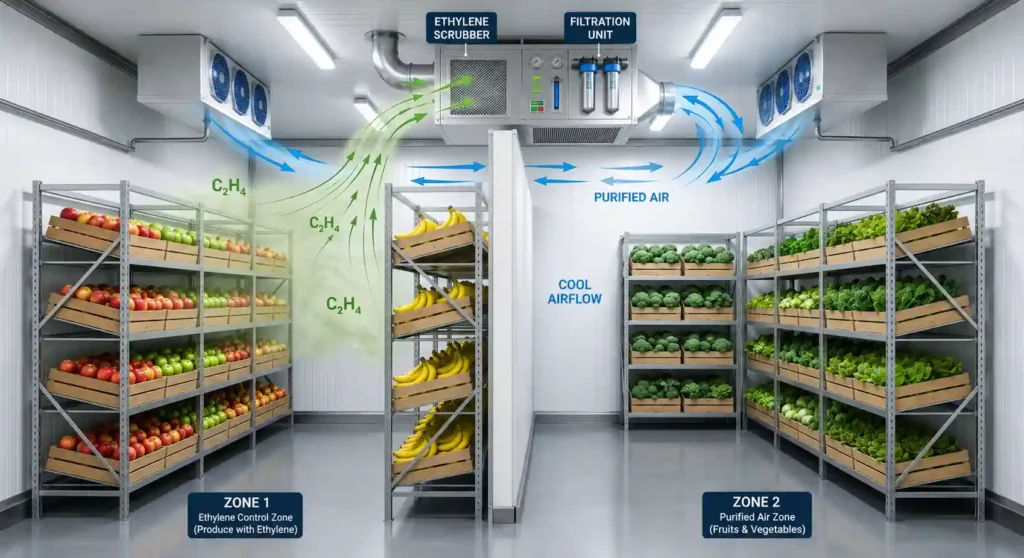
This is the invisible factor behind a huge share of “I don’t understand why it spoiled” losses. Many fruits — apples, bananas, tomatoes — give off ethylene, a natural ripening hormone. Ethylene-sensitive produce like leafy greens, carrots, and broccoli reacts to even small amounts by over-ripening and yellowing.
The fix is simple in principle: separate the ethylene producers from the ethylene-sensitive items, either with distinct storage zones or with ethylene scrubbers in mixed rooms. It’s one decision, but it quietly prevents a large slice of avoidable waste. When we design multi-commodity rooms for UAE clients, ethylene management is one of the first things we plan around, not an afterthought.
HACCP Cold Storage and UAE Compliance
If you’re storing food commercially in the Emirates, compliance isn’t optional, and cold storage sits at the heart of it. A proper HACCP cold storage setup treats temperature as its primary Critical Control Point (CCP). Chilled goods stay at or below 5 °C, and frozen goods at −18 °C or colder. Here’s the part people tend to underestimate, though: that temperature has to be monitored properly. It needs calibrated equipment and a continuous log, not someone walking past and glancing at a dial now and then.
The rest of the rules are simple enough, but they’re strict. Food goes on raised pallets or racks, never straight on the floor. Older stock moves first, following First-In-First-Out (FIFO). Raw and ready-to-eat products stay separated so nothing cross-contaminates. And you keep dated logs of your temperatures, calibrations, and cleaning. Every food business in Dubai answers to Dubai Municipality on this, Abu Dhabi to ADAFSA (the Abu Dhabi Agriculture and Food Safety Authority), and Sharjah to its own authorities — the standards apply across all three. The smart move is to build compliant monitoring and documentation into the cold room from day one. Retrofitting it after an inspector flags a gap always costs more.
Choosing The Right Cold Room
Strip everything back, and consistent temperature and humidity come down to four things working together: a reliable refrigeration unit, correctly specified insulated panels, a tightly sealed door, and an accurate control system. Weaken any one and the other three can’t compensate.
High-density PU or PIR panels, typically 60–150 mm thick depending on how cold the room needs to be, do the heavy lifting on insulation and energy loss. For the refrigeration itself, monoblock and scroll-compressor units suit small to mid-scale rooms, while larger facilities with bigger thermal loads move up to semi-hermetic or screw-compressor systems. Layer in humidifiers or dehumidifiers to hit each crop’s specific humidity target, and always plan power backup so a grid outage doesn’t undo weeks of careful storage in a single hot afternoon.
ChillerRoom.ae designs all of these elements as one matched system, built around the produce you actually handle rather than a generic spec sheet.
Frequently Asked Questions
There’s no single number, because it depends on the crop. Most leafy vegetables and temperate fruits do best around 0–2 °C. Citrus and subtropical produce prefer a milder 5–9 °C, and chilling-sensitive items like tomatoes sit around 10–13 °C, while bananas need to stay warmer still, at 13–15 °C.
You can, but two rules matter. Keep ethylene-producing fruits away from ethylene-sensitive vegetables, and put items with similar temperature and humidity needs together.
A home fridge runs at 2–5 °C, which is too cold for tomatoes. That chill injures the fruit, breaking down its cell membranes and stripping out the compounds that give a tomato its flavour.
It really comes down to the crop. Leafy greens might give you a few days to a couple of weeks, while apples and potatoes can hold for months when the conditions are right.
Onions and garlic are the odd ones out. Where most produce wants high humidity, these two need it low — around 65–70% — to keep mould, rot, and sprouting at bay.
Yes — refrigeration at 0–5 °C or freezing at −18 °C stops the natural oils in nuts from turning rancid and keeps dry fruit fresh for up to a year.
Talk to ChillerRoom.ae
Whether you need a small cold room for a produce shop or a large multi-commodity facility serving wholesale distribution across Dubai, Abu Dhabi, and Sharjah, ChillerRoom.ae designs cold storage for fruits and vegetables matched to your produce, your volume, and your compliance obligations. Get in touch for a tailored quote, and we’ll spec the room around what you actually store.