
Vegetable Cold Storage Manufacturers UAE
Engineered cold rooms that hold the exact temperature, humidity, and airflow your produce needs — designed, manufactured, and installed by ChillerRoom.ae, a leading commercial and industrial vegetable cold storage manufacturer and supplier across Dubai, Abu Dhabi, and Sharjah.
Keep Every Crate Market-Ready
Vegetables are unforgiving to store. They’re mostly water, they keep breathing after harvest, and in a vegetable cold room that’s a few degrees off or a little too dry, they wilt, spot, and shed saleable weight within a day. In summer heat that regularly tops 40°C, there’s almost no margin for error.
A room that’s simply “cold” doesn’t solve it. A proper vegetable cold room has to hold the right humidity and move air evenly, or produce still spoils inside a running cold room. That’s the part ChillerRoom.ae engineers in from the start.
As vegetable cold storage manufacturers, we design, build, and install every vegetable chiller room around what you actually store — insulated with high-density PU or PIR panels, matched with the right refrigeration and humidity control, and sized so it runs efficiently for years rather than fighting the UAE climate.
- Walk-in, monoblock, and multi-commodity cold rooms
- Precise temperature and humidity control per crop
- Built for UAE heat, dust, and daily door traffic
- HACCP-ready monitoring and layout
Small Cold Storage for Vegetables
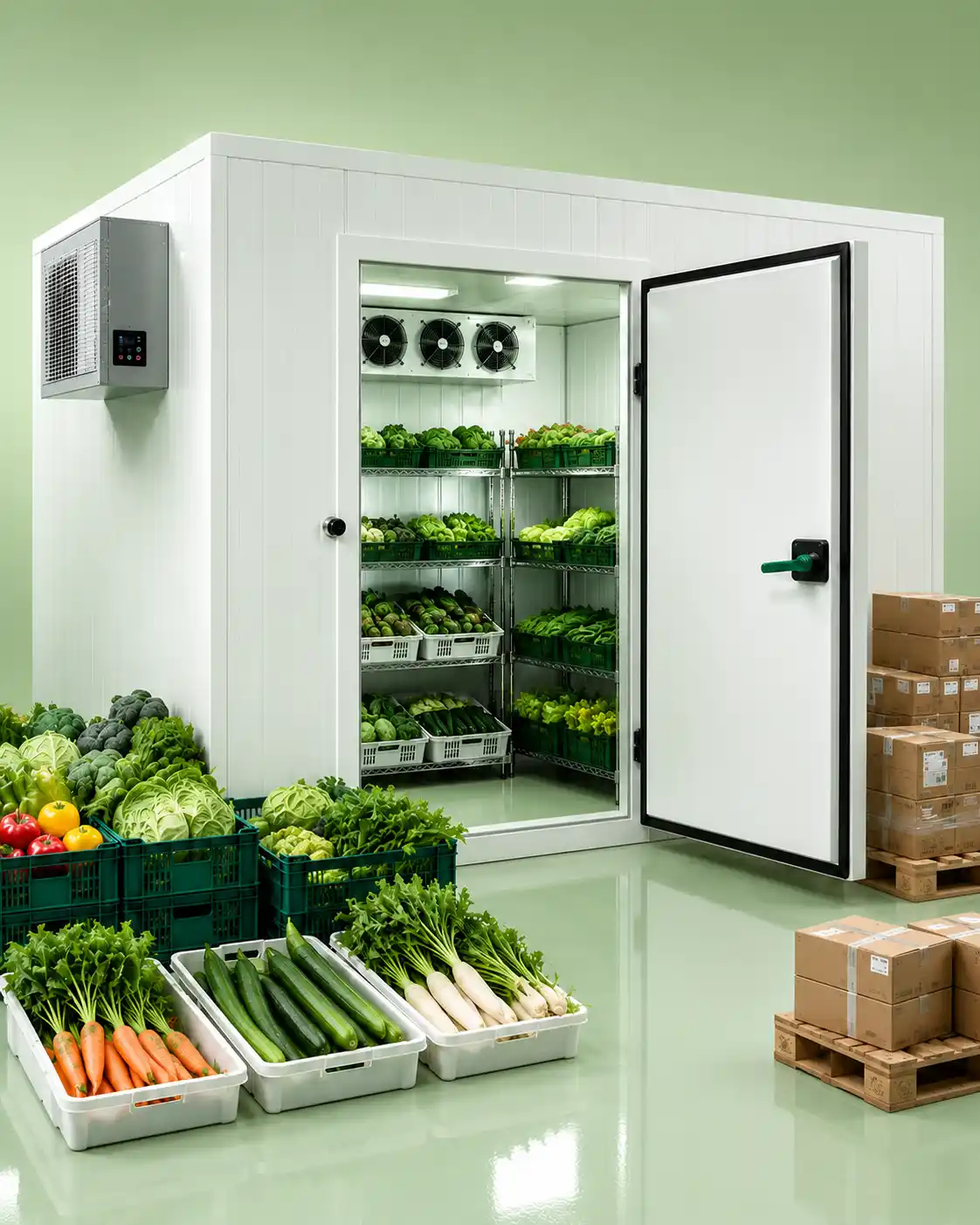
Not every business needs a distribution warehouse, and over-buying refrigeration you’ll never fill is a costly mistake. A produce shop, a farm-to-table restaurant, or a small grower usually just needs a compact walk-in or monoblock vegetable chiller room sized for daily rotation. ChillerRoom.ae builds small cold storage for vegetables matched to your real throughput. Right-sizing matters more than people expect — an oversized room cycles inefficiently and struggles to hold humidity, while a right-sized one stays stable and cheap to run.
HACCP-Ready by Design
If you store food commercially in the UAE, compliance isn’t optional. Every vegetable cold room we build can be specified for HACCP cold storage from day one — calibrated, continuously logged temperature monitoring as the primary control point, raised racking to keep produce off the floor, and layouts that support FIFO rotation and raw/ready-to-eat separation. Food businesses across Dubai (under Dubai Municipality), Abu Dhabi (under ADAFSA, the Abu Dhabi Agriculture and Food Safety Authority), and Sharjah all answer to these standards. Building it in upfront costs far less than retrofitting after an inspection flags a gap.
Which Setup Fits Your Business?
For commercial and industrial distributors and logistics yards moving mixed produce at volume, with zoned temperature and humidity and layouts built for fast loading.
Produce Retail & Food Service
For shops, supermarkets, and restaurants needing daily-access chilled storage that keeps greens, tomatoes, and roots market-ready with frequent door traffic.
Farms & Growers
For small and mid-scale growers needing compact, right-sized vegetable cold rooms to hold harvests, cut post-harvest loss, and store through seasonal price swings.
Wholesale & Distribution
For distributors and logistics yards moving mixed produce at volume, with zoned temperature and humidity and layouts built for fast loading.
Which Vegetable Cold Room Fits Your Operation
The right build depends on how much you store, how often you access it, and whether you’re mixing produce types.
| Cold Room Type | Best For | Typical Users |
|---|---|---|
| Walk-in Vegetable Cold Room | Daily-access chilled vegetable storage with room to move stock | Supermarkets, restaurants, distributors |
| Monoblock Vegetable Chiller Room | Compact, plug-and-run storage in tight spaces | Produce shops, cafés, small farms |
| Multi-commodity Cold Room | Mixed produce needing separate temperature and humidity zones | Wholesalers, industrial distributors, caterers |
For most UAE sites, the final design comes down to your product mix, daily loading pattern, door-opening frequency, and available space — which is exactly what we spec around.
Designed Around Each Vegetable Group
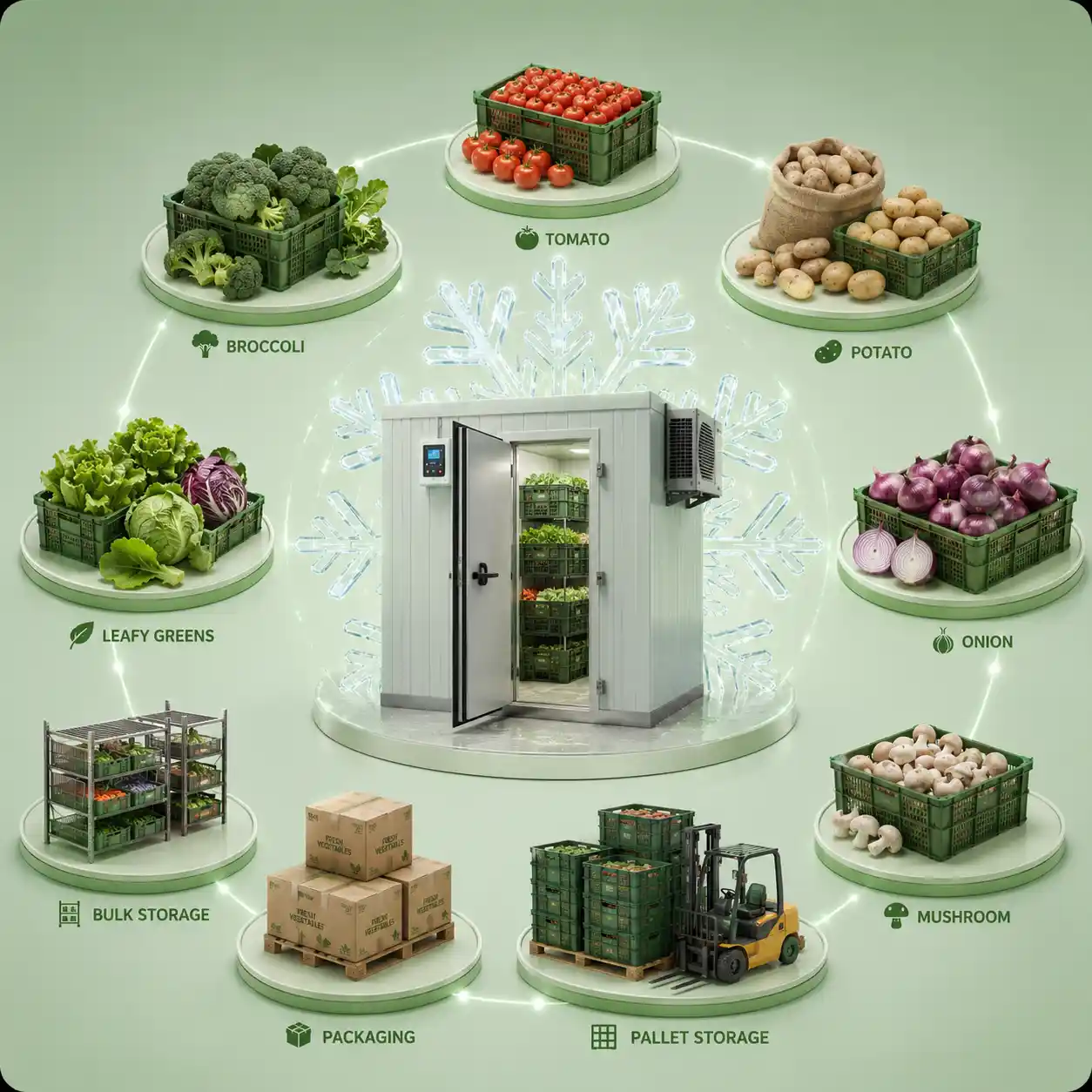
Different vegetables want different settings, and mixing them carelessly is how operators lose half a room’s stock. We design each vegetable cold room around the group your product belongs to. For the full crop-by-crop breakdown with shelf-life data, see our complete guide to cold storage for fruits and vegetables in the UAE.
Leafy Greens
Lettuce, spinach, kale. 0–2°C at 95–98% humidity — the thirstiest group, quick to wilt if humidity slips.
Cruciferous
Broccoli, cauliflower, cabbage. Broccoli cold storage in particular needs 0–4°C at 90–100% humidity, held close to freezing.
Root Vegetables
Carrots, beets, radishes. 0–4°C at 90–95% humidity. Potatoes need 7–10°C with ventilation to prevent sprouting.
Onions
The exception. Onion cold storage stays cold at 0–4°C but dry, at 65–70% humidity, or bulbs rot and sprout.
Tomatoes
Warmer than most expect — cold storage for tomato sits at 10–13°C at 85–90%. Standard fridge chill turns them mealy.
Mushrooms
Mushroom cold storage needs 0–4°C at 85–95% humidity, with fast pre-cooling to stretch shelf life past a week.
Why Vegetable Cold Storage Needs More Than Cold
A basic cold room just drops the temperature and stops there. For vegetables in the Emirates, that’s rarely enough — which is why produce still spoils in rooms that read “cold enough” on the wall. Three things decide whether your vegetables actually last.
Crop-Matched Humidity
Leafy greens need 95%+ to stay crisp; onions and potatoes need it lower or they rot. One fixed setting can't serve both.
Ethylene Separation
Sensitive crops like leafy greens and broccoli yellow fast near ripening gas. We plan zoning or scrubbing for mixed loads.
Even Airflow
Still, humid corners are where mould starts. Proper evaporator placement keeps every crate at the same temperature.
Less Waste
The payoff: less shrinkage, and the freedom to hold stock through a glut instead of selling cheap before it turns.
Vegetable Cold Room Installation in UAE
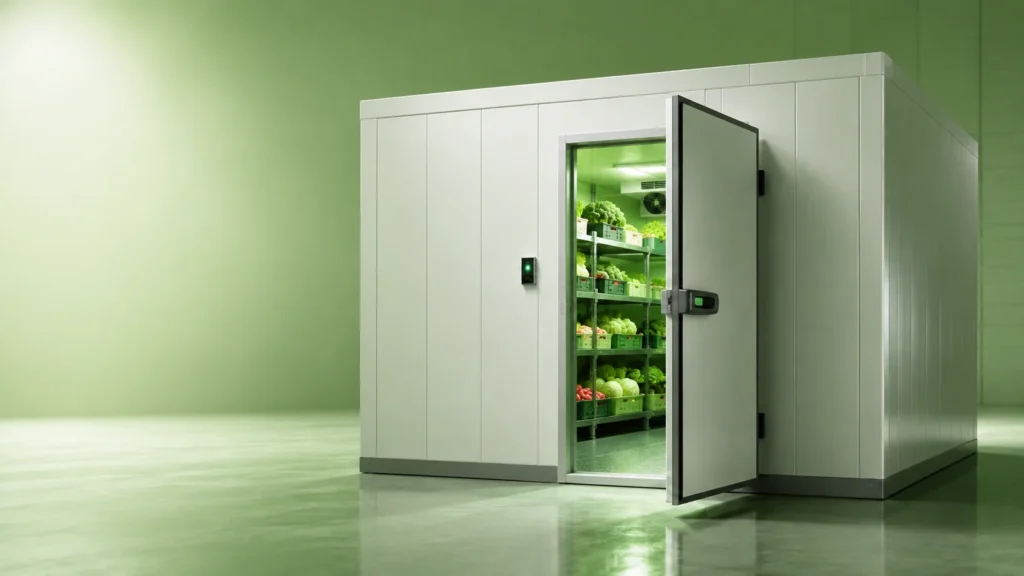
Every vegetable cold room starts with your produce, not a catalogue. We check what you store, the temperature and humidity each crop needs, your volume, site access, and available power. From there ChillerRoom.ae, as your vegetable cold storage manufacturer and supplier, specs the refrigeration capacity, insulation, airflow layout, humidity control, doors, shelving, and monitoring — the full system, matched to what actually goes inside. Before install, your site should be ready with a level base, power connection, a drainage plan, and clear space around the refrigeration unit for airflow and servicing.
Frequently Asked Questions
Most leafy and cruciferous vegetables store best at 0–4°C, while chilling-sensitive crops like tomatoes stay warmer at 10–13°C. Onions and potatoes need cooler, drier conditions with lower humidity than most other vegetables.
Yes. We build small cold storage for vegetables — compact walk-in and monoblock units sized for daily rotation, so you’re not paying to cool space you don’t use.
Yes. Potato cold storage needs warmer, well-ventilated conditions than most root vegetables to prevent sprouting and unwanted sugar conversion — we design the room’s temperature and airflow specifically around that.
Mushroom cold storage runs at 0–4°C and 85–95% humidity, with fast pre-cooling after harvest to extend shelf life.
Yes. Every room can be specified with calibrated, logged temperature monitoring, proper racking, and a compliant layout to meet UAE food-safety standards.
They can, but items need similar temperature and humidity, and ethylene-sensitive produce must be kept away from ethylene producers. For mixed loads — including onion or potato alongside leafy crops — we design zoning.
We design, manufacture, and install vegetable cold storage across Dubai, Abu Dhabi, Sharjah, and the wider UAE.
Tell us what you store and roughly how much, and we’ll spec a vegetable cold room around it.
Yes. ChillerRoom.ae is a vegetable cold storage manufacturer and supplier, designing, manufacturing, and installing vegetable cold rooms across Dubai, Abu Dhabi, and Sharjah — from compact walk-in setups for shops and farms to large multi-commodity facilities for wholesale distribution. If you also handle fruit, see our cold storage for fruits page.
Need Vegetable Cold Storage in UAE?
Tell us your produce type, storage volume, site location, and access to power. ChillerRoom.ae will design, manufacture, and install a vegetable cold room matched to your operation — from a single walk-in to a multi-commodity facility across Dubai, Abu Dhabi, and Sharjah.