Cold Room Temperature Chart by Product: Storage Temperature and Humidity Guide
Senior Refrigeration Engineer · Chiller Room Manufacturers in UAE
Updated 2026 · Estimated read time: 10–20 min
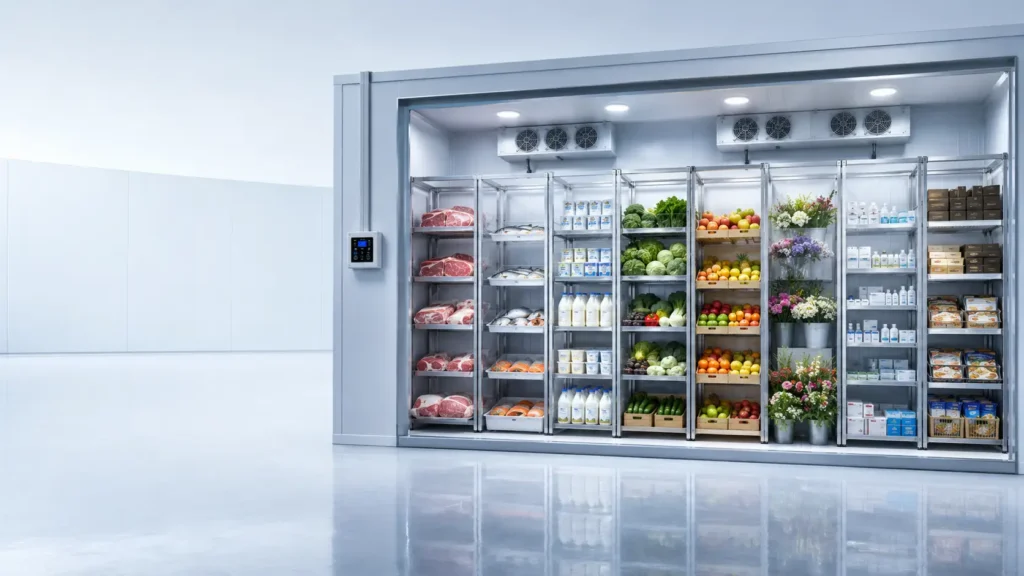
Table of Contents
Different products cannot simply be placed in the same cold room at one standard setting. Fresh meat and fish may need temperatures close to 0°C, but those conditions can damage bananas, mangoes and ripe tomatoes.
Humidity matters too. Leafy vegetables can wilt when the air is too dry, while onions, chocolate and dry ingredients need much less moisture. Medicines are another case entirely, as their approved storage instructions must always be followed.
The cold room temperature chart below brings these requirements together in one place. It covers recommended temperature and humidity ranges, typical storage periods, common risks and products that are better kept apart.
Quick answer: Cold room settings vary by product. Many chilled foods are kept at 5°C or below, and frozen goods at −18°C or colder. But the right setting may change with the product’s condition, packaging and expected storage time.
Cold Room Temperature Chart: Quick Reference
| Product category | Typical temperature | Typical humidity | Important note |
|---|---|---|---|
| Fresh meat | −1°C to 2°C | 85–90% RH | Keep below ready-to-eat food |
| Fresh poultry | 0°C to 2°C | 85–90% RH | Store separately on the lowest shelf |
| Fresh fish | 0°C to 2°C | 95–99% RH when iced | Very short storage life |
| Dairy products | 0°C to 4°C | Product-dependent | Keep away from strong odours |
| Shell eggs | 7°C or colder | 70–80% RH | Avoid condensation and temperature cycling |
| Frozen food | −18°C or colder | Not applicable | Avoid thawing and refreezing |
| Leafy vegetables | 0°C to 1°C | 95–100% RH | Keep away from ethylene-producing fruit |
| Bananas | 13°C to 14°C | 85–95% RH | Chilling injury can occur below about 13°C |
| Mangoes | 10°C to 13°C | 85–90% RH | Do not place in a normal 0–4°C chiller |
| Ripe tomatoes | 10°C to 13°C | 85–90% RH | Chilling-sensitive and ethylene-producing |
| Apples | −1°C to 4°C | 90–95% RH | Strong ethylene producer |
| Temperate cut flowers | 0°C to 2°C | 90–95% RH | Keep away from fruit and vegetables |
| Tropical flowers | 7°C to 15°C | 90–95% RH | Sensitive to low-temperature damage |
| Most refrigerated vaccines | 2°C to 8°C | Not applicable | Many are damaged by freezing |
| Unopened insulin | 2°C to 8°C | Not applicable | Product label always takes priority |
| Chocolate | 15°C to 18°C | Below 50–55% RH | Store cool and dry, not in a normal refrigerator |
| Ice cream | −18°C to −25°C | Not applicable | Stable temperature helps prevent ice crystals |
These are commercial storage targets rather than guarantees of shelf life. Product condition, initial quality, packaging, airflow, sanitation and temperature history all affect how long stock can be stored.
Meat and Poultry Storage Temperature Chart
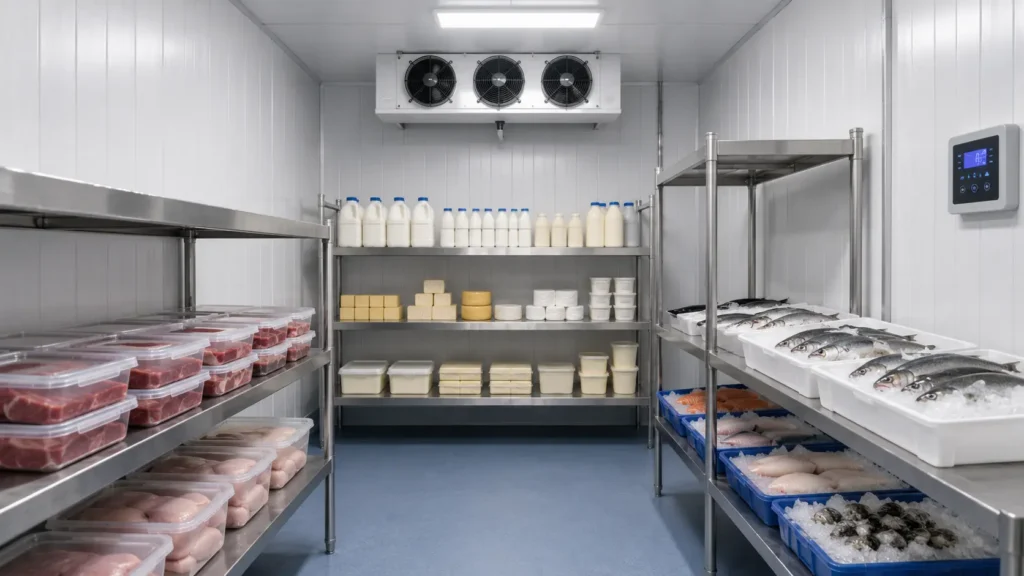
Fresh meat should be kept close to its freezing point without being allowed to freeze unintentionally. A room temperature of 4°C may satisfy general chilled-storage requirements, but a lower and more stable range is usually preferred for commercial meat storage.
For day-to-day commercial storage, these conditions are commonly maintained in a properly sized walk-in chiller designed around the product load and frequency of access.
| Product | Condition | Temperature | RH | Typical commercial duration | Main storage concern |
| Beef | Fresh or chilled | −1°C to 2°C / 30–36°F | 85–90% | 1–3 weeks; vacuum-packed products may last longer | Bacterial growth, drying and drip loss |
| Lamb or mutton | Fresh or chilled | −1°C to 2°C / 30–36°F | 85–90% | 1–2 weeks | Spoilage and surface dehydration |
| Chicken and poultry | Fresh or chilled | 0°C to 2°C / 32–36°F | 85–90% | A few days to about one week | Rapid spoilage and raw-poultry contamination |
| Processed meat | Cooked or cured, chilled | 0°C to 4°C / 32–39°F | 80–85% | Follow the label | Listeria risk, drying and odour transfer |
| Frozen meat | Fully frozen | −18°C or colder / 0°F or below | Not applicable | Several months | Freezer burn, oxidation and thaw–refreeze damage |
Raw meat and poultry should be stored below cooked and ready-to-eat products. This prevents raw juices from dripping onto food that will not receive further cooking.
Different raw meats may share a correctly managed room, but they should still be separated by shelving, containers or designated storage areas.
Fish and Seafood Storage Temperature Chart
Fresh seafood deteriorates faster than most meat. It should arrive cold, be placed into storage quickly and remain surrounded by suitable ice or held in a properly designed fish chiller.
| Product | Condition | Temperature | RH | Typical commercial duration | Main storage concern |
| Lean or white fish | Fresh, stored on ice | 0°C to 2°C / 32–36°F | 95–99% when iced | 1–3 days | Rapid spoilage, odour and temperature abuse |
| Fatty fish | Fresh, stored on ice | 0°C to 2°C / 32–36°F | 95–99% | 1–2 days | Rancidity and histamine risk in susceptible species |
| Live shellfish | Live and chilled | 2°C to 7°C / 36–45°F | High humidity; do not immerse in fresh water | Usually 1–2 days | Mortality, contamination and poor ventilation |
| Frozen seafood | Fully frozen | −18°C or colder / 0°F or below | Not applicable | Several months | Freezer burn and texture loss |
Fish should generally be separated from dairy products, butter, eggs, chocolate, mushrooms and other items that readily absorb odours.
Live shellfish need product-specific handling. They must remain alive, ventilated and protected from fresh water or conditions that cause them to suffocate.
Dairy Products and Egg Storage Chart
Dairy products usually perform well in a clean 0–4°C cold room. Packaging and odour control are important because milk, butter and some cheeses can absorb smells from nearby food.
| Product | Condition | Temperature | RH | Typical commercial duration | Main storage concern |
| Milk | Pasteurised and sealed | 0°C to 4°C / 32–39°F | Not normally controlled for sealed packs | Follow the label | Spoilage and odour absorption |
| Cheese | Hard or soft | 2°C to 8°C / 36–46°F | About 65–80%, depending on variety | Weeks to months | Mould, drying and odour transfer |
| Butter | Chilled | 0°C to 4°C / 32–39°F | Not normally controlled for sealed packs | Weeks; longer when frozen | Rancidity and odour absorption |
| Yogurt | Chilled | 2°C to 4°C / 36–39°F | Not applicable to sealed packs | Follow the label | Spoilage and quality deterioration |
| Shell eggs | Chilled | 7°C or colder / 45°F or below | 70–80% | Several weeks | Condensation, moisture loss and contamination |
Eggs should be kept at a stable temperature. Moving cold eggs repeatedly into warm, humid air can create condensation on the shell and increase contamination risk.
Vegetable Cold Room Temperature and Humidity Chart
Vegetables do not all belong in the same room. Leafy vegetables need cold, humid conditions, while onions require lower humidity and tomatoes and cucumbers can suffer chilling injury in a standard cold room.
| Vegetable | Condition | Temperature | RH | Typical commercial duration | Main storage concern |
| Leafy greens | Lettuce, spinach and similar produce | 0°C to 1°C / 32–34°F | 95–100% | 1–3 weeks | Wilting, decay and ethylene damage |
| Root vegetables | Beets, turnips and similar produce | 0°C to 2°C / 32–36°F | 95–100% | Weeks to months | Drying and sprouting |
| Potatoes | Table stock | 4°C to 10°C / 40–50°F | 90–95% | Weeks to months | Cold sweetening, greening and sprouting |
| Dry onions | Properly cured | 0°C to 5°C / 32–41°F | 65–70% | Several months | Sprouting, rot and odour transfer |
| Ripe tomatoes | Ready for distribution | 10°C to 13°C / 50–55°F | 85–90% | 1–2 weeks | Chilling injury below about 10°C |
| Mature-green tomatoes | Held for ripening | 13°C to 21°C / 55–70°F | 85–90% | Depends on ripening stage | Failure to ripen when stored too cold |
| Cucumbers | Fresh | 10°C to 12°C / 50–54°F | 85–95% | About 10–14 days | Chilling injury, pitting and ethylene damage |
| Bell peppers | Fresh | 7°C to 10°C / 45–50°F | 90–95% | 2–3 weeks | Chilling pitting below about 7°C |
| Broccoli | Fresh | 0°C to 1°C / 32–34°F | 95–100% | About 10–14 days | Yellowing and ethylene exposure |
| Cauliflower | Fresh | 0°C to 1°C / 32–34°F | 95–98% | 2–4 weeks | Browning and ethylene exposure |
| Carrots | Topped | 0°C to 1°C / 32–34°F | 95–100% | Up to several months | Drying and ethylene-related bitterness |
| Mushrooms | Fresh | 0°C to 2°C / 32–36°F | 90–95% | About 5–7 days | Browning, sliminess and odour absorption |
| Fresh herbs | Most varieties | 0°C to 2°C / 32–36°F | 95–100% | About 1–2 weeks | Wilting and decay |
| Basil | Fresh | 10°C to 12°C / 50–54°F | High humidity | Product-dependent | Chilling injury below about 10°C |
Why onions and leafy vegetables should not share a room
Leafy vegetables commonly need 95–100% relative humidity. Dry onions need approximately 65–70% RH.
Setting the room for leafy vegetables can encourage onion rot and sprouting. Setting it for onions will cause leafy vegetables to lose water and wilt. Separate rooms or independently controlled storage zones are therefore preferable.
Fruit Cold Room Temperature and Humidity Chart
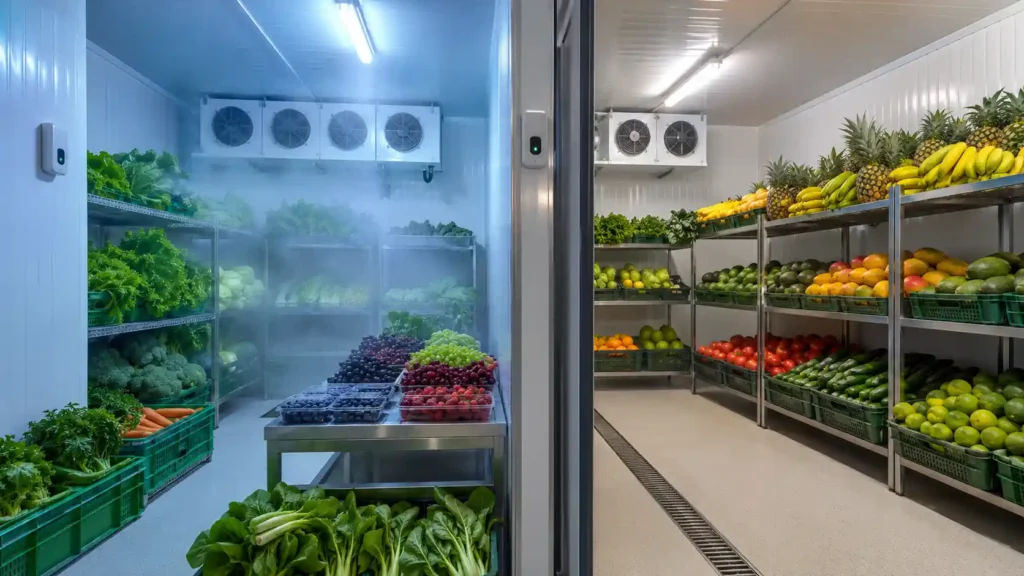
Fruit storage depends heavily on variety, ripeness and whether the product is intended for ripening, short-term distribution or long-term storage.
Fruit that still needs to ripen may require a different setup from produce being held only for storage. Our guide to fruit ripening cold storage explains how temperature, airflow and ripening stage affect the room design.
| Fruit | Condition | Temperature | RH | Typical commercial duration | Main storage concern |
| Apples | Fresh | −1°C to 4°C / 30–39°F | 90–95% | Several months in suitable commercial storage | Ethylene production and storage scald |
| Bananas | Green or ripening | 13°C to 14°C / 55–58°F | 85–95% | About 1–2 weeks | Blackening and chilling injury below about 13°C |
| Mangoes | Fresh | 10°C to 13°C / 50–55°F | 85–90% | About 2–3 weeks | Chilling injury below about 10°C |
| Oranges and citrus | Fresh | 3°C to 9°C / 37–48°F | 85–90% | Several weeks | Rind drying and variety-dependent chilling injury |
| Grapes | Fresh | −1°C to 0°C / 30–32°F | 90–95% | Weeks to months | Freezing, berry shatter and mould |
| Berries | Strawberries, blueberries or raspberries | 0°C to 1°C / 32–34°F | 90–95% | A few days to about one week | Mould and rapid softening |
| Dates | Fresh or semi-dry | 0°C to 4°C / 32–39°F | 70–75% | Several months; longer when frozen | Sugaring, fermentation, insects and excess moisture |
| Avocados | Ripe | 4°C to 7°C / 40–45°F | 85–90% | About 1–2 weeks | Chilling injury and uneven ripening |
| Avocados | Unripe | 7°C to 13°C / 45–55°F | 85–90% | Variety-dependent | Chilling injury and ripening control |
| Pineapples | Fresh | 7°C to 13°C / 45–55°F | 85–90% | About 1–2 weeks | Internal browning and chilling injury |
| Watermelons | Whole | 10°C to 15°C / 50–59°F | 85–90% | About 2–3 weeks | Pitting and chilling injury below about 10°C |
| Cut fruit | Fresh-cut and ready to eat | 0°C to 4°C / 32–39°F | Controlled through packaging | Usually 1–3 days | Rapid microbial growth and contamination |
Cut fruit is no longer protected by its skin. It should be treated as ready-to-eat chilled food and stored above raw meat, poultry and seafood.
Which Fruits and Vegetables Produce Ethylene?
Ethylene is a natural plant hormone that speeds ripening and ageing. Problems arise when strong ethylene producers are stored beside sensitive vegetables or flowers.
Common ethylene-producing products
- Apples
- Bananas
- Tomatoes
- Mangoes
- Avocados
- Melons
Common ethylene-sensitive products
- Lettuce and leafy greens
- Broccoli
- Cauliflower
- Carrots
- Cucumbers
- Cut flowers
Ethylene-producing fruit should not share an enclosed cold room with sensitive products unless the room has suitable ventilation, gas management and product separation.
Flower Cold Room Temperature and Humidity Chart
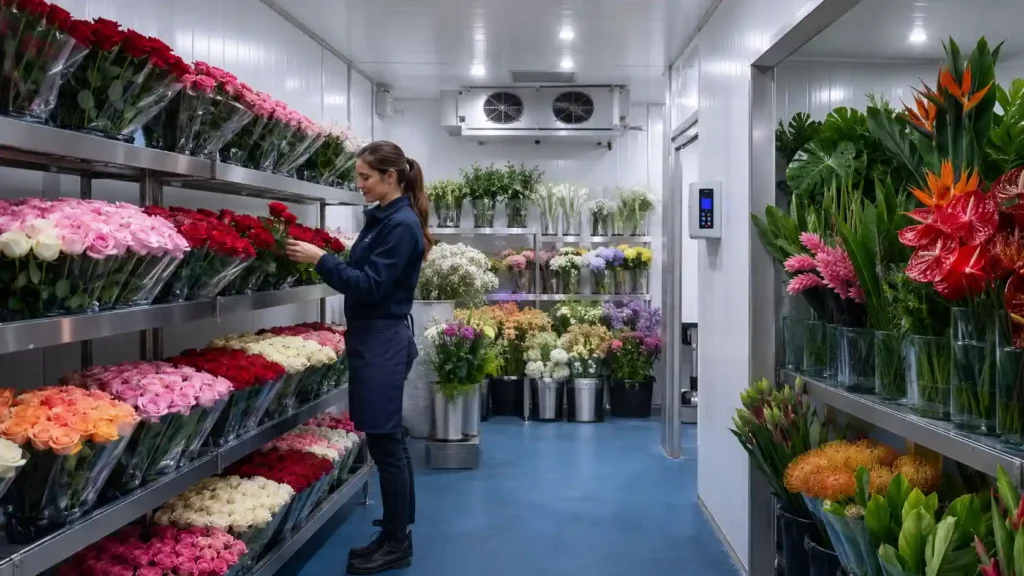
Flower storage is not the same as fruit and vegetable storage. Most cut flowers need high humidity, gentle airflow and protection from ethylene.
| Flower type | Condition | Temperature | RH | Typical commercial duration | Main storage concern |
| Temperate cut flowers | General mixed flowers | 0°C to 2°C / 32–36°F | 90–95% | Several days to about two weeks | Dehydration, Botrytis and ethylene damage |
| Roses | Cut | 0°C to 2°C / 32–36°F | 90–95% | Up to about two weeks | Bent neck, mould and ethylene exposure |
| Tropical flowers | Orchids, Anthurium, and Heliconia | 7°C to 15°C / 45–59°F | 90–95% | Several days to about one week | Chilling injury and blackening |
Businesses handling roses, mixed bouquets and tropical varieties may need a dedicated flower chiller in the UAE with separate conditions for products that react differently to low temperatures.
Tropical flowers should not be kept at the same temperature as roses and other temperate flowers. They can develop visible cold damage even though the cold room is operating correctly for the temperature stock.
Flowers should also be kept away from apples, bananas, tomatoes and other ethylene-producing produce.
Medicine and Pharmaceutical Storage Temperature Chart
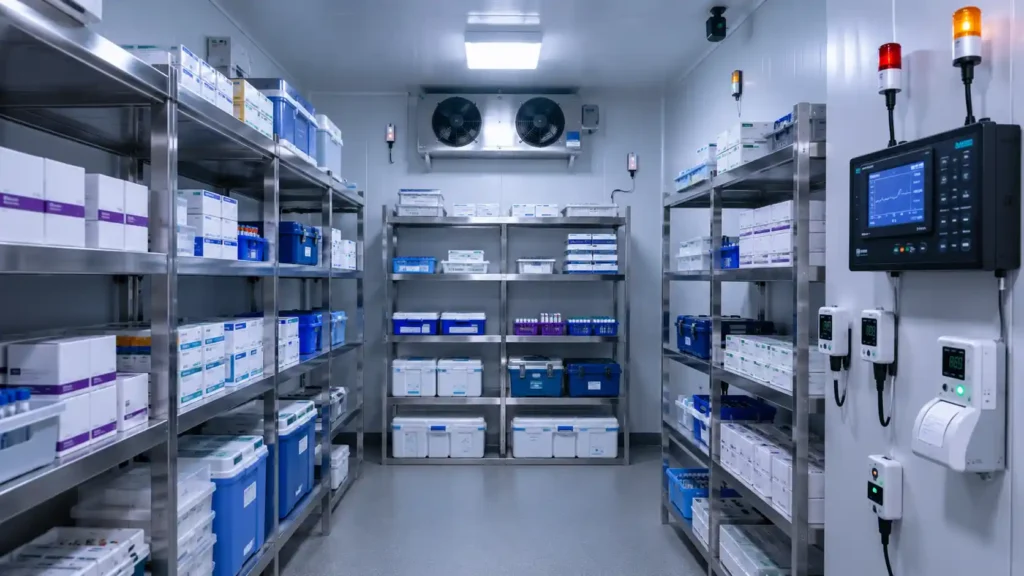
Pharmaceutical storage must always follow the approved product label, registered stability data and manufacturer instructions. A general chart must never replace product-specific requirements.
| Product | Condition | Temperature | RH | Storage period | Main storage concern |
| Most refrigerated vaccines | Unopened and refrigerated | 2°C to 8°C / 36–46°F | Follow product requirements | Until approved expiry when correctly stored | Heat exposure and irreversible freeze damage |
| Insulin | Unopened | 2°C to 8°C / 36–46°F | Follow the specific product label | Product-specific | Freezing and loss of potency from excessive heat |
| Refrigerated medicines | As stated on the label | Commonly 2°C to 8°C / 36–46°F | Product-specific | Follow the label | Product-specific temperature sensitivity |
| Controlled-room-temperature medicines | As stated on the label | Commonly 20°C to 25°C / 68–77°F | Product-specific | Follow the label | UAE heat and humidity exposure |
Important pharmaceutical storage rules
- Do not give one storage temperature for all medicines.
- The approved label always takes priority over a general temperature chart.
- Many refrigerated vaccines and insulin products are damaged by freezing.
- Damage caused by freezing may not be visible.
- Pharmaceutical products should not be stored with food. A dedicated pharmaceutical walk-in chiller allows the temperature, monitoring, alarms and storage layout to be planned around medical stock.
- Refrigerated medicines require dedicated, monitored equipment.
- Temperature alarms, data logging, calibration and thermal mapping may be required depending on the operation and regulatory framework.
- Any temperature excursion should be documented and assessed using the manufacturer’s stability information.
Some vaccines and biological products require frozen or ultra-cold conditions. These are exceptions and must be handled strictly according to their individual instructions.
Chocolate, Bakery and Speciality Product Storage Chart
Not every temperature-controlled product belongs in a refrigerator or freezer.
| Product | Condition | Temperature | RH | Typical duration | Main storage concern |
| Chocolate | Finished product | 15°C to 18°C / 59–64°F | Below 50–55% | Several months; varies by type | Fat bloom, sugar bloom, condensation and odour |
| Flour and sugar | Dry ingredients | 10°C to 21°C / 50–70°F | Below 60% | Several months | Moisture, caking and pests |
| Fresh compressed yeast | Chilled | 0°C to 4°C / 32–39°F | Not normally controlled for sealed packs | Product-dependent | Loss of activity when warm |
| General frozen food | Fully frozen | −18°C or colder / 0°F or below | Not applicable | Several months | Freezer burn and thaw–refreeze damage |
| Ice cream | Frozen | −18°C to −25°C / −13–0°F | Not applicable | Several months | Heat shock and formation of large ice crystals |
| Soft drinks | Chilled for sale | 2°C to 7°C / 36–45°F | Not applicable | Follow the label | Freezing and container damage |
| Bottled water | Sealed | Cool ambient or chilled | Not applicable | Follow the label | Heat, sunlight and odour exposure |
| Seeds | Cool and dry | 0°C to 10°C / 32–50°F | Commonly below 40% | Months to years | Loss of viability from heat and moisture |
| Shelled nuts | Chilled or cool | 0°C to 4°C / 32–39°F | Around 55–65% | Several months | Rancidity, pests and odour absorption |
| Rice, pasta and canned food | Temperature-controlled dry store | 10°C to 21°C / 50–70°F | Below 60% | Product-dependent | Moisture, pests and accelerated deterioration |
Some values in this section are broad commercial guidance. Product packaging, supplier instructions and label requirements should be checked before finalising the room setting.
Should chocolate be stored in a cold room?
Chocolate can be kept in temperature-controlled storage, but a standard 0–4°C cold room is usually too cold. A dry room at around 15–18°C is a better fit.
The real trouble often starts when very cold chocolate is taken into warm, humid UAE air. Moisture can settle on the surface, leaving pale marks, a rough finish or damp packaging. Chocolate also picks up nearby smells quite easily, so it should be kept away from strongly scented products.
Frozen and Deep-Frozen Storage
The normal commercial target for frozen food is:
−18°C or colder
This applies to frozen meat, seafood and general frozen products. Relative humidity is not normally used as the main control value in a room operating below −18°C.
Ice cream is often held at a lower and more stable temperature, such as −18°C to −25°C, because small temperature changes can soften the product and create large ice crystals.
A colder freezer setting cannot compensate for poor packaging, repeated door opening or products that have partially thawed.
Can Different Products Share One Cold Room?
Sharing a cold room is only practical when products have compatible temperature, humidity, hygiene, airflow and odour requirements.
| Product group | Products normally requiring separation |
| Raw meat, poultry and fish | Ready-to-eat food, dairy, flowers, medicines, chocolate and dry goods |
| Dairy and eggs | Fish, onions, chemicals and strong-smelling cheese |
| Leafy vegetables | Apples, bananas, tomatoes and other strong ethylene producers |
| Tropical produce | Meat, dairy and leafy vegetables stored at 0–4°C |
| Apples and ripening fruit | Ethylene-sensitive vegetables and flowers |
| Temperate flowers | Fruit, vegetables and tropical flowers require warmer storage |
| Pharmaceuticals | All food, flowers, chemicals and general commercial stock |
| Chocolate and dry goods | High-humidity produce, fish, onions and chemicals |
The main reasons products cannot share a room
Temperature mismatch
A room set at 1°C may suit fish, leafy vegetables and roses, but it can damage bananas, mangoes, ripe tomatoes, cucumbers and tropical flowers.
Humidity mismatch
Leafy vegetables need close to saturated air. Onions, chocolate, seeds and dry ingredients require much drier conditions.
Ethylene exposure
Ripening fruit can shorten the life of vegetables and flowers, even when the room temperature is correct.
Odour transfer
Fish, onions, cheese and chemicals can taint milk, butter, eggs, chocolate and produce.
Cross-contamination
Raw meat, poultry and fish must not be stored above ready-to-eat food. Leakage or dripping can contaminate products that will not be cooked again.
Regulatory separation
Medicines and vaccines need dedicated and appropriately monitored pharmaceutical storage. They should never be placed in a general food cold room.
Storage Temperature Is Not the Same as Product Temperature
A cold room thermostat measures air temperature. It does not necessarily show the temperature at the centre of the product.
For example, a delivery of warm meat or cooked food may enter a room operating at 2°C. The room air can return to 2°C while the centre of the product remains much warmer.
This difference matters because:
- Warm stock adds a large refrigeration load.
- Densely packed pallets cool slowly.
- Blocked airflow creates warm spots.
- Door opening changes the air temperature quickly.
- Product core temperature changes more slowly.
- Food inspections may use a calibrated probe to check the product itself.
A storage cold room is also not a substitute for a commercial kitchen blast chiller. Hot cooked food needs rapid cooling before it is moved into normal chilled storage. Hot cooked food should be cooled using a process designed to move it quickly through the temperature danger zone before it enters normal chilled storage.
What Does Relative Humidity Mean in a Cold Room?
A cold room can be at the right temperature and still be wrong for the product inside. The missing part is often moisture in the air.
Take leafy vegetables as an example. In dry air, they lose water, soften and start to wilt. Raise the humidity too far, though, and water may collect on the product, packaging, walls or floor. That creates a different set of problems, including mould, rot and slippery surfaces.
Not every product needs moist air. Chocolate, onions and dry ingredients are usually better kept in drier conditions. Fresh produce and flowers generally need more humidity to hold their weight and appearance.
Packaging changes things as well. It can slow moisture loss, but it may trap droplets when warm stock enters a cold room or when the temperature moves up and down.
Where the natural room humidity does not match the product, a correctly selected humidifier or dehumidifier for chiller rooms may be needed to keep conditions within the required range.
So, when planning storage, do not look at the temperature setting alone. Check how much moisture the product needs, how it is packed and whether condensation is likely to form.
Cold Room Temperature Planning for the UAE Climate
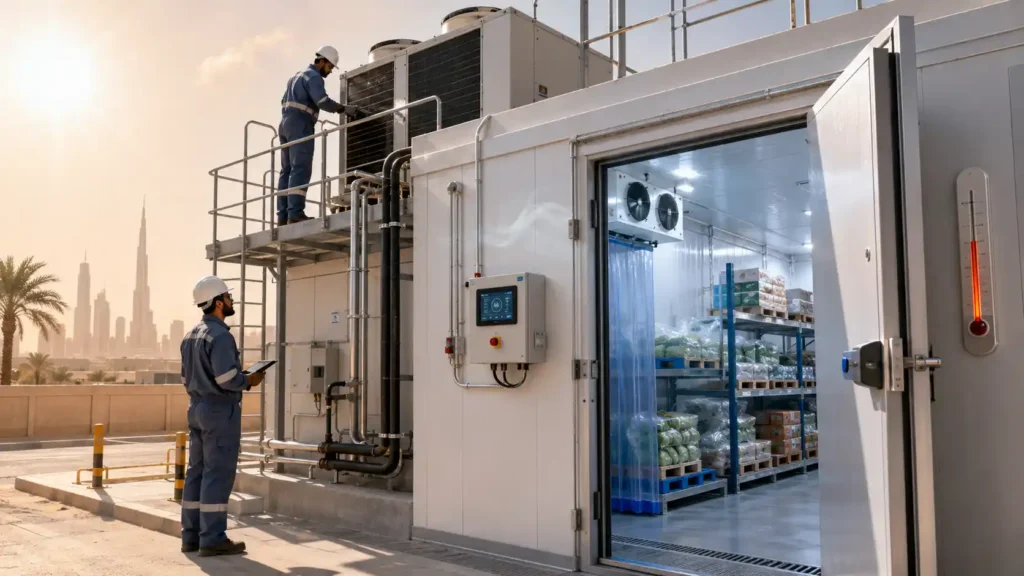
A cold room in Dubai, Abu Dhabi, Sharjah or another UAE location must handle conditions that are very different from those in a mild climate.
Heat, humidity, incorrect sizing and poor operating practices can all affect temperature recovery. Our guide to why chiller rooms fail in the UAE covers the common warning signs and site-related causes.
High outdoor temperature
UAE summer temperatures can exceed 45°C. The refrigeration system must remove both the product load and the heat entering through panels, doors, floors and ceilings. Insulation also matters. The thickness, joints and vapour sealing of the chiller room panels influence how much heat and moisture enter the room.
Equipment selected for a lower outdoor design temperature may run continuously and struggle to recover after loading.
Humid outside air
Hot, humid air enters whenever a cold room door opens. As it cools, moisture can condense on surfaces or freeze on the evaporator.
This may lead to:
- Wet floors
- Ice around doors
- Frosted evaporator coils
- Mould growth
- Damaged packaging
- Higher defrost demand
- Temperature instability
Warm incoming products
Products arriving warm may represent a larger cooling load than the room structure itself. The refrigeration capacity must be based on the incoming product temperature, daily quantity and required cooling time.
Frequent door opening
Busy kitchens, supermarkets and distribution centres may open the cold room door many times per hour. Strip curtains, suitable doors, controlled loading procedures and correct evaporator selection help reduce heat and moisture entry.
Dust on condenser coils
Dust and airborne sand can collect on condenser coils. A dirty condenser cannot release heat efficiently, so the compressor runs hotter and uses more power.
Cleaning frequency should reflect actual UAE site conditions rather than relying only on a generic maintenance interval.
Poor airflow
Stock should not block the evaporator or be packed tightly against walls and ceilings. Restricted airflow creates warm areas that may not appear on the room thermostat.
Monitoring and alarms
Commercial cold rooms should use calibrated temperature monitoring appropriate to the stored product. Pharmaceutical rooms and higher-risk operations may require continuous logging, alarms, backup systems and mapped sensor positions.
How to Select the Right Cold Room Setting
Before selecting a temperature, confirm:
- What exact product will be stored?
- Is it fresh, frozen, ripe, unripe, cooked or ready to eat?
- What is its temperature when it enters the room?
- How much product enters each day?
- How long will it be stored?
- What relative humidity does it need?
- Does it produce or react to ethylene?
- Can it absorb or release strong odours?
- Does it need dedicated hygienic or pharmaceutical storage?
- How frequently will the door open?
- Will the room be installed indoors or outdoors?
- Is rapid cooling required before normal storage?
A cold room should be designed around these conditions instead of selecting a standard refrigeration unit and expecting it to suit every product.
The final room design should reflect the product, incoming temperature, storage volume and daily usage. ChillerRoom.ae works as a specialised chiller and cold room manufacturers in the UAE, planning systems around these requirements rather than using the same setup for every application.
Frequently Asked Questions
A general food chiller commonly operates between 0°C and 5°C. However, the correct setting depends on the product. Bananas, mangoes, tomatoes, chocolate and many other products require warmer conditions.
Fresh beef and lamb are commonly stored between −1°C and 2°C. Fresh poultry is generally kept between 0°C and 2°C. Raw products must remain separated from ready-to-eat food.
Fresh fish is best kept close to melting ice temperature, normally between 0°C and 2°C. It is highly perishable and should be used quickly.
Commercial frozen food should normally be stored at −18°C or colder. A stable temperature is important because repeated warming causes ice-crystal growth and quality loss.
Leafy greens and many root vegetables need approximately 95–100% RH. Onions need much drier air, usually around 65–70% RH. There is no single humidity setting for every vegetable.
Some can, but many should be separated. Apples, bananas, tomatoes, mangoes and avocados produce ethylene, which can damage lettuce, carrots, broccoli, cauliflower and cucumbers.
Bananas are chilling-sensitive. Storage below approximately 13°C can cause peel blackening, poor ripening and internal quality damage.
Most temperate cut flowers and roses are stored around 0–2°C at 90–95% RH. Tropical flowers may need 7–15°C and can be damaged in a colder flower chiller.
The approved product label must always be followed. Many refrigerated medicines and routine vaccines use 2–8°C, while other products require controlled room temperature, frozen or ultra-cold storage.
Vaccines should be kept in dedicated, purpose-appropriate pharmaceutical storage with suitable temperature monitoring. They should not be stored with food.
Chocolate is normally stored at around 15–18°C in a dry, odour-free room. Refrigeration can cause condensation and sugar bloom when the product is returned to warm, humid air.
No. It measures the surrounding air. Newly loaded products may remain warm even after the displayed room temperature returns to its set point.
Final Storage Reminder
The coldest possible setting is not always the safest or most effective one.
Fresh fish needs near-ice conditions. Leafy vegetables need cold air with very high humidity. Bananas and mangoes require warmer storage. Chocolate needs cool, dry conditions. Pharmaceuticals need dedicated storage based on their approved labels.
The right cold room is therefore selected around the product, incoming load, humidity, airflow, storage duration and daily operating pattern.
As specialised chiller and cold room manufacturers in the UAE, ChillerRoom.ae designs commercial and industrial storage systems for food, hospitality, retail, logistics, flowers and pharmaceutical applications.
Sources and Editorial References
This guide was developed using information from:
- Dubai Municipality food-safety guidance
- FDA Food Code
- FDA fish and fishery product guidance
- USDA Agricultural Handbook 66, The Commercial Storage of Fruits, Vegetables, and Florist and Nursery Stocks
- CDC vaccine storage and handling guidance
- Pharmaceutical storage-label and stability principles
- Commercial postharvest and cold-chain references
Temperature ranges are general commercial guidance. Always check the supplier specification, approved product label and current requirements of the relevant UAE authority before establishing a final operating set point.