7 Powerful Fruit Ripening Cold Storage in UAE Solutions (2026 Guide)
Senior Refrigeration Engineer · Chiller Room UAE
Updated 2026 · 10–12 min read
Table of Contents
Quick Answers
What is fruit ripening cold storage in UAE?
Fruit ripening cold storage in UAE is a controlled system that uses temperature, airflow, humidity, ethylene, and CO₂ management to standardize fruit ripening under high ambient conditions.
What is the ideal ripening temperature?
Ripening temperature depends on the fruit type:
- Bananas: 14–18°C
- Mangoes: ~20–22°C
- Avocados: ~15–18°C
Temperatures up to 25°C are only used as an upper limit.
What ethylene level is used?
Ethylene is used in the range of 10–150 ppm, typically applied for 12–24 hours, not continuously.
How long does ripening take?
Ripening begins within 24–72 hours, but full commercial ripening usually takes 4–6 days.
Why do fruit ripening cold storage systems fail in UAE?
Failures occur due to poor airflow, lack of pulp temperature control, incorrect condenser sizing, and poor CO₂ management.
Key Takeaways
- Fruit ripening cold storage in UAE is a high-performance biological control system
- UAE climate significantly increases system load
- Fruit generates internal heat during ripening
- Ethylene triggers ripening, while elevated CO₂ levels can suppress or slow the process
- Airflow determines uniformity across pallets
- Pulp temperature is more critical than air temperature
- System design drives both performance and operating cost
What is Fruit Ripening Cold Storage in UAE and How Does It Work?
Fruit ripening cold storage in UAE is a precision-controlled environment that regulates temperature, airflow, humidity, ethylene, and CO₂ to control fruit ripening.
Unlike traditional storage, it is an active biological process system designed for consistency and commercial quality.
Why Fruit Ripening Cold Storage in UAE Requires Engineering
The UAE environment creates extreme constraints:
- Ambient temperatures: 45–50°C
- High coastal humidity
- Long import cycles
This results in:
- High external heat load
- Mixed fruit maturity
A properly engineered system must manage both simultaneously.
Ripening Room vs Cold Storage
| Parameter | Ripening Room | Cold Storage |
|---|---|---|
| Purpose | Controlled ripening | Preservation |
| Temperature | Dynamic | Static |
| Gas | Ethylene + CO₂ | None |
| Airflow | Pressurised | Passive |
| Control | Pulp-based | Air-based |
👉 See detailed comparison:
https://chillerroom.ae/cold-room-vs-chiller-room/
How Fruit Ripening Works
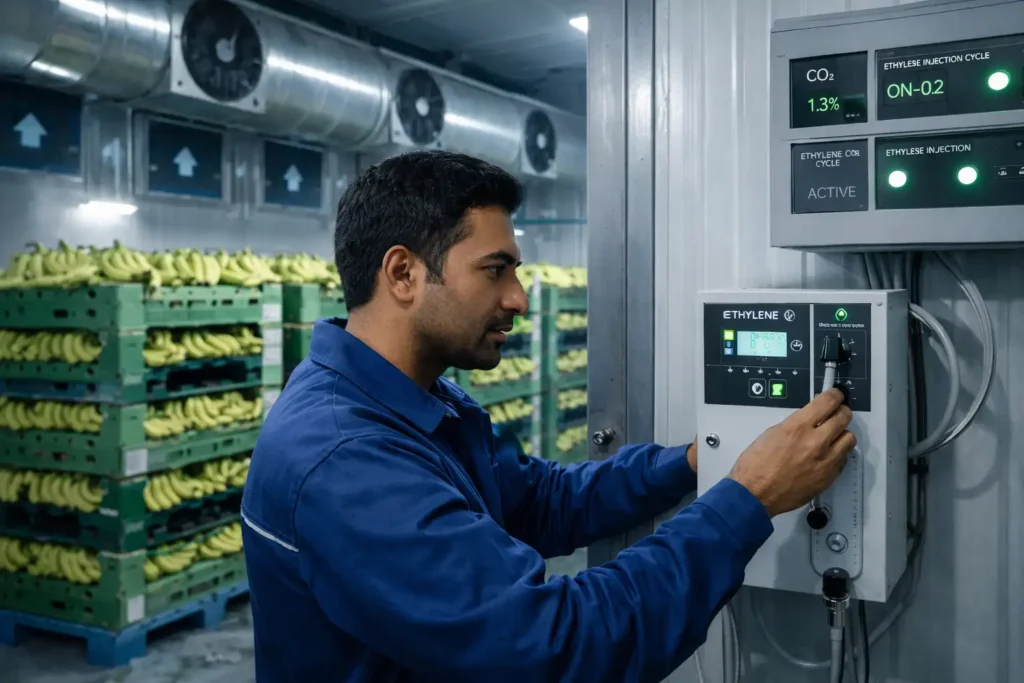
- Fruit is loaded in the mature-green stage
- Ethylene is introduced
- Respiration increases
- Heat and CO₂ are generated
- Cooling removes excess heat
- CO₂ is vented
- Fruit develops colour and texture
Ethylene & CO₂ Control in Fruit Ripening Cold Storage in UAE
Ethylene (C₂H₄)
- Range: 10–150 ppm
- Bananas: 100–150 ppm dosing
👉 Applied for 12–24 hours, then ventilated.
Carbon Dioxide (CO₂)
CO₂ directly affects ripening, but thresholds vary by fruit:
- Bananas: above ~1% slows ripening
- Other fruits vary depending on physiology
CO₂ must be controlled as part of the ripening process.
Design of Fruit Ripening Cold Storage in UAE
A complete system includes:
- Refrigeration system
- Airflow design
- Gas control system
- PLC automation
👉 Explore system types:
- https://chillerroom.ae/portable-chiller/
- https://chillerroom.ae/walk-in-chiller/
- https://chillerroom.ae/blast-chiller/
- https://chillerroom.ae/customised-chiller/
Heat Load in Fruit Ripening Cold Storage in UAE
Includes:
- Transmission load
- Respiration load
- Infiltration load
- Equipment load
👉 In UAE, respiration and infiltration often dominate.
Refrigeration System Design
TR Calculation
- 1 TR = 3.517 kW
Compressor Selection
| Type | Use Case | Suitability |
|---|---|---|
| Scroll | Up to ~20 TR | Efficient |
| Reciprocating | Medium systems | Flexible |
| Screw | Large systems | Industrial |
Critical Engineering Insight: Air vs Pulp Temperature
Air temperature is not equal to fruit temperature.
👉 In real operations, pulp temperature can lag 2–4°C behind air temperature, especially in dense pallet loads.
This means:
- Air may show the correct temperature
- Fruit may still be overheating
👉 This is why pulp temperature monitoring is essential.
Airflow & Humidity Engineering
Airflow ensures:
- Uniform ripening
- Proper gas distribution
Humidity:
- Typically 85–95% RH, depending on fruit type
Defrost Systems (Often Ignored)
| System | Impact |
|---|---|
| Electric | Higher energy use |
| Hot gas | More efficient |
👉 Poor defrost leads to:
- Ice buildup
- Reduced airflow
- Uneven ripening
UAE-Specific Operational Challenges
High Ambient Temperature
Reduces condenser efficiency significantly
Door Openings
Frequent access increases heat load
Power Fluctuations
Affects compressor life
Coastal Humidity
Leads to insulation degradation over time
Insulation Degradation (Hidden Problem)
In UAE, humidity:
- Vapour ingress reduces insulation efficiency
- Poor sealing leads to long-term energy loss
👉 Proper vapor barriers are critical.
Energy Consumption & Cost
kW = TR × 3.517 / COP
- 30 TR → ~42 kW
- ~30,000+ kWh/month
👉 Learn more:
https://chillerroom.ae/reduce-chiller-room-electricity-costs-uae/
Cost of Fruit Ripening Cold Storage in UAE
- 4,000–6,000 AED per pallet (mid to large systems)
👉 Smaller systems cost more per pallet
👉 Larger systems benefit from economies of scale
Common Failures in Fruit Ripening Cold Storage in UAE
- Poor airflow
- No CO₂ control
- No pulp monitoring
- Undersized condenser
👉 Detailed breakdown:
https://chillerroom.ae/why-chiller-rooms-fail-in-uae/
Compliance & Food Safety
Required:
- HACCP system
- Monitoring of temperature, CO₂, and ethylene
Prohibited:
- Calcium Carbide
Ethylene Safety
- LFL: 2.7% (27,000 ppm)
- UFL: ~32% (320,000 ppm)
- Operating levels: <150 ppm
Ensure:
- Proper ventilation
- Safe handling systems
Why Choose Chiller Room Manufacturers in UAE
Choosing the right partner ensures:
- Correct engineering
- Long-term efficiency
- Lower operating cost
Final Engineering Principle
Fruit ripening cold storage in UAE is a controlled biological system:
- Fruit = process
- Ethylene = trigger
- CO₂ = influencing factor
- Refrigeration = control
Frequently Asked Questions (FAQs)
Fruit ripening cold storage in UAE is a controlled environment that uses temperature, airflow, humidity, ethylene, and CO₂ management to standardize the ripening process of fruits like bananas, mangoes, and avocados.
Ripening temperature depends on the fruit:
Bananas: 14–18°C, Mangoes: ~20–22°C, Avocados: ~15–18°C.
Temperatures above 25°C are typically avoided for continuous operation.
Ethylene exposure triggers ripening within 24–72 hours, but full commercial ripening to the desired color and texture usually takes 4–6 days.
Ethylene is a natural plant hormone that initiates ripening by triggering biochemical changes such as color development, softening, and sugar conversion in climacteric fruits.
CO₂ levels influence ripening speed and quality. Elevated CO₂ can slow or disrupt the ripening process, so proper ventilation and monitoring are required.
A standard cold room cannot effectively ripen fruit because it lacks controlled airflow, ethylene dosing, and CO₂ management. While it can be modified, proper ripening requires fundamental redesign of airflow and gas control systems, not just adding equipment.
A typical system costs around 4,000–6,000 AED per pallet for medium to large facilities. Smaller systems usually have higher cost per pallet due to lower economies of scale.
Common causes include poor airflow design, lack of pulp temperature monitoring, incorrect condenser sizing, and inadequate CO₂ management in high ambient conditions.