Cold Room in UAE:
How to Choose the Right System for Your Business
Freezer Room · Chiller Cold Room · Floral Storage · General Cool Room

Table of Contents
What Is a Cold Room in UAE and Why Does It Matter?
A cold room in UAE is a sealed, insulated storage enclosure designed to maintain a controlled internal temperature — regardless of what is happening outside. In a country where summer ambient temperatures exceed 45°C across Dubai, Abu Dhabi, Sharjah, and the wider Emirates, reliable temperature-controlled storage is not optional. It is the foundation of every business that handles perishable goods.
But here is what many businesses do not realise when they begin searching for a cold room in UAE: the term cold room covers a wide family of refrigeration systems, each engineered differently, each designed for a specific set of products and operating conditions. A chiller room for a restaurant is built differently from a freezer room for a seafood exporter. A floral cold room for a flower importer has entirely different humidity and airflow requirements from a cool room for wine storage.
Choosing incorrectly — or being sold a general system when your products need a specific one — is one of the leading causes of cold room failure, product loss, and energy waste across UAE businesses. As our guide on why chiller rooms fail in UAE explains, most cold room failures are not equipment problems. They are specification problems. This guide cuts through the confusion. It explains each type of cold room in UAE — what it does, who needs it, and how it is engineered — so you can go into any conversation with a cold room manufacturer knowing exactly what your operation requires and what questions to ask.
Important: cold room vs chiller room in UAE

Many UAE businesses use these terms interchangeably. Technically they are different systems.
A cold room is the broader category — it includes chiller rooms, freezer rooms, floral rooms, and
cool rooms. A chiller room specifically refers to above-freezing refrigerated storage, operating
between 0°C and +8°C. Most food safety applications tighten this to 0°C to +5°C, while
pharmaceutical storage and certain beverages use the upper range up to +8°C.

Getting this distinction right matters because it affects insulation thickness, compressor
specification, and energy cost. For a detailed comparison, read: Cold Room vs Chiller Room —
Even Experts Mix Them Up.
The Four Types of Cold Room in UAE at a Glance
Before going into detail on each system, the table below gives you the full picture at once. Most UAE businesses need one of these four types — the right one depends entirely on what you are storing and how your operation works.
| Cold Room Mode | Temperature Range | Primary Purpose | Key UAE Industries |
|---|---|---|---|
| Chiller Room | 0°C to +8°C | Fresh food, dairy, pharma, daily access | Restaurants, hotels, supermarkets, pharmacies |
| Freezer Room | -18°C to -25°C | Long-term frozen storage | Seafood exporters, meat processors, frozen food distributors |
| Floral Cold Room | +2°C to +5°C | Cut flowers and plant preservation | Flower importers, florists, event companies |
| General Cool Room | +8°C to +15°C | Mild-temperature specialty storage | Wine distributors, bakeries, root vegetables suppliers |
| Multi-Temperature | Adjustable | Multiple products, evolving operations | Growing businesses, multi-product facilities, new builds |
Each row in that table represents a different engineering specification — different insulation thickness, different compressor type, different humidity management, different door systems. This is why the right answer for your business is never simply ‘a cold room.’ It is the specific system matched to your products, your access patterns, and your UAE operating environment.
Chiller Room in UAE: 0°C to +8°
What a chiller room does
A chiller room is the most widely used cold room type across the UAE. It maintains temperatures between 0°C and +8°C — above freezing, but cold enough to significantly slow bacterial growth and preserve the freshness, texture, and safety of perishable products for days or weeks. Most food storage applications operate within the tighter 0°C to +5°C band to meet HACCP and Dubai Municipality food safety requirements. Beverages, certain packaged foods, and pharmaceutical cold chain storage may use the upper part of the range up to +8°C — this is not a contradiction; it is a product-specific decision.
The chiller room is designed for frequent access. Staff enter and exit multiple times a day. Products move in and out regularly. The refrigeration system is engineered to recover temperature quickly after the door opens — a critical design requirement in a UAE environment where the warm air that enters every time a door opens can be 45°C or more. This is a fundamentally different engineering brief from a freezer room, which prioritises sustained sub-zero temperatures, or a floral cold room, which prioritises humidity precision. Mixing up these requirements — using a chiller room spec when you need a freezer room, or vice versa — leads directly to the failures detailed in our guide: Why Chiller Rooms Fail in UAE.
Who needs a chiller room in UAE
Operating a cold room in UAE at -18°C to -25°C while the external environment exceeds 45°C requires significant engineering rigour. Standard equipment specified for cooler climates will underperform or fail. The following specifications apply when a multi-purpose cold room is configured for freezer operation:
Restaurants and commercial kitchens
A restaurant chiller room stores daily ingredient stocks — fresh meat, dairy, vegetables, sauces, and prepared items. It needs to recover temperature quickly after the door opens, maintain consistent humidity to prevent produce dehydration, and comply with Dubai Municipality HACCP requirements. Our walk-in chiller solutions are engineered specifically for this operating pattern.
Supermarkets and retail grocery
Supermarkets across Dubai, Abu Dhabi, and Sharjah use large chiller rooms as backend storage before products move to front-of-store display refrigerators. Volume, throughput, and consistent temperature are the priorities — the chiller room is the invisible engine behind every fresh food aisle.
Hotels and catering operations
Large hotel commissaries and catering companies handling hundreds or thousands of covers per day rely on chiller rooms for bulk ingredient storage. The engineering requirement here combines high volume, frequent access, and strict HACCP documentation — all achievable with a properly specified chiller room built for UAE ambient conditions.
Pharmaceutical distributors and healthcare
Vaccines, insulin, and temperature-sensitive medications must be stored at +2°C to +8°C as specified by WHO cold chain guidelines and UAE Ministry of Health regulations. Pharmaceutical chiller rooms require validated temperature monitoring, continuous data logging, and alarm systems that go significantly beyond standard food-grade chiller specifications. Read: Pharma Cold Storage & Medical Chillers in UAE.
What a chiller room in UAE is built from
- Insulation panels: 80–100 mm PIR sandwich panels, sealed at all joints to prevent thermal bridging
- Compressor: Desert-rated, sized for UAE peak ambient of 48°C to 50°C — not standard 35°C European ratings
- Evaporator: Low-TD evaporator to manage both temperature and humidity simultaneously
- Door system: Airtight insulated door with an automatic closer and strip or air curtain
- Controls: Digital temperature controller with alarm, data logging, and remote monitoring capability
For the full technical breakdown of chiller room temperature requirements by product type — including dairy, meat, seafood, produce, and pharmaceuticals — read: Chiller Room Temperature in UAE: Engineering Accuracy & Compliance Reality.
Freezer Room in UAE: -18°C to -25°C
What a freezer room does
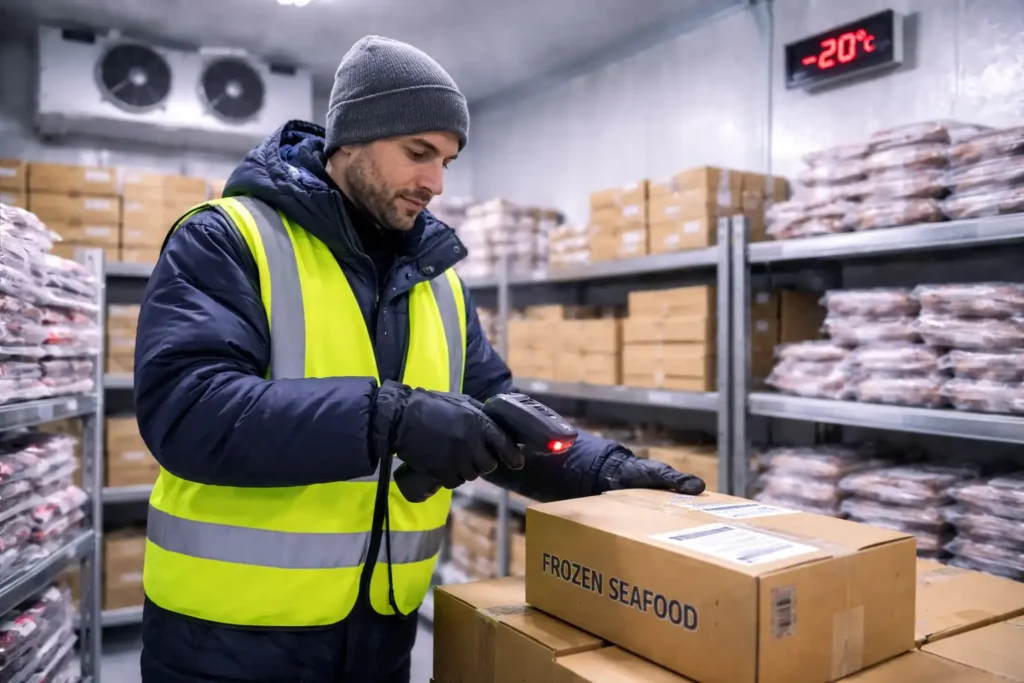
A freezer room is a cold room in UAE that maintains sustained sub-zero temperatures between -18°C and -25°C. At these temperatures, microbial activity is almost entirely halted and enzymatic degradation is suspended — allowing products to be stored safely for months or longer without loss of quality or safety.
The engineering challenge in UAE is the extreme temperature differential. A freezer room in Dubai must maintain -22°C internally while the outside environment hits 48°C or more — a differential of 70°C across the insulation. Standard equipment designed for cooler climates cannot sustain this. Every component — insulation, compressor, condenser, evaporator — must be specified for UAE peak conditions from the outset.
This is why freezer room specification and chiller room specification are completely separate engineering exercises, not variations of the same system. For a detailed comparison of the two, including insulation thickness, compressor requirements, and running costs: Chiller Room & Freezer Room: Complete Guide for UAE Businesses.
Who Needs a Freezer Room in UAE?
Seafood exporters and fish processors
The UAE’s seafood trade — centred on Dubai’s fish markets and port facilities — depends on freezer rooms maintained at -18°C to -22°C to comply with ESMA food safety regulations and international import standards. A temperature fluctuation of even 2°C causes ice crystal formation that degrades texture and reduces marketable shelf life.
Halal meat processors and wholesale butchers
Halal meat processors, wholesale operations, and hotel commissaries storing bulk beef, lamb, and chicken need sustained sub-zero storage for food safety compliance, extended shelf life, and Dubai Municipality HACCP documentation requirements.
Frozen food manufacturers and distributors
Ice cream producers, ready-meal manufacturers, and frozen food distributors supplying UAE supermarkets require freezer rooms with precise temperature stability. These operations also typically need rapid pull-down capacity for newly introduced products — something that must be factored into the refrigeration load calculation from the design stage.
Cold chain logistics operators
Third-party logistics providers running temperature-controlled warehouses in Jebel Ali, Dubai Industrial City, and Dubai South maintain freezer rooms as part of larger cold storage facilities. These sites often store products for multiple clients, each with different temperature requirements — a scenario where system design becomes particularly important.
How a freezer room in UAE differs from a chiller room
| Feature | Chiller Room | Freezer Room |
| Temperature range | 0°C to +8°C (food-safe: 0°C to +5°C) | -18°C to -25°C |
| Insulation panels | 80–100 mm PIR | 120–150 mm PIR |
| Floor insulation | Not always required | Required — underfloor heating elements |
| Defrost system | Standard | Hot-gas or electric defrost essential |
| Energy consumption | Moderate | Hot-gas or electric defrost is essential |
| Door system | Insulated + curtain | Heavy insulated door + anti-condensation heater |
Floral Storage Room Mode: +2°C to +5°C

Why is flower storage a separate engineering requirement
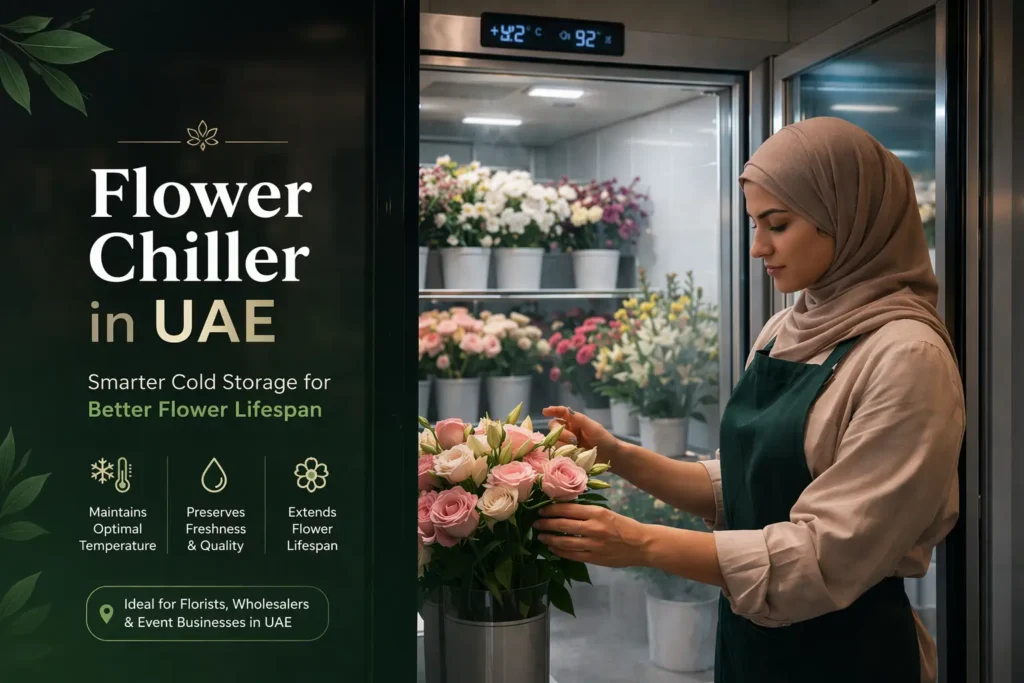
A floral cold room operates at a similar temperature to a chiller room — but it is not a chiller room. The difference is not the temperature. It is the environment the system must create and maintain around that temperature.
Flowers are among the most environmentally sensitive products stored in any cold room in UAE. They deteriorate rapidly when humidity drops below 90% RH — petals dry, stems weaken, and commercial value collapses within hours. They are physically damaged by high airflow velocity — the same airflow that keeps a chiller room efficient will strip moisture from petals. They are also highly sensitive to ethylene gas, a natural by-product of fruit ripening that accelerates flower ageing. None of these requirements features in standard chiller room design.
Optimal Conditions for a Floral Cold Room in UAE
- Temperature: +2°C to +5°C for most temperate varieties — roses, lilies, carnations, tulips
- Relative humidity: 90% to 95% RH — maintained through low-TD evaporator design and controlled defrost cycles
- Airflow: Low velocity, even distribution — no direct high-speed airflow onto flowers
- Ethylene: Activated carbon filtration or ethylene scrubbers, where flowers share space with fruit or produce
- Lighting: Low-heat LED only — conventional lighting creates localised warm spots that accelerate wilting
Tropical flower species require warmer storage — do not use a standard floral cold room setpoint
- Orchids: +8°C to +13°C (varies significantly by species — always verify with your supplier)
- Anthuriums: +13°C to +15°C
- Heliconias: +12°C to +15°C
Storing any tropical species below its chilling threshold causes irreversible cellular damage — blackening, petal collapse, and total product loss within 24 to 48 hours.
Who Needs a Floral Cold Room in UAE?
Wholesale flower importers
The UAE imports significant volumes of cut flowers from the Netherlands, Kenya, Colombia, Ecuador, and India. Importers at Dubai International Airport and Sharjah Airport use floral cold rooms to hold incoming stock during customs clearance and redistribution — preserving bloom quality and commercial vase life before the product reaches retailers.
Event management and wedding companies
Dubai’s luxury events sector — servicing high-profile weddings, corporate events, and international exhibitions — relies on floral cold rooms to preserve large volumes of arrangements prepared 48 to 72 hours before an event. A well-specified floral cold room is the difference between an arrangement that arrives perfect and one that arrives wilted.
Retail florists and supermarket floral sections
Independent florists and supermarket floral departments use walk-in floral cold rooms as both a preparation workspace and an active retail display environment — maintaining flower condition throughout the retail day in a climate that would destroy unrefrigerated stock within hours.
General Cool Room in UAE: +8°C to +15°C
What a cool room does
A general cool room maintains temperatures between +8°C and +15°C — warmer than a chiller room but still well below UAE ambient. Products stored in this range do not need full refrigeration but cannot survive the UAE’s ambient environment, where an unrefrigerated storage room in summer routinely reaches 35°C to 40°C indoors, even with standard air conditioning.
The cool room is often the most energy-efficient cold room option, because the temperature differential it must overcome is smaller. But it still requires proper insulation, a correctly sized refrigeration system, and a condensing unit rated for UAE peak ambient temperatures.
Who needs a cool room in UAE
Fine wine and specialty beverage distributors
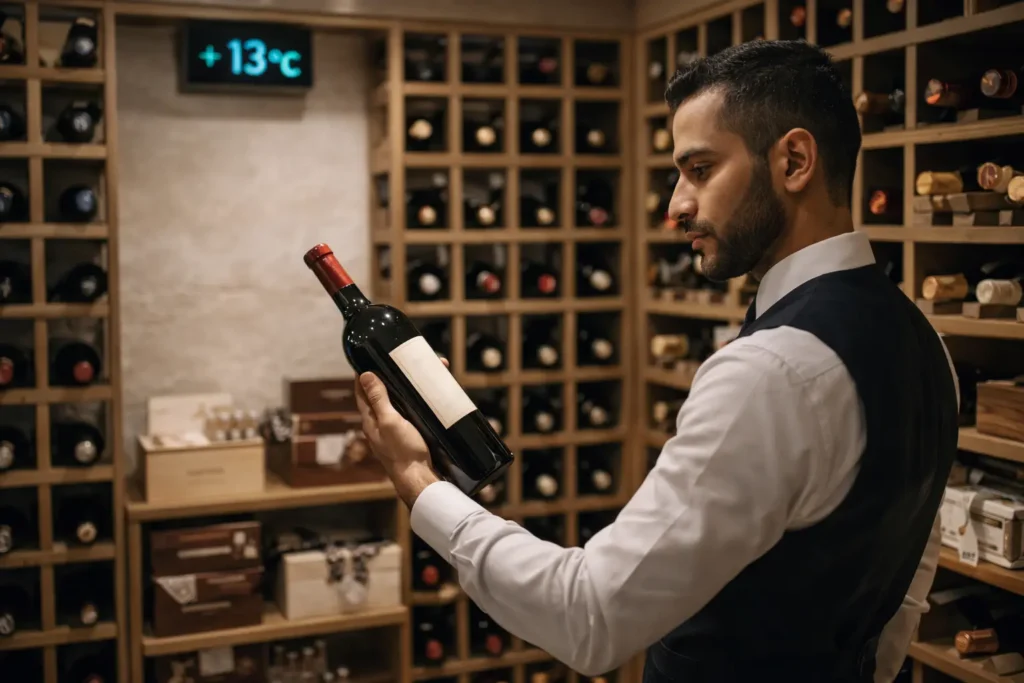
Wine storage requires stable temperatures between +12°C and +15°C with low vibration, minimal light, and controlled humidity. Hotels, restaurants, and specialty beverage importers across Dubai use cool rooms as a cost-effective alternative to purpose-built wine cellars — protecting premium stock from UAE heat without the energy overhead of full refrigeration.
Bakeries and chocolate producers
Chocolate stored in a standard chiller room at +4°C develops sugar bloom — condensation pulls sugar to the surface and ruins the appearance. At +10°C to +14°C, a cool room maintains chocolate in perfect condition without triggering bloom. Pastries and certain baked goods also benefit from cool room storage over full refrigeration.
Root vegetable and dry produce suppliers
Potatoes, onions, garlic, and other root vegetables store best at +8°C to +12°C. Placing these products in a chiller room at +4°C converts starches to sugars — altering flavour and making potatoes unsuitable for frying. A cool room provides exactly the right environment without over-cooling.
Pharmaceutical raw materials and nutraceuticals
Certain herbal supplements, raw pharmaceutical materials, and health products specify storage at cool conditions — typically +8°C to +15°C rather than full cold chain. A properly specified cool room delivers this range precisely, eliminating the energy cost of over-refrigerating products that do not need it.
When Does a Multi-Temperature Cold Room Make Sense?
Having read through the four dedicated cold room types above, you will notice a pattern: each one is engineered for a specific set of conditions. A chiller room is not a freezer room. A floral cold room is not a standard chiller room. Getting the right dedicated system for your primary operation is almost always the correct starting point. However, there are specific business scenarios where investing in a single adjustable multi-temperature cold room system — one that can operate across multiple temperature ranges through programmable controls — is the more logical and cost-effective decision. These scenarios are not for everyone. They are for businesses in a specific stage of growth or operational complexity.
Scenario 1: You are building a new facility from scratch
If you are fitting out a new food processing facility, a new logistics warehouse, or a new hotel commissary, and you know your operation will require multiple temperature zones — a chiller zone, a freezer zone, and possibly a floral or cool zone — then designing a single multi-temperature system from the outset is significantly more cost-effective than installing separate systems later. The engineering is done once. The insulation, electrical, and refrigeration infrastructure is built for the full range from day one.
Scenario 2: Your business has outgrown a single dedicated system
A restaurant that started with a chiller room and now also runs a catering operation requiring frozen storage. A supermarket that has added a fresh flower section to its fresh food offer. A pharmaceutical distributor that has expanded into nutraceuticals requires different temperature storage. In each case, the business has grown beyond its original cold room, and a multi-temperature system becomes the consolidation solution rather than installing a second or third separate unit.
Scenario 3: You manage multiple product lines with different requirements
Food distributors, cold chain logistics operators, and hospitality groups managing multiple properties often store products with fundamentally different temperature requirements under one roof. A multi-temperature cold room system — or a properly partitioned multi-zone cold storage facility — allows this to be managed as a single system with centralised monitoring, a single maintenance contract, and a unified compliance record.
What a multi-temperature system requires to work properly
This is the critical point that the previous version of this article did not make clearly enough: a multi-temperature cold room is not simply a standard cold room with a dial that goes lower. It must be engineered from the outset for its coldest intended operating mode.
- Insulation: Specified for the coldest setpoint — if it will ever operate as a freezer room, the panels must be 120–150 mm regardless of what mode it runs in most of the time
- Compressor: Rated and sized for the full temperature range, not just the average setpoint
- Controls: Programmable digital system with the range to cover all intended operating modes
- Humidity management: Adjustable to suit different product requirements at different setpoints
| A standard chiller room cannot be converted to a freezer room by turning down the thermostat. The insulation, compressor, defrost system, and floor specification are all different. Attempting to run a chiller-spec system at -18°C will cause equipment failure, inconsistent temperatures, excessive energy consumption, and product loss. If a multi-temperature system is what your operation needs, it must be engineered as such from the design stage — not retrofitted from an existing dedicated system. |
Which Cold Room in UAE Is Right for Your Business?
Use the table below to match your operation to the right cold room type. If you are unsure, the answer is almost always to speak to an engineer who will ask about your products, your access patterns, your space, and your growth plans — before recommending anything.
| Your operation | What you need | Where to start |
|---|---|---|
| Restaurant, hotel kitchen, café | Chiller room 0°C to +8°C (food-safe: 0°C to +5°C) | Walk-In Chiller |
| Supermarket, grocery retailer | Chiller room 0°C to +8°C (food-safe: 0°C to +5°C) | Walk-In Chiller or Customised Chiller |
| Seafood exporter, meat processor | Freezer room -18°C to -25°C | Customised Chiller (freezer spec) |
| Pharmaceutical distributor, hospital pharmacy | Validated chiller room +2°C to +8°C | Customised Chiller (pharma spec) |
| Flower importer, florist, event company | Floral cold room +2°C to +5°C | Customised Chiller (floral spec) |
| Wine distributor, bakery, root vegetable supplier | Cool room +8°C to +15°C | Customised Chiller (cool spec) |
| Temporary storage, event catering, site project | Portable Chiller | Portable Chiller |
| New facility, multi-product distributor, logistics hub | Multi-temperature cold room | Customised Chiller (full consultation) |
Designing Any Cold Room in UAE: What the Climate Demands
Regardless of which cold room type your operation requires, designing for UAE conditions is a fundamentally different engineering exercise from designing for Europe or North America. The combination of extreme ambient heat, high coastal humidity, year-round cooling demand, and fine desert dust creates stresses that standard equipment specifications do not account for.
Desert-rated condensing units — the most critical decision
A condensing unit rated for 35°C ambient will underperform, short-cycle, and fail prematurely during a UAE summer when ambient rooftop temperatures exceed 48°C. This is one of the most common and most avoidable cold room failures across the UAE. Every condensing unit in any cold room in Dubai must be specified with UAE peak ambient temperatures built into the load calculation — not European or North American standard ratings. For a full breakdown of why this causes failures: Why Chiller Rooms Fail in UAE.
Insulation specification by cold room type
| Cold Room Type | Panel Thickness | Notes |
| Cool room +8°C to +15°C | 60–80 mm PUF or PIR | Lower differential — lighter insulation load |
| Chiller room 0°C to +8°C | 80–100 mm PIR | Food-safe range 0°C to +5°C; pharma and beverages up to +8°C |
| Floral cold room +2°C to +5°C | 80–100 mm PIR | Same panels; humidity management is the key differentiator |
| Freezer room -18°C to -25°C | 120–150 mm PIR | High-density panels are essential; floor insulation is required |
Condenser cleaning — the UAE maintenance priority
Fine desert dust drawn into condenser fins by cooling fans forms a dense insulating layer that causes compressors to overwork and fail. In UAE cold rooms, condenser cleaning should be scheduled monthly during the sandstorm season — March through May — and quarterly at a minimum throughout the year. This single maintenance task has the single greatest impact on both energy efficiency and system longevity across all cold room types in UAE.
Door discipline — the biggest operational energy leak
Every time a cold room door opens in UAE, warm, humid air infiltrates the storage space — raising temperature, increasing humidity, and triggering a recovery cycle from the refrigeration system. Strip curtains, air curtains, and automatic door closers are not accessories. In a UAE operating environment, they are fundamental energy management tools. Their absence in a cold room installation is a specification gap, not a cost saving.
Inverter compressors — energy efficiency in UAE conditions
Variable-speed inverter compressors modulate refrigeration output based on actual thermal load — running at lower output during cooler evening periods and higher output during peak daytime heat. Compared to fixed-speed systems, inverter compressors reduce energy consumption by 20–35% and deliver more stable internal temperatures. For UAE businesses operating under DEWA or ADDC electricity tariffs, this represents a material reduction in operating overhead. For proven energy reduction strategies: How to Reduce Chiller Room Electricity Costs in UAE.
Cold Room Solutions in UAE from ChillerRoom.ae

At ChillerRoom.ae, we have designed and installed over 1,000 cold room systems for businesses across Dubai and the wider UAE — restaurants, supermarkets, pharmaceutical distributors, seafood processors, event companies, and logistics operators. Every system starts with the same question: what are you storing, how do you access it, and what does your operation look like in three years?
We do not recommend a system until we understand the answers to those questions. Then we engineer the system that is right for your products, your space, and your UAE operating environment — not a standard catalogue product.
Walk-In Chiller — View service
Large refrigerated walk-in cold rooms for restaurants, hotels, supermarkets, and food distributors. Engineered for UAE ambient conditions, HACCP compliance, and high-access operating patterns.
Portable Chiller — View service
Mobile, self-contained cold room units for temporary storage needs, event catering, construction site operations, and businesses that cannot install a permanent system.
Blast Chiller — View service
Rapid pull-down systems that reduce food temperature from cooking temperature to safe storage temperature in minimum time — a HACCP-critical tool for commercial kitchens, catering operations, and food manufacturers.
Customised Cold Room — View service
Bespoke cold room systems designed around your exact requirements — temperature range, dimensions, insulation specification, refrigeration capacity, humidity control, monitoring, and compliance. This is the right starting point if your needs do not fit a standard solution.
See our completed cold room installations across the UAE: Our Projects.
Conclusion: The Right Cold Room in UAE Starts with the Right Question
The most important decision any UAE business makes about cold storage is not which brand to buy or how many square metres to build. It is whether the system they are specifying is actually the right system for what they need to store.
A restaurant needs a chiller room. A seafood exporter needs a freezer room. A flower importer needs a floral cold room with precision humidity management. A wine distributor needs a cool room. A logistics operator managing multiple product lines may need a multi-temperature system. Each of these is a different engineering answer to a different operational question.
In UAE conditions — where the climate punishes every specification error with higher energy costs, faster equipment failure, and greater product loss than you would experience anywhere else in the world — getting that first decision right is everything. The businesses across Dubai, Abu Dhabi, Sharjah, and the wider UAE that get the most from their cold room investment are not the ones that bought the cheapest system. They are the ones who started by understanding exactly what their operation required — and then found a manufacturer experienced enough to engineer it properly for a UAE climate.
Frequently Asked Questions: Cold Room in UAE
Cold room is the umbrella term covering all refrigerated storage enclosures — chiller rooms, freezer rooms, floral cold rooms, and cool rooms. A chiller room specifically refers to above-freezing refrigerated storage, operating between 0°C and +8°C. Most food safety applications tighten this to 0°C to +5°C to meet HACCP and municipality requirements, while pharmaceutical storage and beverages may operate in the upper range up to +8°C. Many UAE businesses use the terms interchangeably, but they describe different engineering specifications — a distinction that matters when commissioning a system.
It depends entirely on what you are storing. Fresh meat: 0°C to +2°C. Dairy and produce: 0°C to +5°C. Beverages and certain packaged foods: up to +8°C. Pharmaceuticals: +2°C to +8°C. Frozen goods: -18°C or below. Wine: +12°C to +15°C. There is no single correct cold room temperature — the correct temperature is the one matched to your product and your regulatory requirements.
Yes — but only if it is engineered from the outset to do so. A multi-temperature cold room system uses a programmable digital controller and refrigeration components sized for the full intended range. A standard chiller room cannot simply be turned down to operate as a freezer room — the insulation, compressor, defrost system, and floor specification are all different. Multi-temperature systems work well for specific business scenarios but must be specified correctly from the design stage.
The main causes are: equipment specified for standard ambient temperatures rather than UAE peak conditions of 48°C to 50°C; condenser coil blockage from desert dust; inadequate insulation specification; poor door management; and undersized refrigeration capacity for the actual thermal load. Most of these failures are specification errors, not equipment defects. Full detail: Why Chiller Rooms Fail in UAE.
Cold room installation costs in UAE vary significantly by type, size, insulation specification, and refrigeration capacity. Indicative ranges: small commercial chiller rooms from AED 50,000 to AED 120,000; medium cold storage installations from AED 150,000 to AED 350,000; large warehouse-scale or multi-temperature facilities from AED 500,000 upward. A proper site assessment and load calculation is required before any accurate quotation.
Look for a manufacturer who asks detailed questions about your products, your access patterns, and your operating environment before proposing anything. A manufacturer who recommends a standard system without understanding what you are storing is not bringing engineering discipline to your project. Verify that they specify for UAE peak ambient conditions, not European ratings, and that they offer after-sales maintenance support across your emirate.
A portable chiller is a self-contained, mobile cold room unit that can be deployed rapidly without permanent installation. It is the right solution for temporary storage needs, event catering, short-term project requirements, or businesses that need refrigeration before a permanent facility is ready. See: Portable Chiller solutions.