Humidifier and Dehumidifier for Chiller Rooms in UAE
Senior Refrigeration Engineer · Chiller Room Manufacturers in UAE
Updated 2026 · Estimated read time: 08–14 min
Table of Contents
Introduction
A chiller room can show the correct temperature on the display and still create problems inside. That is where humidity comes in.
UAE conditions make humidity control genuinely difficult. Warm outside air, coastal moisture, frequent door openings, poor sealing, weak airflow — any one of these disrupts the room environment. Together, they create conditions where condensation forms on panels, products dry out faster than expected, cartons get damp, frost accumulates around cooling coils, and shelf life shortens before it should.
This is why understanding the right Humidifier and Dehumidifier setup matters for any business using cold storage in the UAE.
Fresh vegetables, herbs, and flowers need moisture in the air around them — without it, they wilt, dry out, and lose quality fast. Medicines and most packaged goods are the opposite. Too much humidity compromises packaging, accelerates degradation, and, in pharmaceutical storage, can create compliance problems. Same cold room, very different requirements.
Then you have things like meat, dairy, seafood, fruits, and flowers—each one has its own unique “just right” humidity level. Getting that balance spot-on can make a surprisingly big difference in how long they stay fresh.
To understand the full picture, temperature, airflow, and humidity should be looked at together. You can also read our guide on chiller room temperature in UAE to understand how these factors work inside a cold room.
Quick Answer
A Humidifier and Dehumidifier for Chiller Rooms helps control the moisture level inside cold storage. A humidifier adds moisture when the air is too dry. A dehumidifier removes extra moisture when the room becomes too damp.
In UAE chiller rooms, both problems can happen. Fresh vegetables, herbs, and flowers may dry out if the humidity is too low. Packed goods, medicines, cartons, and frozen products may suffer if the humidity is too high. Too much moisture can also cause condensation, mould smell, wet cartons, and ice around the evaporator coils.
The right choice depends on what you store, the room temperature, door opening frequency, airflow, insulation, and RH sensor readings. Don’t select the equipment blindly. Check the room first, then decide whether you need a humidifier, a dehumidifier, or better humidity control through design changes.
Key Takeaways
- Temperature alone does not tell the full story.
- If the room is too dry, vegetables, flowers, and some fresh products lose quality fast.
- If the room is too damp, cartons get wet, mould risk increases, and condensation starts showing.
- UAE weather makes this harder because warm, moist air enters every time the door opens.
- A humidifier is used when the air is too dry.
- A dehumidifier is used when there is too much moisture.
- RH sensors are useful, but the room design still matters.
- Before adding any machine, check the door sealing, airflow, drains, evaporator, and product type.
Why Humidity Control Matters in Chiller Rooms
Humidity is just moisture in the air. Inside a chiller room, getting that level wrong causes real operational damage — and UAE outdoor conditions make it harder to manage than most operators expect. RH stands for relative humidity, which means how much moisture is in the air compared with how much moisture the air can hold at that temperature.
Too little humidity and products dry out. Too much and you get condensation on walls, wet cartons, mould risk, and ice forming around the evaporator coils. Both extremes cause damage, just from opposite directions.
What poor humidity control looks like in practice:
- Product deterioration — vegetables wilt, flowers fade, meat surfaces dry out
- Weight loss — fresh produce loses moisture in storage, which means it loses sellable weight
- Reduced shelf life — conditions that are too dry or too damp both accelerate spoilage, just differently
- Condensation — water collects on panels, ceilings, cartons, and product surfaces
- Mould growth — warm, damp pockets inside a chiller room are exactly the conditions mould needs
- Ice buildup on coils — excess moisture freezes around the evaporator, reducing cooling efficiency over time
- Packaging damage — wet cartons collapse; packaging that dries out too much cracks or separates
- Misleading sensor readings — an RH sensor placed near a door or evaporator discharge will not reflect actual room conditions
- Higher energy consumption — a refrigeration system managing excess moisture works harder than it should
Coastal cities like Dubai, Sharjah, and Abu Dhabi deal with warm, moisture-heavy air for much of the year. Every door opening pulls some of that air in. In a busy chiller room with frequent access, that adds up fast.
What Is the Ideal Chiller Room Humidity?
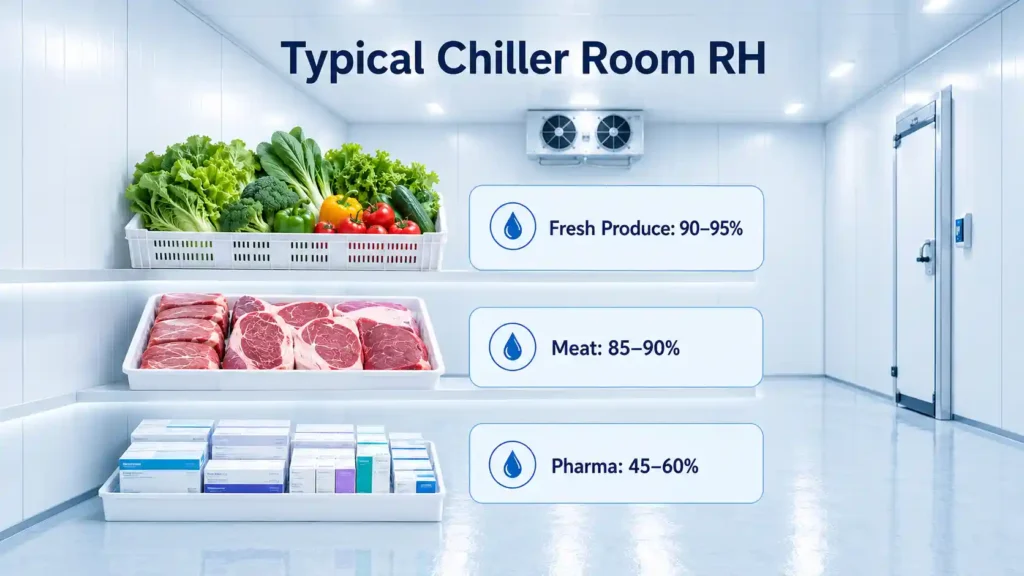
No single humidity level works for every chiller room. The right RH depends on what you are storing, how it is packaged, the storage temperature, and any applicable quality or regulatory standards.
Here is a simple reference table:
| Product Type | Typical RH Range |
|---|---|
| Fresh vegetables | 90–95% RH |
| Leafy greens and herbs | 95–98% RH |
| Flowers | 90–95% RH |
| Fresh meat and poultry | 85–90% RH |
| Fresh seafood | 85–95% RH, depending on storage method |
| Dairy products | 75–85% RH |
| Frozen goods | 60–70% RH, but frost control and packaging matter more |
| Pharmaceutical products | 45–60% RH or as per product requirement |
| General medicine cold rooms | Often below 65%, depending on product requirement |
These are general industry guidance ranges — not fixed targets. Leafy vegetables held at low humidity will dry and lose weight quickly. Pharmaceutical products stored at high humidity risk packaging degradation, label failure, and, in some cases, product instability. The gap between those two requirements is significant, which is why the stored product — not general convention — should always determine the RH target.
Final settings should be confirmed against the product’s own specifications, supplier guidance, and, where applicable, regulatory storage requirements.
This is also why a Humidifier and Dehumidifier should never be selected randomly. The right choice depends on the product, room temperature, packaging, airflow, and how often the chiller room door is opened.
In simple terms, a Humidifier and Dehumidifier solve opposite problems inside a chiller room. One adds moisture when the air is too dry. The other removes moisture when the room becomes too damp.
When Does a Chiller Room Need a Humidifier?
A chiller room doesn’t always need extra humidity. But there are times when the air inside gets too dry for the products you’re storing — and that’s when an industrial humidifier becomes necessary.
This is especially common with fresh vegetables, leafy greens, herbs, flowers, some meat storage areas, and certain food processing cold rooms.
When humidity drops too low, products start losing their natural moisture. It might not look serious at first, but over time, it affects appearance, weight, texture, and overall freshness.
Here are some clear signs that humidity levels inside your chiller room are too low:
- Vegetables wilt faster than they should
- Leafy greens dry out at the edges
- Flowers lose freshness soon after delivery
- Meat surfaces start to look dry
- You notice measurable weight loss in your products
- Vacuum-packed or modified atmosphere packaging shows signs of stress
- Items look older than their expiry dates suggest
A regular home humidifier won’t work here. Chiller rooms need a proper industrial humidifier — one built for cold environments, strict hygiene standards, continuous operation, and even moisture distribution across the entire space.
Choosing the right humidifier isn’t just about brand name. It has to match your room size, temperature range, airflow, product load, target humidity level, and hygiene requirements.
When everything is properly selected, a good industrial humidifier can help reduce product shrinkage and keep vegetables, flowers, herbs, and other moisture-sensitive goods fresher for longer.
When Does a Chiller Room Need a Dehumidifier?
Too much moisture is just as damaging as too little. When RH inside a chiller room climbs above the acceptable range for the stored product, condensation follows — and with it, wet cartons, mould risk, ice buildup on coils, and packaging that starts to fail.
The source is almost always warm air getting in. Open doors, loading bay exposure, worn gaskets, poor panel sealing — any gap that lets outside air into a cold space creates the conditions for moisture to condense on cold surfaces. In the UAE, where ambient air is warm and often humid, the problem is more pronounced than in temperate climates.
Signs the humidity inside your chiller room is too high:
- Water droplets on ceiling panels or walls
- Wet or slippery floors
- Condensation on product surfaces or packaging
- Musty smell or visible mould on surfaces
- Ice is accumulating around the evaporator coils
- Cartons softening, going damp, or collapsing
- Labels peeling or becoming unreadable
- RH sensor readings are consistently sitting above your target range
A dehumidifier can manage the moisture load, but it should not be the first response to every humidity problem. If door seals are failing, airflow is blocked, or the defrost cycle is misconfigured, a dehumidifier fitted on top of those issues will just run harder without fixing anything. Identify the source first.
For rooms running above 15°C, a compressor-based dehumidifier is often practical. Below 15°C — and particularly below 10°C, which covers most commercial chiller rooms — a desiccant dehumidifier is the appropriate choice. Compressor-based units lose efficiency quickly at low temperatures and become unreliable in the range most chiller rooms actually operate in.
Sizing matters too. An undersized unit will not keep up with the moisture load during peak access periods. An oversized one runs inefficiently and may create its own humidity imbalances. The right industrial dehumidifier for a chiller room should be selected based on operating temperature, room volume, moisture load, airflow pattern, door usage frequency, and maintenance access — not just picked from a product catalogue.
Humidifier and Dehumidifier: Which One Does Your Chiller Room Need?
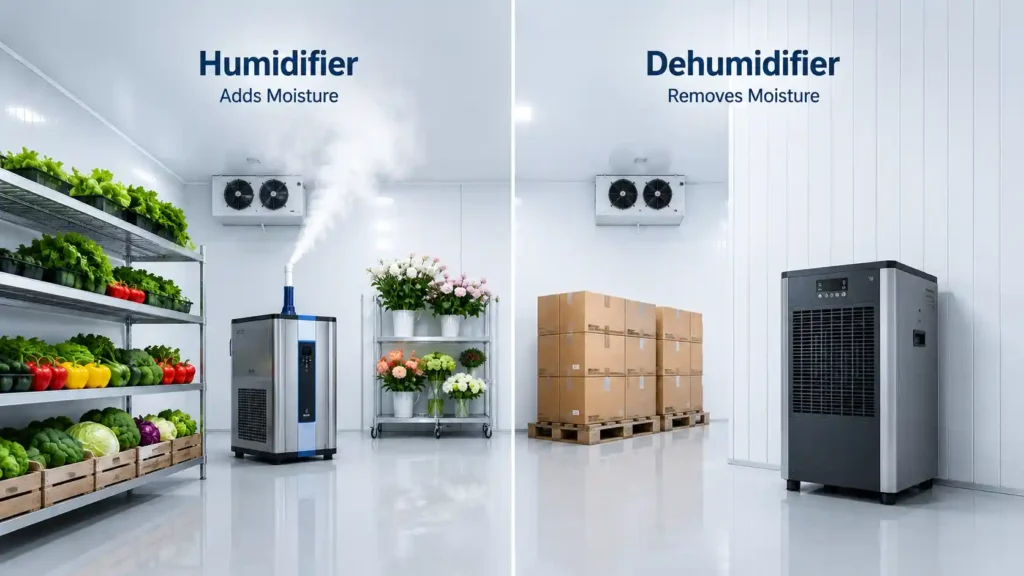
Here is the simple way to understand it:
| Problem or Condition | Likely Solution |
|---|---|
| Products dry faster than expected | Humidifier |
| Produce loses weight in storage | Humidifier |
| Flowers wilt quickly | Humidifier |
| RH is below the product requirement | Humidifier |
| Condensation on panels, ceiling, or products | Dehumidifier |
| Damp cartons or packaging | Dehumidifier |
| Mould risk or musty smell | Dehumidifier |
| RH is above the product requirement | Dehumidifier |
| RH readings are unstable | Check airflow, door seals, sensor location, and refrigeration design |
One important point: the right answer is not always “install a machine.”
Sometimes the real problem is poor insulation, wrong evaporator selection, blocked airflow, damaged door gaskets, poor defrost settings, bad drainage, or sensors placed too close to doors or cooling coils.
Fixing the root cause often gives better results than simply adding a humidifier or dehumidifier.
Chiller Room Humidity with Sensor: Why Monitoring Matters
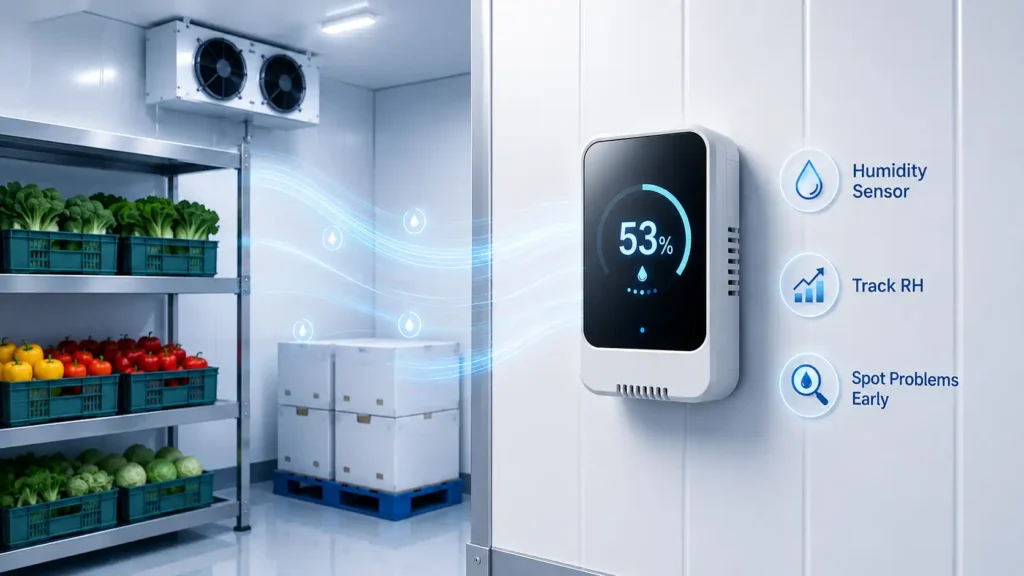
A humidity sensor is very useful inside a chiller room, but it must be installed correctly.
A chiller room humidity with a sensor setup helps you:
- Track RH levels continuously.
- Notice humidity spikes after door openings.
- Identify condensation risk early.
- Record humidity data for food, pharma, or quality control needs.
- Understand whether the problem is constant or only happens during the loading activity.
But a sensor does not control humidity by itself. It only gives the reading.
Actual control depends on proper refrigeration design, airflow, door management, evaporator selection, humidifiers, dehumidifiers, and maintenance.
Sensor placement also matters. If the sensor is too close to the evaporator discharge, door opening, or drainage area, it may not show the true room condition. For better monitoring, sensors should be placed in representative locations and calibrated regularly.
How Air Conditioners Affect Chiller Room Humidity
Your refrigeration system pulls moisture out of the air as a natural part of the cooling process. When warm air passes over the cold evaporator coils, moisture condenses on the coil surface and drains away. This happens in almost every cooling system, whether you plan for it or not.
The problem is that this built-in dehumidifying effect is rarely precise enough to maintain the right RH for every product. It is a byproduct of cooling, not a controlled humidity management system.
The key variable is delta-T — the temperature difference between the coil surface and the room air. A large delta-T strips more moisture from the air. In a room that needs to stay dry, that is useful. In a produce room or flower chiller running at 90–95% RH, the same effect dries out the product even when the room temperature reads correctly. A high delta-T evaporator running significantly colder than the room setpoint will pull humidity down regardless of what the thermostat says — and this is one of the most common design errors in UAE chiller rooms storing fresh produce or cut flowers.
The opposite problem also happens. If warm, humid air keeps entering through frequent door openings, the refrigeration system gets overwhelmed. Moisture load builds faster than the coil can handle it, condensation forms on surfaces, and ice starts accumulating around the evaporator. Neither outcome is acceptable for most commercial cold storage applications. Both come back to the same point: humidity behaviour needs to be considered at the design stage, factored into evaporator selection, coil temperature, and airflow layout — not addressed after installation with bolt-on equipment.
Can You Use an Air Purifier and Humidifier in a Chiller Room?
Many people search for an air purifier and humidifier, but domestic units are not suitable for commercial chiller rooms.
Home appliances are designed for bedrooms, offices, and normal indoor spaces. A chiller room is different. It operates at low temperature, handles high product loads, runs for long hours, and may require hygiene-friendly equipment.
A domestic air purifier or humidifier may:
- Fail in cold conditions
- Create uneven moisture
- It will be difficult to clean
- Not handle commercial room volume
- Create electrical or hygiene risks
- Fail to meet food or pharma storage needs
For commercial cold storage, you need equipment designed for cold environments, continuous operation, hygiene control, and the correct moisture load.
Portable Chiller Room Humidity: What to Consider
Portable chiller rooms are useful for temporary storage, catering, seasonal stock, events, backup storage, and food distribution. But portable chiller room humidity can change faster than in a permanent cold room.
This is because portable units are often placed near loading areas, outdoor spaces, or warm enclosed areas. Every door opening lets in warm air, and in UAE conditions, that air can carry a lot of moisture.
For portable chiller room humidity management:
- Make sure door seals are in good condition.
- Keep door openings as short as possible.
- Use strip curtains where practical.
- Avoid overloading the room.
- Keep airflow paths clear.
- Monitor RH with a portable sensor.
- Check whether the stored product needs a specific RH range.
For temporary or flexible cold storage needs, see our page on portable chiller room solutions.
Common Humidity Problems in UAE Chiller Rooms
Most chiller humidity problems in the UAE come from three areas: daily operation, engineering design, or poor monitoring.
Common causes include:
- Frequent door opening
- Damaged door gaskets
- Poor door sealing
- Warm loading bay air is entering the room
- Wrong evaporator selection
- Incorrect defrost cycle
- Blocked airflow due to poor stacking
- Oversized or undersized refrigeration equipment
- No RH sensor
- The sensor was placed in the wrong location
- Poor insulation joints
- Drainage problems
- Using domestic humidifiers or dehumidifiers
Before installing equipment, the room should be checked properly. A dehumidifier will not fully solve a leaking door. A humidifier will not fix an evaporator that is drying the room too much.
For a wider look at system issues, read our article on why chiller rooms fail in UAE.
Humidity Control for Different Chiller Room Applications
Food and Vegetable Storage
Fresh produce is one of the most humidity-sensitive categories. Many vegetables need around 90–95% RH to reduce moisture loss. Leafy vegetables and herbs may need even higher humidity.
But high humidity must be managed properly. If airflow is poor or the room has warm pockets, condensation may form even when the average RH looks acceptable.
For more details, read our guide on fruit cold storage humidity.
Flower Chiller Rooms
Flowers need a stable temperature and high humidity to stay fresh. Even short periods of dry air can damage petals and stems.
In UAE flower storage, humidity control becomes especially important during deliveries. Every door opening can bring in warm, humid air, which may disturb both temperature and RH.
For more details, see our page on flower chiller humidity control.
Pharmaceutical Chiller Rooms
Pharmaceutical products are different from fresh produce. Many pharma products require lower and tightly controlled humidity.
Excess moisture can affect cartons, labels, packaging, and product stability. The correct RH level should always come from the product datasheet, supplier instructions, or storage protocol.
Refer to our page on pharma cold storage humidity control for more details.
Commercial Cold Storage
Large cold storage facilities often handle multiple product categories. This makes humidity control more complex.
A commercial cold storage facility may need separate zones, careful airflow design, humidity sensors, and different RH strategies for different products.
For more, see our overview of commercial cold storage in UAE.
How ChillerRoom.ae Designs Humidity-Aware Chiller Rooms
Humidity control is not a separate add-on. It should be part of the chiller room design from the beginning. Instead of treating a Humidifier and Dehumidifier as afterthought equipment, we look at humidity control as part of the full chiller room design.
When ChillerRoom.ae designs a cold storage system, we look at the full environment, including:
- Product type and RH requirement
- Room size and usable storage volume
- Target temperature
- Target humidity level
- Door opening frequency
- Loading pattern
- Insulated panel quality
- Door sealing
- Evaporator selection
- Airflow pattern
- Coil temperature and delta-T
- Defrost and drainage design
- Sensor location
- UAE outdoor temperature and humidity
- Maintenance access
As one of the Best Chiller Room Manufacturers in UAE, ChillerRoom.ae designs humidity-aware chiller room systems that balance temperature, airflow, insulation, and moisture control for reliable long-term performance.
A good chiller room should not only reach the correct temperature. It should protect the product inside it, every day, under real UAE operating conditions.
Final Thoughts
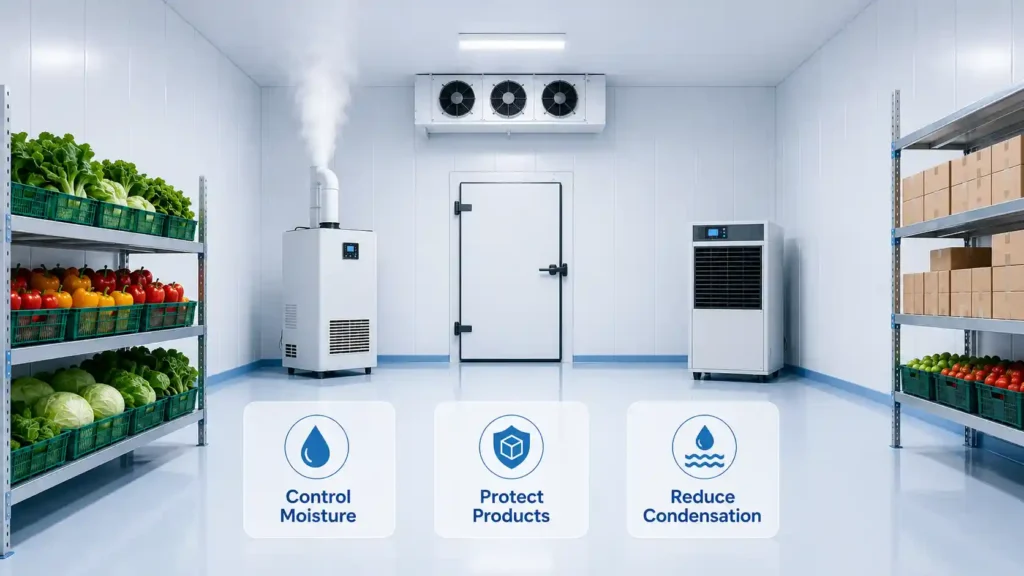
Humidity control is not a minor detail. It directly affects how long your products last, how much weight fresh produce loses in storage, whether your packaging holds up, and how hard your refrigeration system has to work.
Get it wrong in one direction and products dry out, wilt, and lose sellable weight before they reach the shelf. Get it wrong in the other, and you are dealing with condensation, collapsing cartons, mould risk, and ice building up on coils.
A humidifier addresses moisture deficiency. A dehumidifier handles excess. But neither piece of equipment fixes a poorly designed room, a badly selected evaporator, or a door that is opened fifty times a day without a strip curtain. The equipment choice follows the engineering assessment — not the other way around.
The right solution depends on what you are storing, the operating temperature, how the room breathes, the insulation quality, and the specific conditions at your site. UAE facilities face a different baseline than cold storage in cooler climates. That context matters when specifying any humidity control system.
If your chiller room has condensation problems, products drying faster than they should, mould risk, or humidity readings that will not stabilise, contact ChillerRoom.ae for a site assessment. The issue may be the equipment. It may be a design. It may be both. Either way, it is worth finding out before the problem gets worse.
Frequently Asked Questions
Start with the items inside the room.
Vegetables and flowers usually need more moisture. Medicines, cartons, and packed goods usually need drier air. So don’t set one humidity level for everything.
Check the door seals, airflow, drain line, and RH sensor first. If the room is still too dry or too damp, then use an industrial humidifier or an industrial dehumidifier.
Most cool rooms become humid because warm air keeps entering.
Look at the door first. Is it open too often? Is the rubber gasket loose? Is warm air coming from the loading area? Also, check the drain and defrost timing.
Fix these basics before adding a machine. If humidity is still high, use an industrial dehumidifier. In colder rooms, a desiccant dehumidifier is usually better.
Keep the door closed as much as possible. That sounds simple, but it makes a big difference.
Repair damaged gaskets. Seal small gaps. Keep drains clean. Don’t leave the door open during loading. If staff enter often, use strip curtains.
An RH sensor helps, too. It shows humidity rising before you see water drops on panels or cartons.
Yes. A cold room can be dehumidified.
But don’t use a normal room dehumidifier and expect it to work well. Cold rooms need a unit made for low temperatures. For rooms below 10°C, a desiccant dehumidifier is usually the safer choice.
It depends on the product.
Vegetables may need around 90–95% RH. Meat is often around 85–90% RH. Pharma products usually need lower humidity, often 45–60% RH or below 65%, depending on the product.
A flower chiller and a medicine chiller should not run at the same setting.
Check what the room is doing.
Products drying out? Use a humidifier.
Condensation, wet cartons, mould smell, or high RH readings? Use a dehumidifier.
But check the room first. Sometimes the real issue is not the humidity equipment. It may be a weak door seal, blocked airflow, poor drainage, or the wrong cooling unit.