Wine Chiller Room & Beer Chiller Room Solutions in UAE
Senior Refrigeration Engineer · ChillerRoom.ae
Updated 2026 · Estimated read time: 04–08 min
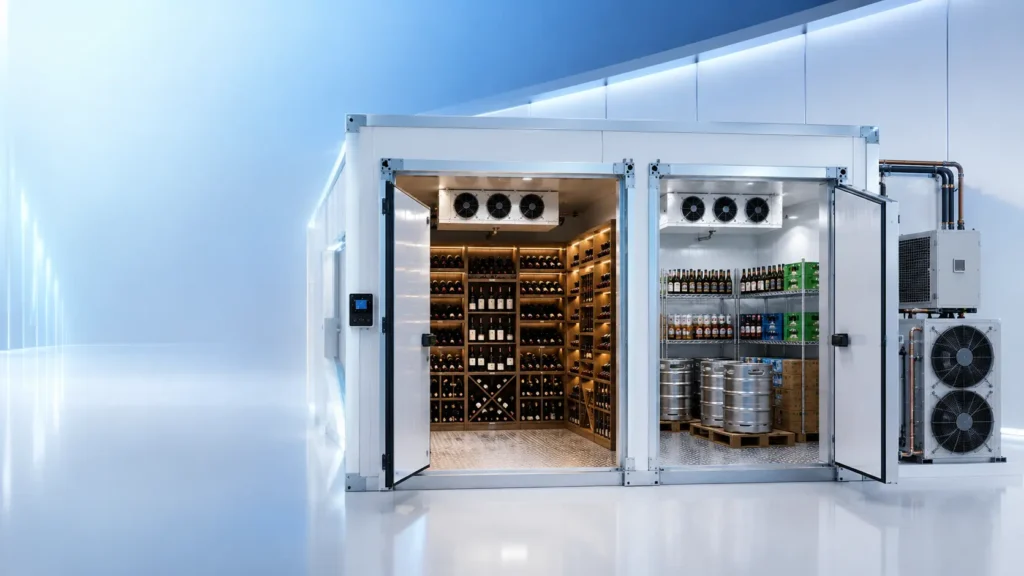
None of the wine or beer sold in Dubai, Abu Dhabi, or Sharjah is made locally. Every bottle and every keg has already survived weeks or months at sea, handled and reloaded more than once, before it ever reaches a restaurant cellar or a bar tap. Then it has to survive the UAE itself. Summer ambient temperatures here regularly climb past 45°C, sometimes closer to 50°C — a heat load most cold rooms were never built to handle. A space designed for stacking frozen chicken or produce doesn’t know what to do with a wine collection that needs steady humidity, gentle airflow, and protection from light. Most of the damage doesn’t happen during shipping. It happens afterward, once the product is sitting in the wrong kind of room. This is where a purpose-engineered wine chiller room and beer chiller room become essential — not a convenience, but a commercial safeguard for high-value, temperature-sensitive inventory.
Table of Contents
What Is a Wine Chiller Room?
A wine chiller room is a purpose-built, insulated storage environment engineered to hold wine at a stable 12°C to 15°C with 60% to 70% relative humidity. Unlike a domestic wine fridge, a commercial or industrial wine chiller room — sometimes specified as a wine room cooler system in engineering and procurement documents — in the UAE requires vapor-sealed insulation, UV-filtered lighting, and vibration-isolated refrigeration to protect cork integrity and prevent premature oxidation.
What Is a Beer Chiller Room?
A beer chiller room is a purpose-built, insulated commercial or industrial space engineered to hold packaged and draught beer between 2°C and 8°C, with unpasteurized craft and draught beer typically held at the stricter 2°C to 4°C range. Once that same room scales up for a distributor’s warehouse, procurement documents usually swap the label too, calling it beer cold storage instead of a beer chiller room. Whichever term applies, the room must halt residual fermentation, preserve hop aromatics, and — critically — block the light exposure that causes “skunking.”
Why Dubai, Abu Dhabi, and Sharjah Businesses Need Purpose-Built Beverage Storage
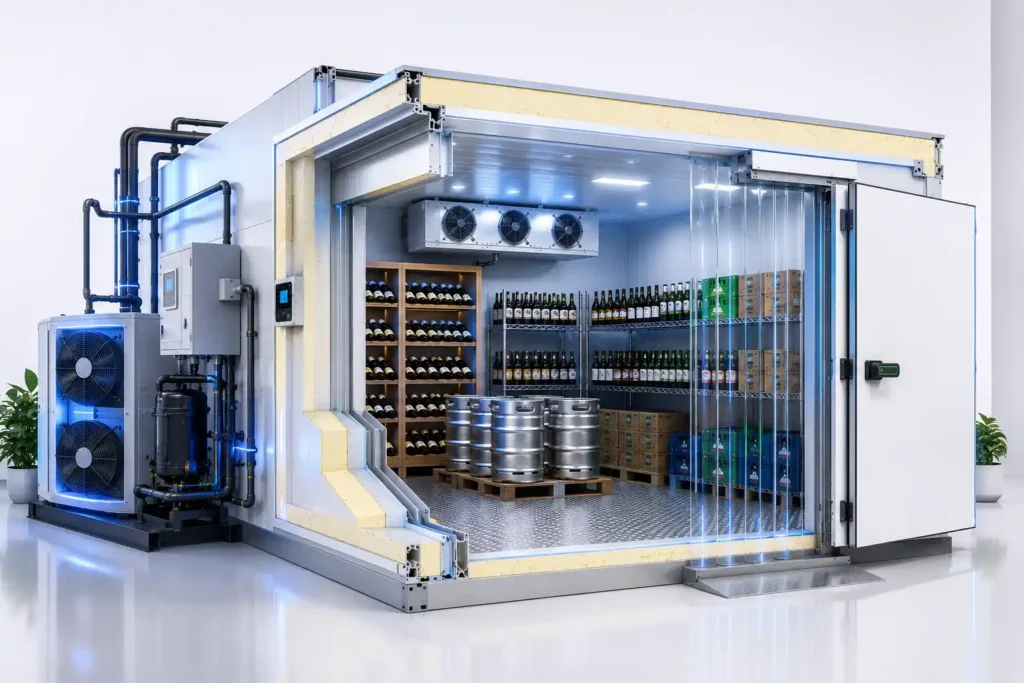
The single biggest variable separating UAE cold storage from cold storage anywhere else in the world is ambient heat load. Push outdoor temperatures past 45°C and the gap between that and a 2°C storage room turns into a serious mismatch — refrigeration systems built for milder climates end up running almost nonstop just to keep up. Humidity makes it worse. Dubai and Sharjah sit on the coast, and if a vapor barrier or panel joint is even slightly off, moisture works its way into the insulation. Once that happens, condensation sets in, then thermal bridging, and eventually the panel itself starts to fail. A hotel in Abu Dhabi or a distributor in Sharjah doesn’t save money by cutting corners here. They end up paying for it twice: once in spoiled inventory, and again on the electricity bill.
Who Needs a Wine Chiller Room or Beer Chiller Room in the UAE?
Not every food and beverage business needs dedicated beverage cold storage. The businesses that do include:
- Fine-dining restaurants and luxury hotels — their wine lists often carry vintages that can lose real value within days if left at UAE room temperature
- Sports bars, lounges, and high-volume pubs — running draught systems that depend on strict keg temperature control
- Beverage distributors and importers — holding full pallets of stock between customs clearance and delivery runs across Dubai, Abu Dhabi, and Sharjah
- Duty-free operators and airport logistics providers — maintaining large premium wine inventories before retail transfer
- Resorts and hospitality groups — managing seasonal tourism surges in both keg and packaged beer volume
- Microbreweries and beverage manufacturers — requiring cold storage for maturation, carbonation, and pre-distribution holding
Wine Chiller Room vs Beer Chiller Room: What’s the Difference?
| Attribute | Wine Chiller Room | Beer Chiller Room |
|---|---|---|
| Ideal Temperature | 12°C to 15°C | 2°C to 8°C (2°C–4°C for draught) |
| Acceptable Fluctuation | ±1°C | ±2°C |
| Relative Humidity | 60%–70% | Below 60% |
| Light Sensitivity | High — causes light-struck fault | Extreme — causes skunking |
| Vibration Sensitivity | Extreme — disturbs aging chemistry | Low to moderate |
| Primary Packaging | Glass bottles, natural/synthetic corks | Steel kegs, cans, glass bottles |
| Air Circulation | Gentle, draft-free | Moderate to high |
Because these two beverages have opposing thermal and humidity requirements, combining them in a single uncontrolled space at a “compromise” temperature — such as 8°C — damages both. Beer stales faster at 8°C, while wine’s aging process stalls and tartrate crystals can precipitate out of the liquid.
Commercial Wine Chiller Rooms
Commercial wine chiller rooms — typically 10 to 50 cubic meters — serve restaurants, hotels, and premium retailers where visual appeal and rapid access matter as much as temperature accuracy. Fine-dining venues often specify “box-in-a-box” designs, where the room is visible to guests through heated, multi-pane, argon-filled glass doors. Without door heating, the temperature differential between a 12°C room and the ambient restaurant floor causes continuous condensation and slip hazards.
Commercial Beer Chiller Rooms
For bars and pubs, the beer chiller room is the operational core of the venue. These installations require reinforced aluminum diamond-plate flooring to withstand dropped and rolled kegs, while sealed wall penetrations carry glycol-cooled “python” trunk lines from the room directly to the bar taps.
Industrial Wine Cold Storage
At warehouse scale, the correct industry term shifts from “wine chiller room” to wine cold storage. These facilities — ranging from hundreds to thousands of cubic meters — serve importers, distributors, and third-party logistics providers across the UAE. They’re engineered around pallet dimensions and forklift turning radii, with multiple high-capacity evaporators ensuring uniform temperature across large air volumes.
Industrial Beer Cold Storage
The same distinction applies to beer: large-scale installations for breweries and distributors are technically termed beer cold storage once they reach warehouse scale. Because a single compressor failure during a UAE summer afternoon can destroy an entire shipment, these systems require N+1 refrigeration redundancy — a backup system that engages instantly if the primary unit fails. Flooring is a civil engineering exercise in itself: a vapor barrier, high-density insulation board, and a reinforced concrete wearing slab must together support the point-loads of loaded forklifts and double-deep pallet racking.
Engineering for UAE Heat: Panels and Refrigeration
| Component | Specification for UAE Conditions |
|---|---|
| Panel Core Material | Polyisocyanurate (PIR) — B1 fire-rated, low K-value (0.020–0.022 W/mK) |
| Panel Thickness | 75mm to 100mm minimum for 2°C–15°C applications |
| Panel Joints | Cam-lock or tongue-and-groove with continuous silicone seal |
| Compressor Type | Tropicalized scroll or semi-hermetic, inverter-driven |
| Condenser Sizing | Oversized heat exchange surface rated for 50°C+ ambient |
| Evaporator Fans | EC (Electronically Commutated), linked to door micro-switches |
Standard 50mm panels are undersized for Gulf conditions and force compressors into near-continuous operation, shortening equipment lifespan and driving up energy costs. PIR is the preferred core material across Dubai, Abu Dhabi, and Sharjah installations, not only for its thermal performance but because it meets the B1 fire-rating civil defense codes require, unlike standard PUF panels that often fall into lower fire-safety categories.
The Hidden Threat: Why Light Exposure Ruins Wine and Beer
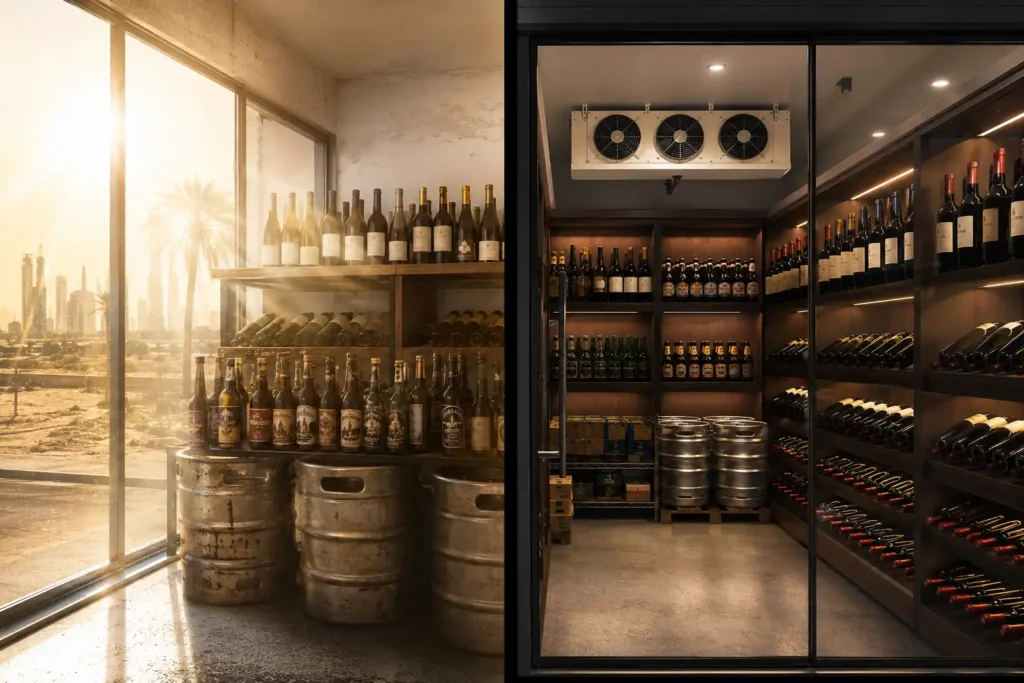
Temperature and humidity are only part of the equation — light is the silent variable most generic cold rooms ignore entirely. Wine exposed to UV and blue-spectrum light undergoes a photochemical reaction involving riboflavin and sulfur-containing amino acids, producing volatile compounds that create off-aromas often described as cooked cabbage. Research from bodies such as the Australian Wine Research Institute has documented this “lightstruck fault” extensively. Beer faces an even more sensitive version of the same chemistry: hop-derived bittering compounds react with light-activated riboflavin to form a sulfur compound with a detection threshold of just 4 parts per trillion — among the most potent flavor compounds known, and the source of the distinct “skunky” odor familiar to anyone who’s left a beer in direct sun. Because this reaction can occur within minutes, both room types must use UV-filtered glazing and warm-spectrum LED lighting rather than standard fixtures.
Can Wine and Beer Be Stored in the Same Cold Room?
Not for long-term commercial use. The two have opposing temperature, humidity, and vibration requirements, so combining them undermines both. The practical solution for UAE operators seeking space efficiency is a multi-zone beverage cold room — a single insulated envelope divided by internal PIR partition walls, each zone running its own evaporator and digital controller, so wine and beer are each held at their correct climate within one physical footprint.
Energy Efficiency and DEWA Slab Tariffs
Dubai’s utility billing structure uses a progressive slab tariff, meaning electricity rates climb as consumption rises. A poorly insulated cold room that runs continuously doesn’t just waste energy — it pushes a business into a higher billing bracket. Industry estimates suggest that upgrading from 50mm to 100mm PIR paneling can reduce energy consumption by roughly a quarter to a third, while inverter-driven compressors and strip curtains further cut the load created by frequent door openings during peak service hours.
Frequently Asked Questions
Not exactly. “Wine chiller room” typically refers to a commercial, restaurant, or retail-scale installation, while “wine cold storage” describes warehouse-scale, palletized storage used by importers and distributors. Both maintain the same 12°C to 15°C range — the difference is scale, not temperature.
They describe the same core function at different scales. A beer chiller room usually refers to a bar, pub, or hotel-scale keg cooler, while beer cold storage refers to the larger warehouse facilities used by breweries and distributors. Both are held between 2°C and 8°C.
Between 12°C and 15°C, which preserves phenolic compounds and prevents tartrate crystals from forming, which happens at lower temperatures.
Between 2°C and 8°C, with draught and unpasteurized craft beer stored at the stricter 2°C to 4°C range to halt fermentation and protect hop aromatics.
Not for long-term storage. Their conflicting temperature and humidity needs require either separate rooms or a multi-zone room with independent climate controls.
Given ambient temperatures exceeding 50°C, 75mm to 100mm PIR insulated panels are the standard requirement for both wine and beer applications.
Under-insulated rooms or non-tropicalized compressors run continuously, pushing consumption into DEWA’s highest tariff bracket and significantly raising operating costs.
Partner with ChillerRoom.ae
Whether you’re a hotel in Abu Dhabi protecting a vintage wine collection, a pub in Sharjah running a live keg system, or a distributor in Dubai managing palletized imports, generic cold storage isn’t built for what you’re storing. ChillerRoom.ae designs and installs commercial and industrial wine chiller rooms and beer chiller rooms engineered specifically for UAE heat, humidity, and regulatory requirements. Consult with our beverage refrigeration engineers today to protect your inventory.