
Chiller Cooling System Explained: Why It’s Not Cold Storage
Senior Refrigeration Engineer · Chiller Room Manufacturers in UAE
Updated 2026 · Estimated read time: 10–15 min
Quick Answer
A water chiller is a mechanical system — it cools water, and that water does the cooling work somewhere else, whether that is an air conditioning network or a production line. A chiller room is a cold storage space, insulated and refrigerated, built to keep products safe at low temperatures. Same word, completely different purpose. And in the UAE, mixing them up is a mistake that costs real money.
Table of Contents
Two Systems, One Word — and a Lot of Confusion
There is a reason this question keeps coming up. Speak to any procurement manager who has been in the UAE market for a few years, and they will tell you — the word “chiller” gets thrown around loosely. HVAC companies use it. Cold storage contractors use it. Equipment suppliers use it. And they are all talking about different things.
The problem is not the terminology, really. The problem is what happens when a business specifies the wrong system. A restaurant owner in Sharjah once described it well: “We asked for a chiller, we got a chiller — and our vegetables were still spoiling.” What they had installed was a building comfort cooling system. What they needed was a walk-in chiller room with proper insulation, airflow design, and a refrigeration unit sized for food storage loads.
That kind of gap — between what someone asks for and what their operation actually needs — is surprisingly common across UAE food, pharma, and logistics businesses. This article is here to close it.
What Does a Chiller Cooling System Actually Do?
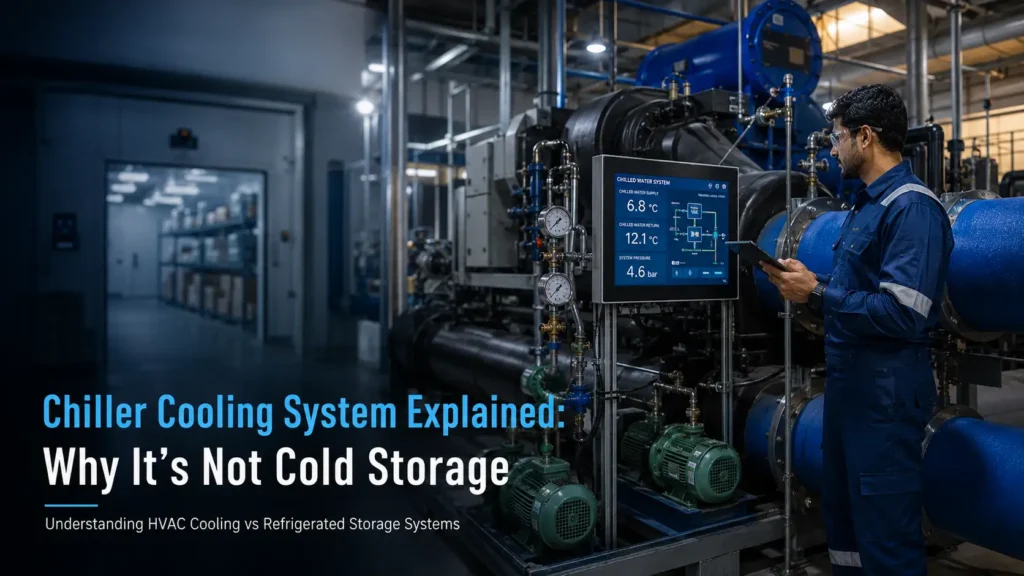
Strip away the technical language, and a chiller system does something fairly straightforward: it takes warm water, removes the heat from it, and sends it out cold. That cold water then travels through a network of pipes and does the cooling work — whether that means air conditioning a hotel on Sheikh Zayed Road or keeping a pharmaceutical filling line at a stable operating temperature.
The chilled water pump is what keeps everything moving. Without it, the cold water just sits there. With it, you have a continuous loop — cold water out, warm water back, chilled again, repeat. In real-world applications, a chiller cooling system in UAE is engineered to perform reliably even in extreme outdoor temperatures exceeding 45°C.
This is the backbone of central HVAC in most large UAE commercial buildings. When you walk into a mall in July, and the temperature is 22°C despite the world outside being 46°C, a chiller system is doing that work. It is an infrastructure system, not a storage system. That distinction matters enormously when you are deciding what to install.
The Different Types of Chillers — Explained Without the Jargon
Not every chiller works the same way, and knowing the differences helps you understand why none of them is a substitute for a purpose-built cold storage room.
Air Cooled Chiller: This one pushes the heat it collects out into the surrounding air using fans and a condenser coil. No cooling tower is needed, so it is simpler to set up. For smaller commercial buildings, it is a reasonable choice. The catch in the UAE is physics — when outdoor air is already at 44°C, rejecting heat into it takes more energy and more effort from the machine. Modern high-ambient units are rated for operation up to around 52–55°C, but energy consumption goes up noticeably as temperatures rise. Worth knowing before specifying.
Water-cooled chiller: Rather than using outdoor air, this type uses a cooling tower and a water circuit to carry heat away. It is more efficient, particularly at scale — which is why you will find water-cooled systems running the central cooling in large UAE hospitals, district cooling plants, and five-star hotels. More infrastructure to manage, more maintenance required, but the efficiency gains at large loads make it worthwhile.
Water Chiller System (Process Cooling): Here, the chilled water is not going to an air conditioning network — it is going directly to a piece of equipment or a production process to keep it from overheating. A water tank chiller stores and circulates this cooled water. Common in food processing, beverage production, plastics manufacturing, and laboratory settings.
Thermo Chiller: This is a compact, self-contained unit that controls the temperature of a recirculating fluid — it can heat or cool depending on what is needed. Used mainly in precision industrial applications: laser cutting systems, semiconductor equipment, and research instruments. Accurate, but small-scale. Not a cold storage tool.
Compression Chiller: The vapour compression refrigeration cycle — compressor, condenser, expansion valve, evaporator — is the engine inside most chillers, whether for HVAC or cold storage. The terminology describes the technology; the application determines whether it belongs in a building’s plant room or inside a chiller room for food storage.
Chiller AC / Chiller Air Conditioner: This is simply what you call it when a chiller system powers a building’s central air conditioning. Cold water from the chiller travels to fan coil units installed throughout the building. Those units blow cold air into the occupied space. Standard setup for large UAE commercial buildings.
So, What Is a Chiller Room?
A chiller room is a completely different category of solution.
Think of it as an engineered cold environment — not just a room with an air conditioning unit pointed at it. The walls, ceiling, and floor are built from insulated panels (usually polyurethane foam between steel faces) that resist heat transfer. A dedicated refrigeration unit — the heart of the room — removes heat from the interior and holds the internal temperature at a set level, hour after hour, regardless of how hot it is outside.
The purpose is preservation, not comfort. Nothing inside a chiller room is there to feel the cold air. The products inside — food, medicine, flowers, vaccines — need that stable temperature to remain safe, compliant, and saleable.
Temperature requirements vary depending on what is being stored. Fresh produce and dairy in a supermarket context typically need 0°C to +4°C. Hotel kitchens generally work in the 0°C to +6°C band. Pharmaceutical storage — vaccines, biologics, temperature-sensitive medicines — usually demands +2°C to +8°C with strict monitoring and traceability.
Chiller rooms can be permanent walk-in chiller rooms built into a facility, portable chiller units that can be moved and redeployed as operations change, or fully customised cold storage rooms engineered from scratch around specific products, load profiles, and site conditions.
Side-by-Side: How They Actually Compare
| Water Chiller / Chiller Cooling System | Chiller Room | |
|---|---|---|
| Core function | Cools water for HVAC or industrial process | Stores products at controlled low temperature |
| What it produces | Cold water flowing through pipes | A stable cold environment inside an insulated room |
| Typical temperature | ~6–7°C supply / 12°C return (chilled water) | 0°C to +8°C depending on product type |
| Built for | Cooling buildings, cooling processes | Storing food, medicine, perishables |
| Key components | Chiller unit, chilled water pump, pipework | Insulated panels, refrigeration unit, temperature controls |
| UAE application | Large hotels, hospitals, malls, factories | Supermarkets, restaurants, pharma facilities, logistics |
| Who specifies it | HVAC engineer / MEP contractor | Cold storage specialist |
When a Water Chiller Is the Right Answer
If your requirement falls into any of these categories, a water chiller or chiller cooling system in UAE facilities is what belongs in your operation:
- Central air conditioning for a large commercial building across multiple floors or zones
- Industrial process cooling — machinery, equipment, or production lines that generate continuous heat
- Data centre thermal management, where server infrastructure needs consistent cooling
- Manufacturing operations where the product is being processed at a temperature, not stored at a temperature
- Any scenario where the deliverable is cold water moving through a distribution loop
These are HVAC and mechanical engineering decisions. The right contractor is an MEP or process cooling specialist.
When a Chiller Room Is What You Actually Need
If your concern is the safety, quality, and regulatory compliance of what you are storing, the answer is a chiller room — and it needs to be properly engineered, not improvised.
You need a chiller room when:
- You store fresh food, dairy, beverages, or prepared meals and must meet UAE food safety requirements consistently
- Your operation handles pharmaceuticals, vaccines, or healthcare products with defined temperature tolerances
- You run a commercial kitchen, catering facility, or food processing operation where raw and finished goods need proper cold holding conditions
- You are distributing perishable goods and need reliable cold storage at the warehouse before onward delivery
- You need rapid temperature reduction after cooking — a blast chiller is designed for exactly that, and it is a food safety requirement in many UAE commercial kitchen environments
- Your situation calls for flexible or temporary cold storage — a portable chiller can be up and running quickly without permanent construction
The common thread is product protection. If what is inside the cold space has value, has a compliance requirement, or has a shelf life, it deserves a system designed for storage — not one repurposed from building services.
The Mistake That Costs Businesses the Most
It usually starts the same way. A business briefs a contractor. The brief says “chiller.” The contractor — experienced in their field, doing their job correctly — installs what they know. And then the problems begin.
The temperature inside the space is inconsistent. Humidity is not controlled. Airflow was never designed around pallet racking or product density. The loading bay introduces a heat surge every time the door opens, and there is no buffer to absorb it. Products spoil faster than they should. An audit flags non-compliance.
Nobody made an obviously bad decision. The contractor did what they were briefed to do. The problem was upstream — the requirement was not defined precisely enough, and the two categories of “chiller” were treated as one.
The rework is expensive. The compliance exposure, in food or pharma contexts, can be more expensive still.
The practical fix is straightforward: before any specification conversation, answer one question. Am I cooling a space, or protecting a product? The answer to that single question determines which category of system you need — and which type of specialist should be designing it.
In Summary
Water chillers and chiller rooms are not competing products. They are solutions to different problems, and the UAE market needs both. Large commercial buildings depend on chiller cooling systems in UAE to maintain indoor comfort and operational stability. Food businesses, pharmaceutical operations, and cold chain logistics need properly engineered chiller rooms.
The confusion between the two is understandable — but it is also avoidable. Know what your operation actually requires before any equipment conversation begins.
At Chiller Room UAE, cold storage engineering is the only thing we do. With 7+ years of experience and over 1,000 installations across Dubai, Abu Dhabi, and Sharjah, we have worked with supermarkets, hotel groups, food processors, pharmaceutical distributors, and logistics operators — all of whom needed a chiller room built correctly for their specific operation, not a generic cold room solution off a catalogue.
Learn more about who we are and how we work, or explore the full range of chiller room solutions we provide. If you have a cold storage requirement and want to understand what it should actually look like before committing to anything, get in touch. A technical consultation costs nothing. Getting it wrong costs considerably more.
Frequently Asked Questions – Chiller Cooling System
A water chiller cools water that is then circulated through a building’s air conditioning network or an industrial cooling system. It is not a storage solution — it is part of a building’s or facility’s mechanical infrastructure. If your goal is to store perishable products safely, that is a different requirement entirely.
A chiller cooling system is used for central air conditioning and industrial process cooling. It circulates chilled water to remove heat from buildings or equipment, ensuring stable performance even in high ambient temperatures.
No — and conflating the two is one of the more common mistakes in UAE facility planning. A chiller AC system delivers cooled air to occupied spaces through fan coil units. A chiller room is a refrigerated, insulated space built specifically to hold products at stable low temperatures. They share a word, not a function.
It depends on the product. Fresh food and dairy generally need 0°C to +4°C. Hospitality and catering operations typically work between 0°C and +6°C. Pharmaceutical and healthcare storage usually requires +2°C to +8°C with tight tolerances and monitoring. A chiller room engineered for your product type will be specified accordingly — not set to a generic temperature and left to run.
Not appropriately. A water chiller or chiller AC system does not provide the insulation performance, humidity management, or airflow distribution that food or pharmaceutical storage requires. Temperature consistency throughout the storage space — which is what actually matters for product safety — is a cold storage engineering challenge, not an HVAC challenge.
An air cooled chiller releases heat into outdoor air using fans, making it simpler to install with no cooling tower required. A water cooled chiller uses a cooling tower and water circuit to reject heat more efficiently — better suited to large UAE facilities where the scale justifies the additional infrastructure. In high UAE ambient temperatures, both types need to be specified with high-ambient performance ratings.
A thermo chiller is a compact unit that precisely controls the temperature of a recirculating fluid, usually for a specific piece of industrial equipment — laser systems, lab instruments, semiconductor machinery. It is a precision temperature control tool, not a cold storage solution.
One question usually clarifies it: are you trying to cool a building or a process, or are you trying to protect a stored product? Building and process cooling points to a chiller system. Product protection points to a chiller room. If you are still unsure, speak to a cold storage specialist — not a general HVAC contractor — and describe what you are storing, in what volumes, and what temperature it needs to be held at. That conversation will give you a clear answer.