
Chiller Room Maintenance UAE: What Every Operator Needs to Know
Senior Refrigeration Engineer · ChillerRoom.ae
Updated 2026 · Estimated read time: 08–10 min
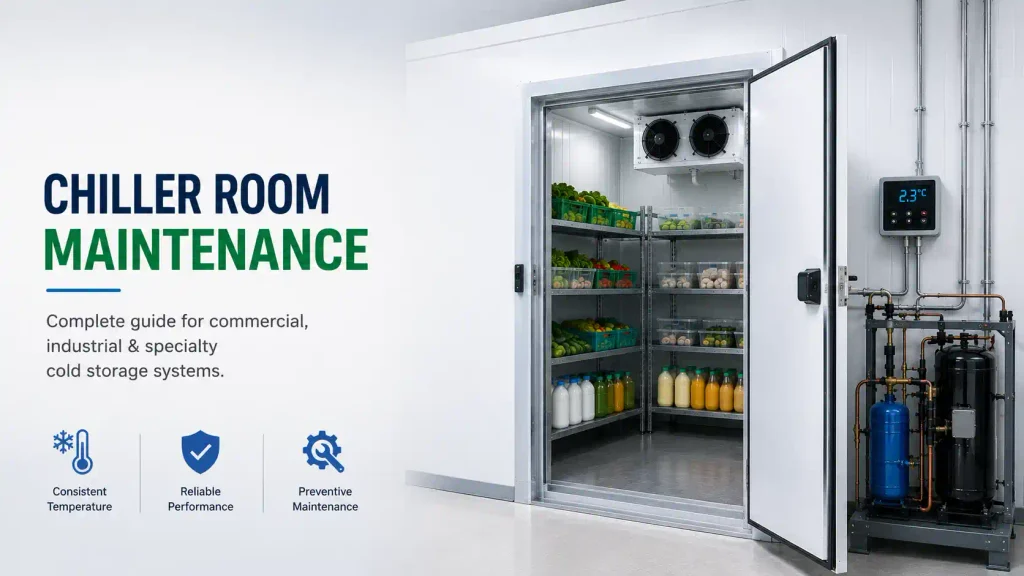
Run a chiller room in the UAE and maintenance isn’t really optional — it’s what stands between a normal shift and a room full of spoiled stock. At the core, that means keeping an eye on the compressor, condenser, evaporator, door seals, drainage, and temperature controls so the room holds its set range without burning through electricity or breaking down mid-service. Do it here, though, and you’re also up against summer heat that doesn’t let up, dust that gets into everything, coastal humidity, and the temperature rules set out under Dubai Municipality Food Code 2.0.
This guide covers chiller room maintenance for every setup used across Dubai, Abu Dhabi, Sharjah, Ajman, and the wider UAE — including walk-in, portable, container, blast, solar-powered, and flower/floral chiller rooms — along with a full daily-to-annual maintenance checklist and the type-by-type differences most guides skip.
Table of Contents
What Is a Chiller Room?
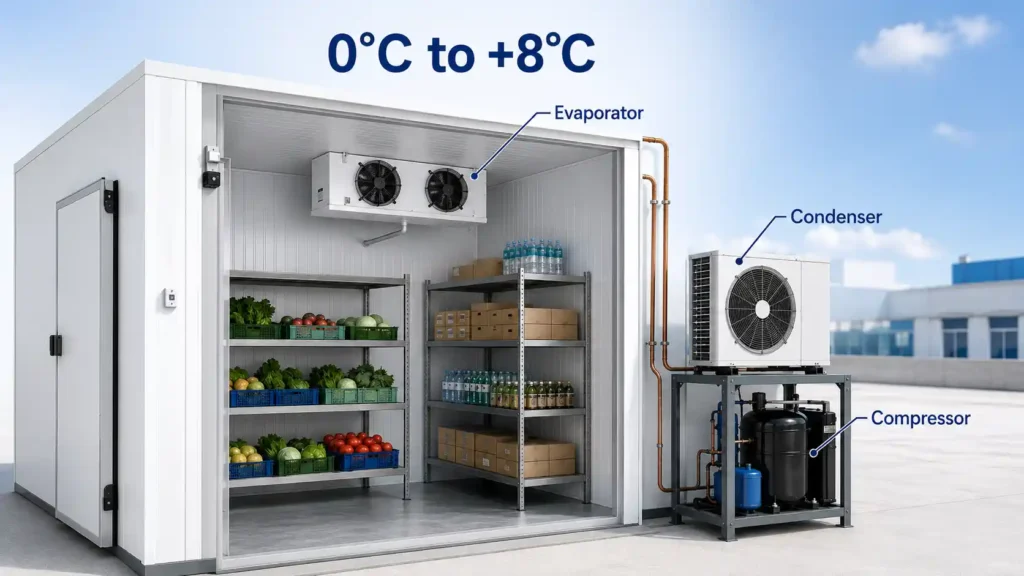
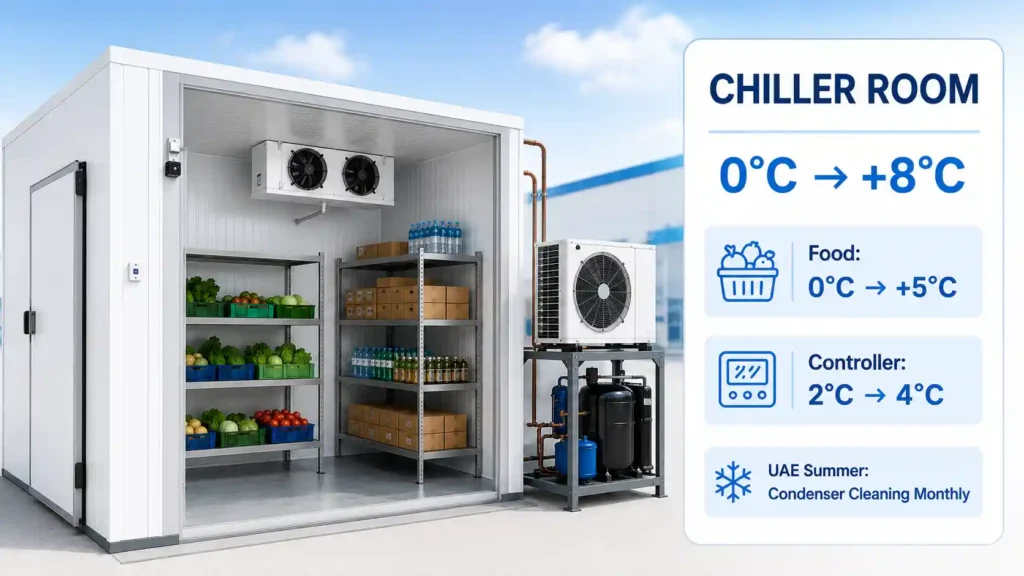
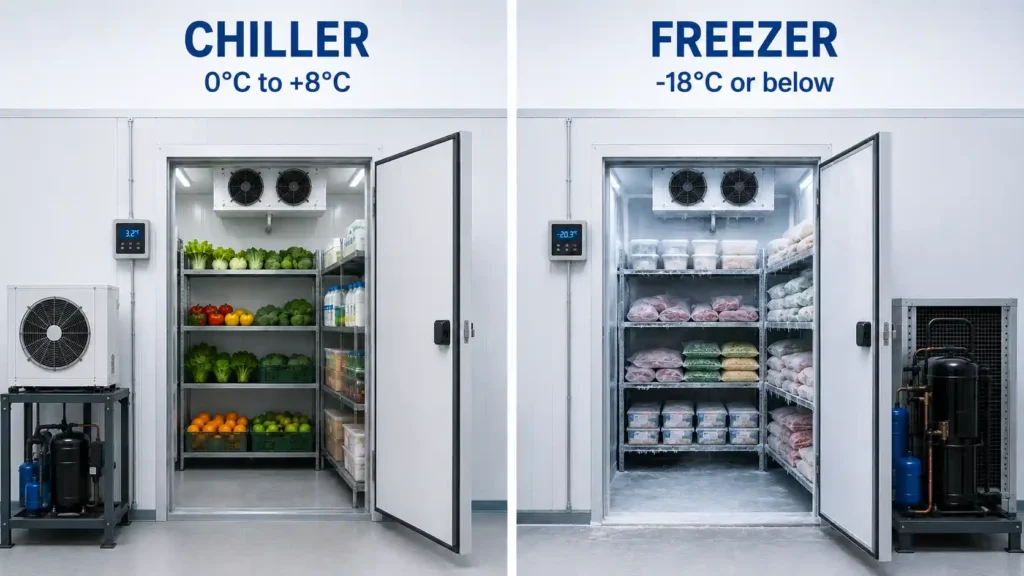
A chiller room is a commercial refrigeration facility that maintains temperatures above freezing, typically 0°C to +8°C, with most food applications requiring tighter control within 0°C to +5°C. This is distinct from a freezer room, which operates at -18°C or below for long-term frozen storage — the two are built and maintained differently, so it’s worth confirming which system you’re operating before applying a maintenance schedule. For a full breakdown of the temperature ranges by product type, humidity control, and compliance requirements, see our chiller room temperature guide for the UAE.
A chiller room relies on a vapor-compression refrigeration cycle — compressor, condenser, expansion valve, and evaporator — working together with refrigerant lines, insulated panels, and door seals to hold that stable internal environment, whether it’s storing food, beverages, pharmaceuticals, flowers, or industrial materials.
Why Chiller Room Maintenance Matters
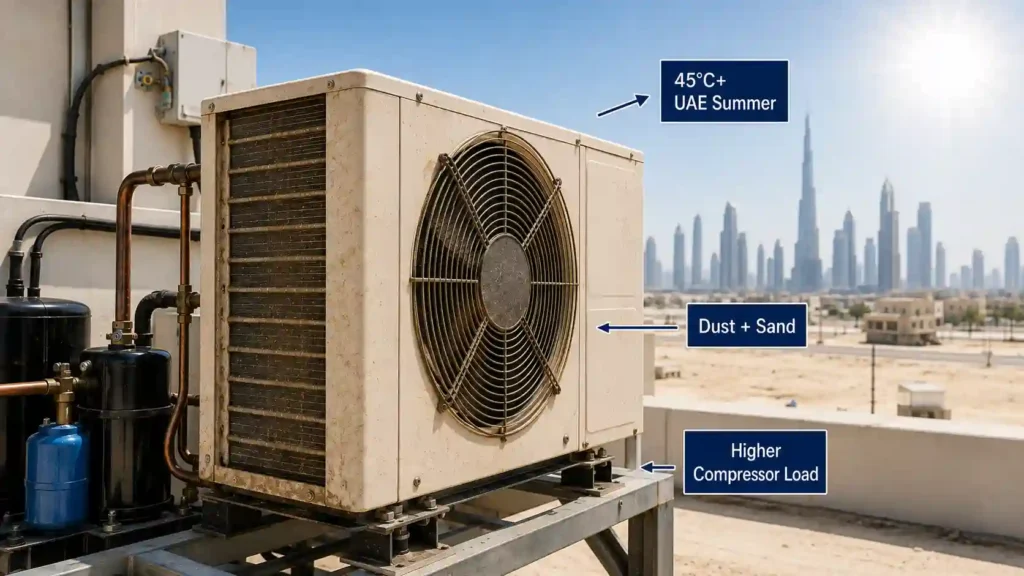
Chiller rooms run continuously under high load, and neglected maintenance compounds quickly:
- Dirt on a condenser coil doesn’t sound like much, but it drives energy use up 17-30% on its own — and in units nobody’s cleaned in a while, that number has climbed as high as 90% in industry energy audits.
- There’s a hard ceiling on compressor discharge temperature: 225°F (107°C). Push past around 250°F (121°C), and the lubricating oil starts breaking down thermally, which corrodes internal parts and eventually seizes the compressor.
- A single breakdown in UAE summer conditions can mean total stock loss, regulatory non-compliance fines, and emergency replacement costs — far more expensive than preventive servicing.
- Ambient temperatures of 45°C and above during UAE summers — occasionally reaching 50°C in peak conditions — force compressors to run 30–40% longer per cycle than in winter, accelerating wear on components that aren’t well maintained.
Most chiller room failures in the UAE aren’t random — they follow predictable patterns tied to heat, dust, and humidity. For the engineering detail behind each failure mode, see our breakdown of why chiller rooms fail in UAE conditions. Preventive maintenance is consistently the cheaper option — a scheduled Annual Maintenance Contract (AMC) costs a fraction of an emergency callout and stock-loss event.
Core Components of a Chiller Room and How They Work Together
A chiller room functions as an interdependent system — a fault in one component quickly affects the others:
- Compressor. This is what actually drives the cooling cycle — it compresses the refrigerant gas, and everything downstream depends on it running properly.
- Condenser coil. Its job is to push the heat pulled from inside the room back out into the air. Dust, sand, and grease build up here fast and choke that process.
- Expansion valve — sits between the condenser and evaporator, dropping the refrigerant’s pressure and temperature before it goes in. When it’s faulty, you’ll usually see either weak cooling or frost building up where it shouldn’t.
- Evaporator coil. Absorbs the heat from inside the room. If airflow gets blocked or a defrost cycle skips, this is where frost and ice show up first.
- Leaks in the refrigerant lines connecting these components cut cooling capacity and put extra strain on the compressor — often before anyone notices anything’s wrong.
- Door gaskets and seals keep the room airtight. Once they wear out, warm humid air starts leaking in, and energy use climbs along with it.
- The insulated panels form the room’s thermal envelope. A damaged joint here creates a thermal bridge, and that’s a slow, steady energy leak that’s easy to miss.
- Drainage system — clears condensate out of the room. When it’s blocked, water pools on the floor, which brings mold and slip hazards with it.
- Finally, the digital thermostat or controller regulates and logs temperature — but if the sensor drifts out of calibration, it can quietly mask storage conditions that are actually out of compliance.
Quick Reference: Chiller Room Key Facts
| Entity | Attribute | Value / Range |
|---|---|---|
| Chiller room | General operating range | 0°C to +8°C |
| Chiller room (food applications) | Recommended operating range | 0°C to +5°C |
| Chiller room (UAE food safety) | Recommended controller setpoint | 2°C to 4°C buffer, per Dubai Municipality Food Code 2.0’s 5°C legal ceiling |
| Compressor | Maximum safe discharge temperature | 225°F / 107°C |
| Compressor | Oil thermal breakdown onset | Approximately 250°F / 121°C |
| Condenser coil | Cleaning frequency (temperate climates) | Every 3 months |
| Condenser coil | Cleaning frequency (UAE, peak summer/sandstorm season) | Monthly |
| Dirty condenser coil | Energy consumption increase | 17%–30% typical, up to 90% in neglected units |
| UAE summer | General ambient air temperature | 45°C and above, up to 50°C in peak conditions |
| Condensing unit in direct sun | Local microclimate temperature* | 55°C–60°C * |
| PVC strip air curtains | Energy savings from reduced infiltration** | 12%–25% ** |
* Single-source figure, not independently corroborated — treat as directional.
** Based on general commercial-building air curtain studies, not chiller-room-specific data — also directional.
Types of Chiller Rooms and Their Specific Maintenance Needs
Not all chiller rooms are maintained the same way. Here’s what changes by type.
Commercial and Industrial Chiller Room Maintenance
Supermarkets, restaurants, food processing plants, and warehouses all rely on these rooms running non-stop, so the schedule has to be layered: daily temperature and seal checks, a weekly pass on hygiene and airflow, coil cleaning once a month, and then a technician coming in every quarter to a year for compressor diagnostics, refrigerant checks, and electrical testing.
Walk-In Chiller Room Maintenance
Keep the internal temperature inside its designed range, clean the condenser and evaporator coils monthly, and check the door gaskets regularly for cracks or gaps — that’s the baseline for a walk-in. Drain lines need flushing on a regular basis too, or you’ll end up with clogs and mold. It’s also worth listening to the fan motors now and then; unusual noise is often the first sign of bearing wear starting.
Portable Chiller Room Maintenance
Portable units need everything a fixed installation does — coils, seals, drains — but refrigerant pressure deserves closer attention here, checked monthly for leak signs, since moving the unit around puts extra strain on the line connections and fittings. These get deployed a lot for events and temporary storage around Dubai, Abu Dhabi, and Sharjah, so it’s worth adding a pre-deployment check to the routine rather than waiting for the next scheduled one.
Container Chiller Room Maintenance
Container chiller rooms — commonly used for logistics, construction sites, and temporary industrial storage — need the standard coil and seal checks, but also periodic inspection of external cladding, transport-related vibration damage, and door hinge alignment, since these units are frequently moved between sites.
Blast Chiller Room Maintenance
Blast chillers have one job: get hot food down to a safe temperature fast, and that changes the daily routine. Interior surfaces get wiped down with a food-safe detergent every day, the core temperature probes need careful cleaning (they’re delicate, and dirty probes give false readings), and the unit should sit with the door cracked between cycles so moisture doesn’t get trapped inside. On top of that daily habit, coils and gaskets get checked monthly like any other chiller room, and a technician should come by twice a year for refrigerant levels, electrical testing, and probe calibration.
Solar Chiller Room Maintenance
Solar-powered chiller rooms combine standard refrigeration upkeep with maintenance of the solar power system itself. This means cleaning solar panels every few weeks to remove dust and sand (critical in the UAE’s dusty conditions), inspecting DC/AC wiring and mounting brackets, and testing battery storage and inverter performance, alongside quarterly coil cleaning and standard seal and refrigerant checks on the chiller side.
Flower Chiller Maintenance
Flowers just don’t forgive the way food does — a small temperature swing or a bit of condensation, and you’ve got wilted stock. That’s why floral chiller rooms run on tighter humidity and temperature margins than most, and why door seals matter more here than almost anywhere else: florists and wholesalers are in and out of these doors all day long. Humidity control has to stay stable, defrost cycles need watching so ice doesn’t damage the stock, and drain lines should be cleared promptly to keep moisture from pooling near the flowers.
Chiller Room vs Freezer Room Maintenance
A common point of confusion: chiller rooms and freezer rooms are maintained on different schedules and with different priorities, since freezer rooms run at -18°C or below and place far greater strain on insulation, defrost systems, and compressors. If you’re unsure which system you’re maintaining — or deciding which one your operation needs — our chiller room and freezer room guide breaks down the differences in insulation thickness, refrigeration capacity, and energy consumption between the two.
Daily, Weekly, Monthly, Quarterly and Annual Chiller Room Maintenance Checklist
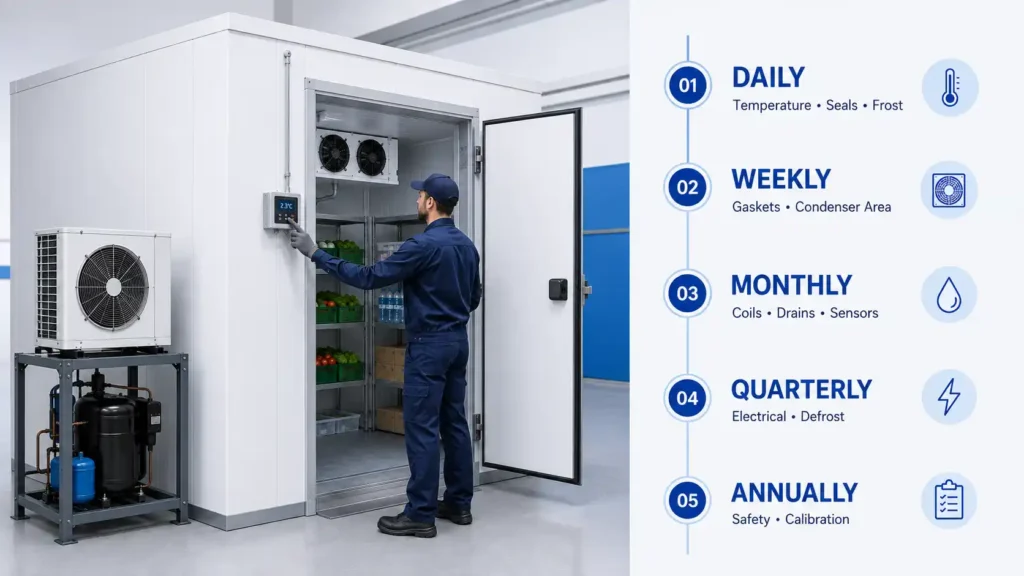
Daily (internal staff)
- Record and monitor internal temperatures at shift start, middle, and end
- Inspect door seals for cracks, gaps, or light leakage (test by checking for light around a closed door)
- Check for frost or ice on evaporator coils and floors
- Listen for unusual compressor noise or vibration; smell for burning electrical odors
- Wipe down interior walls, floors, and shelving with food-safe, non-abrasive cleaner
- Keep stock away from evaporator fans and vents to maintain airflow
Weekly (internal staff)
- Clean door gaskets with warm soapy water; run the paper test to check seal tightness
- Sweep the area around exterior condenser units to prevent debris intake
- Check interior lighting for function (poor visibility hides spills and hazards)
Monthly (internal staff or basic technician visit)
- Clean accessible condenser and evaporator coils of dust, grease, and sand
- Flush condensate drain lines with warm water to clear biofilm and blockages
- Inspect and clean or replace air/refrigeration filters
- Calibrate digital thermostats and sensors
- Lubricate door hinges, latches, and closers
Quarterly (professional technician)
- Deep-clean condenser coils with chemical foaming agents
- Inspect and torque electrical terminals and contactors
- Test defrost heater amperage and timer intervals
- Check water/glycol concentration where applicable to prevent scaling and corrosion
Bi-Annually (professional technician)
- Check refrigerant charge, suction/discharge pressures, and superheat/subcooling
- Inspect filter-driers for restriction or clogging
- Run certified refrigerant leak tests
Annually (professional technician)
- Test compressor motor winding insulation resistance (megger test)
- Conduct thermal imaging or smoke tests on insulated panel joints
- Recalibrate thermostats and sensors against traceable reference instruments
- Full safety control and pressure cutout testing
When to Call a Professional
Internal staff can safely manage daily hygiene, temperature logging, and surface-level checks. Tasks involving pressurized refrigerant, high-voltage electrical components, and internal compressor diagnostics require a certified refrigeration technician — immediately if you notice ice building up rapidly, the compressor short-cycling, water pooling inside the room, burning smells, or a steady rise in internal temperature.
For a full breakdown of routine servicing frequency, cost factors, and how preventive maintenance differs from repair, see our cold storage maintenance service page, which covers both for commercial cold rooms and freezer rooms across the UAE.
UAE-Specific Considerations: Dubai, Abu Dhabi, Sharjah and Ajman
Operating a chiller room in the UAE is not the same as operating one in a temperate climate:
- Extreme heat — General summer ambient temperatures reach 45°C and above, occasionally peaking near 50°C, forcing compressors to work significantly harder. Condensing units need shading and a minimum 60 cm clearance for airflow — never sealed plastic covers.
- Dust and sandstorms — Industrial zones in Dubai, Sharjah, and Abu Dhabi see heavy dust accumulation that clogs condenser coils fast. Monthly coil cleaning during summer is standard practice rather than the quarterly interval used elsewhere.
- Coastal humidity — Sharjah, Dubai, and Fujairah’s humidity places extra load on door seals and drainage systems; weekly seal and drain checks are recommended in these emirates.
- Regulatory compliance — Refrigeration equipment used in UAE chiller rooms should carry relevant ESMA-recognized product certification, and day-to-day operation must meet Dubai Municipality’s food safety regulations and HACCP-based systems. Under Dubai Municipality Food Code 2.0 specifically, high-risk and perishable food must be held at a core temperature of 5°C or below. Because inspectors check core product temperature (not just the ambient display), operators are advised to set chiller controllers to a 2°C–4°C buffer to stay compliant during busy service periods.
Common Chiller Room Problems: Quick-Response Checklist
For the underlying causes behind these UAE-specific failures, see our engineering breakdown of why chiller rooms fail in UAE conditions. For a fast first response:
| Symptom | First Action |
|---|---|
| Ice building up on the evaporator | Clear airflow obstructions; call a technician to check the defrost cycle and refrigerant level |
| Compressor short-cycling | Deep-clean the condenser; check shading and ventilation around the unit |
| Water leaking inside the room | Flush the drain line; have a technician check the drain pan heater |
| Internal temperature drifting up | Replace worn gaskets and clean coils; have a technician check compressor discharge readings |
| Flickering lights or buzzing | Isolate power immediately; call a technician to inspect terminals and motors |
| Excessive condensation or fog | Install PVC strip curtains, enforce door discipline, reseal panels |
Choosing a Chiller Room Manufacturer or Supplier for Maintenance Support
Not every manufacturer that sells you a chiller room will actually be there once it’s running. If maintenance is the priority, a few things matter more than the sales pitch:
- Do they offer an Annual Maintenance Contract, or just a one-time service call when something breaks?
- Are their technicians actually certified, and do they know what UAE heat and dust do to a system over time — plus what Dubai Municipality Food Code compliance actually requires?
- Emergency repair availability across Dubai, Abu Dhabi, Sharjah, and Ajman
For the full criteria on evaluating chiller room manufacturers — installation experience, refrigeration technology, customization capability — see our guide to chiller room and freezer room manufacturers in UAE.
Frequently Asked Questions
Chiller rooms generally run somewhere in the 0°C to +8°C range. But if you’re storing perishable food, Dubai Municipality Food Code 2.0 sets the real ceiling: 5°C or below. Since doors get opened constantly during service, most operators don’t cut it that close — they set the controller to 2°C–4°C instead, so there’s a buffer before anything drifts out of compliance.
Yes — in addition to standard coil, seal, and refrigerant checks, solar chiller rooms need regular cleaning of solar panels and inspection of wiring, batteries, and inverters to maintain reliable power.
For anything touching pressurized refrigerant or electrical diagnostics, yes — that has to go to a certified technician with proper refrigerant-handling credentials, no way around it. Day-to-day hygiene and temperature checks are fine for your own staff to handle, but the AMC-level work needs a licensed provider on contract.
Generally yes — freezer rooms run at -18°C or below, which places significantly more strain on insulation, defrost cycles, and compressors than a chiller room’s above-freezing range, so they typically need closer monitoring of ice buildup and defrost performance.
Conclusion
None of this is complicated on paper — check the seals, clean the coils, watch the temperature, bring in a technician on schedule. What makes it hard in the UAE is the environment working against you every single day: the heat doesn’t ease off for months, dust gets into equipment faster than you’d expect, and the food code doesn’t leave much room for error. Skip a few weeks of coil cleaning here, and you’ll feel it a lot sooner than you would somewhere with a milder climate.
That’s really the whole point of staying on top of it. A walk-in unit in a Dubai restaurant, a solar-powered room in Abu Dhabi, a container chiller on a Sharjah site — different setups, but they all fail the same way when maintenance slips: slowly, then all at once, usually during the worst possible week.
If you’d rather not find that out the hard way, the ChillerRoom.ae team puts together maintenance plans and Annual Maintenance Contracts for commercial, industrial, and specialty chiller rooms across Dubai, Abu Dhabi, Sharjah, and Ajman. Get in touch, and we’ll work out what your setup actually needs.