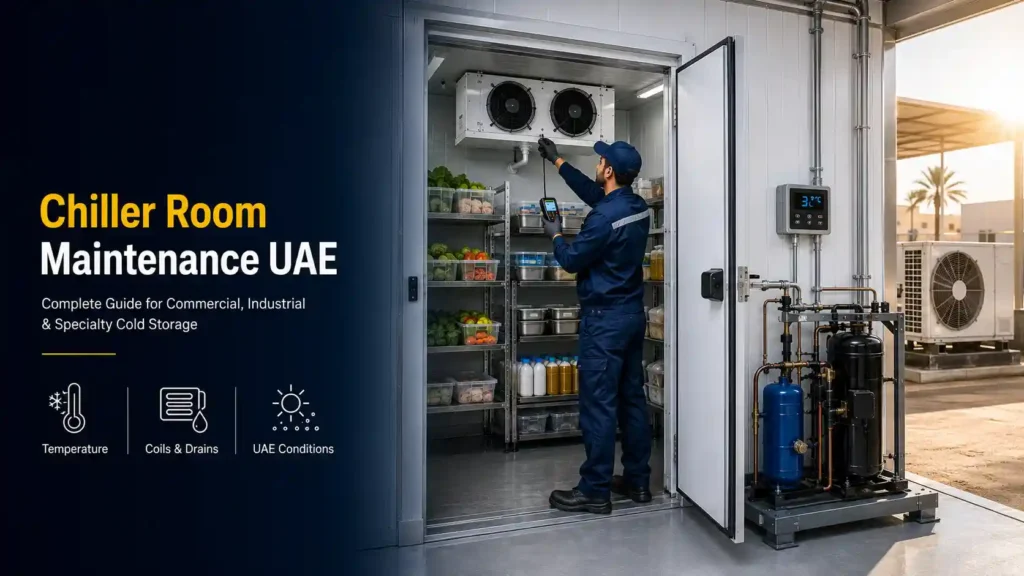
Chiller Room vs Refrigerated Container: Which Is Better for Your Business?
Senior Refrigeration Engineer · ChillerRoom.ae
Updated 2026 · Estimated read time: 08–10 min
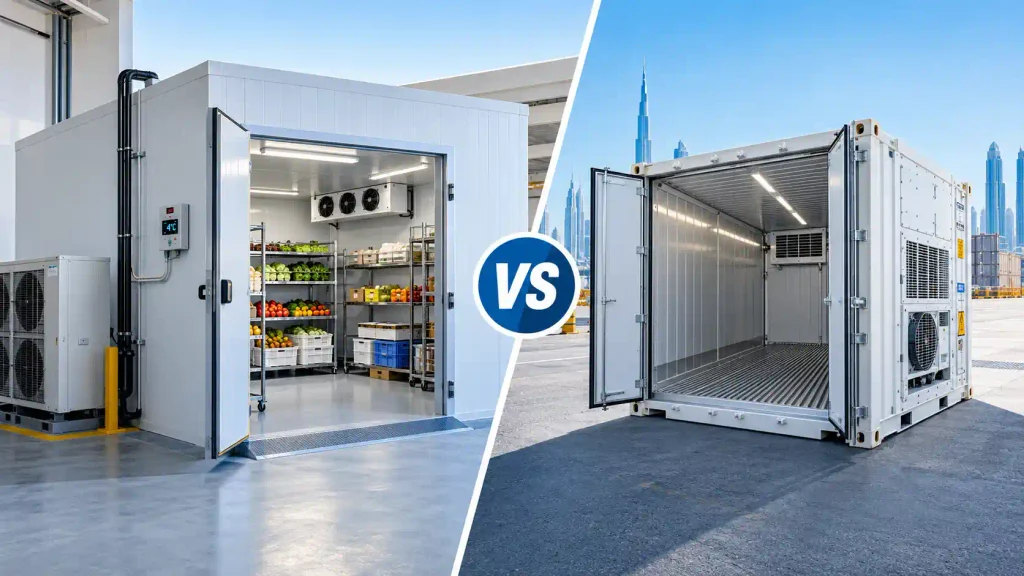
This choice usually arrives with a deadline. A restaurant group wants extra chilled space before Ramadan, a distributor has run out of room in its warehouse, or a project site needs storage it can move when the work ends. The two options on the table, a chiller room and a refrigerated container, can look close in price and size. Once they are working in Dubai, Abu Dhabi, or Sharjah, with the air outside near 45°C, they stop looking alike.
This guide sets a walk-in chiller room against a reefer container and covers construction, airflow, electricity, compliance, and lifespan. It is aimed at commercial and industrial buyers who are talking to chiller room manufacturers and suppliers in the UAE.
Quick answer: The better option depends mainly on how long the storage is needed and how often people have to enter it. A chiller room suits permanent storage with daily access, such as kitchens, supermarkets, pharmaceutical stores, and distribution hubs. A refrigerated container (reefer container) is the better fit when the requirement is temporary, seasonal, or needs to move from site to site. Where the need will last beyond a year or two, a built chiller room tends to be the more practical and economical choice in the UAE. The point at which it overtakes a container varies with the site and the quotation.
What Is a Chiller Room?
A chiller room is an insulated room that holds perishable goods just above freezing, usually between 0°C and +8°C. It is also known as a walk-in chiller, a room chiller, or a walk-in chiller room, and the names are used interchangeably in the trade. The walls and ceiling are made from modular insulated panels. Inside, a ceiling-mounted evaporator cools the air, and a condensing unit placed outside the room carries away the heat.
The room is built around the site, so the dimensions, door type, shelving layout, floor finish and drainage are all chosen to suit how it will be used. A chiller room should not be confused with a freezer room, which runs at -18°C to -25°C, or with a blast chiller. A blast chiller brings cooked food down in temperature quickly and is not designed for holding stock over a long period. Our guide to chiller room temperature in the UAE lists the ranges by product, and the article on cold room vs chiller room explains how the terms differ.
What Is a Refrigerated Container?
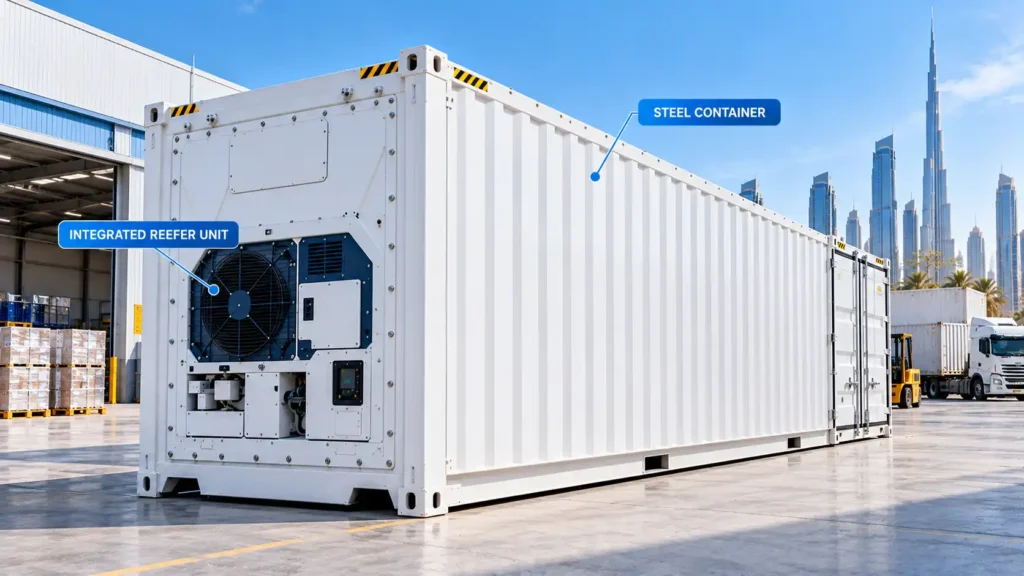
A refrigerated container, or reefer container, is a standard steel shipping container lined with insulation and fitted with a refrigeration unit. Online, the same product is usually searched as a refrigerated shipping container. The box keeps ISO dimensions, and the cooling unit is mounted in the front wall, so cranes, rail wagons, and truck chassis can all handle it without disconnecting anything. Shipping lines use these units to carry chilled and frozen cargo over long distances.
Lengths are typically 10 ft, 20 ft, or 40 ft high cube. Setpoints run from about -30°C to +30°C, so one container can be set up for chilled goods on one contract and frozen goods on the next. The doors are meant to stay closed. Cargo is loaded once, sealed, and left alone until it reaches its destination. Staff who need to enter several times a day will find that arrangement inconvenient.
How Do UAE Conditions Change the Comparison?
In the UAE, summer shade temperatures regularly go past 45°C, and along the coast the humidity often sits above 85%. Both put extra load on a cold store.
An air-cooled condenser has to work well above the temperature of the air around it, which means condensing temperatures can reach 60°C to 75°C in summer. Equipment rated for European conditions loses capacity quickly at that level. Sun adds to the problem for containers. Studies of container thermal behaviour suggest bright walls run about 12 K above ambient and roofs about 16 K above, so a steel box left in an open yard soaks up a lot of heat. Humidity matters too. Each time a door opens, moist air gets in and condenses on the coils and floor, and the frost that builds up means more defrost cycles and more energy.
A chiller room built inside a building or under shade avoids most of the solar gain. A container standing in an open yard takes the full load unless someone adds a canopy.
Chiller Room vs Refrigerated Container: Side-by-Side
| Factor | Chiller Room | Refrigerated Container (Reefer) |
|---|---|---|
| Structure | Modular PIR or PUF panels built to site dimensions | Fixed ISO steel container, 10 / 20 / 40 ft |
| Temperature range | 0°C to +8°C, with multi-zone layouts possible | About -30°C to +30°C |
| Internal volume | Any size, from about 10 m³ upward | About 14 m³ (10 ft), 28 m³ (20 ft), 56 to 67 m³ (40 ft HC) |
| Insulation | 100 mm panels are our recommended minimum for UAE chillers | Typically 70 to 80 mm of foam |
| Refrigeration | Split system with a condensing unit rated for UAE ambient heat | Integral marine unit (Carrier, Daikin, and similar) |
| Airflow | Overhead horizontal throw from ceiling evaporators | Bottom-up through floor T-bars; needs full pallet coverage |
| Floor and door | Flat or coved floor with drains, standard walk-in door | Ribbed aluminium floor, heavy double cargo doors |
| Power | 230 V single-phase (small rooms) or 380 to 415 V three-phase | 380 to 460 V three-phase, 32 A, or a diesel generator |
| Installation | Site survey, then days to weeks of assembly | Hours, on a level pad with crane access |
| Mobility | Fixed once built; panels can be relocated with effort | Moved by crane or truck in hours |
| Long-term durability | Panel envelope can last 10 to 20+ years; refrigeration equipment is replaced on a shorter cycle | Steel box outlasts its unit; marine machinery typically 12 to 15 years |
Values come from manufacturer specifications and industry sources. Final figures depend on the model, its condition, and the site.
Which Works Better for Daily Walk-In Use?
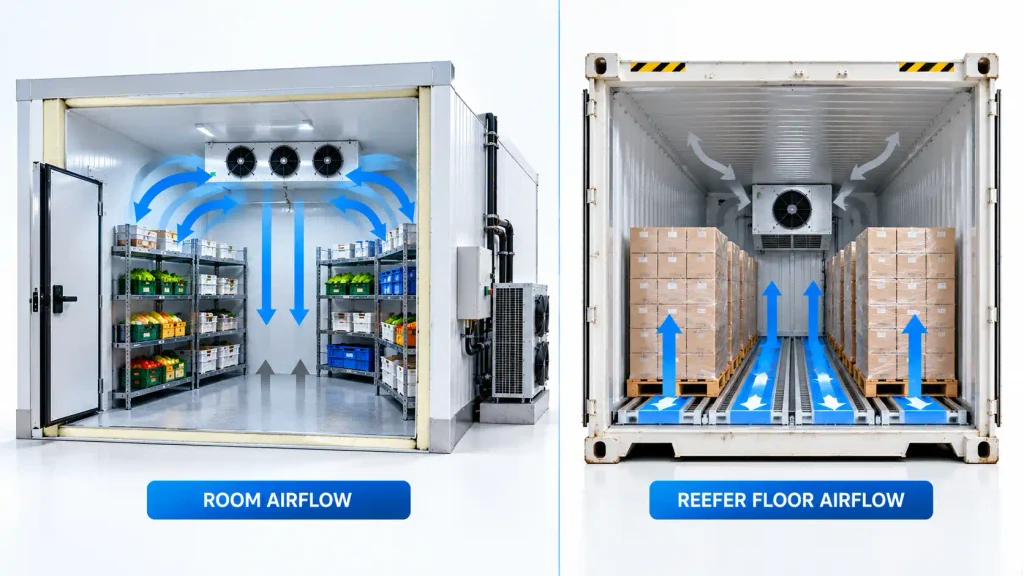
For any operation where people enter repeatedly through the day, the chiller room is the better fit. The two designs move air in opposite ways.
A chiller room sends cold air across the ceiling and down through the shelving, so racks, aisles, and trolleys are part of the design. A reefer pushes air under the cargo through aluminium T-bar channels and expects pallets to cover them. If shelves are fitted along the walls with an open central aisle, the supply air escapes through the uncovered floor and returns to the intake without cooling the stock at the back. Stacking boxes tight against the ceiling causes the opposite fault, with warm spots near the door and freezing near the unit.
The ribbed floor, raised threshold and heavy doors add to the difficulty with hand trolleys. These points apply to a standard marine reefer used as a walk-in store, which is a use it was never designed for.
Where Does a Container Chiller Room Fit?
A container chiller room starts as a container shell and is fitted out as a walk-in cold room that stays in one place. It gets a normal cold room door and a flat floor, plus shelving, a drain, and a commercial refrigeration unit. Businesses with no spare indoor space, but with staff going in and out every day, tend to find it a good fit. If the lease ends or the site changes, the whole unit can be moved. We build it in 20 ft and 40 ft sizes, and the page on container chiller room manufacturers in the UAE explains the sizes and what the site needs before delivery.
How Do Running Costs Compare?
Electricity is where most of the ongoing cost sits, so it helps to work out the kWh first and convert to dirhams afterwards.
Supplier figures for a 20 ft reefer come to around 70 to 120 kWh a day, and for a 40 ft unit around 100 to 170 kWh. That is about 2,100 to 3,600 kWh a month for the smaller container and 3,000 to 5,100 kWh for the larger one. Treat these as rough numbers. The real figure moves with the unit, the load, the setpoint, and how much sun the container gets.
DEWA charges by slab, and the slabs apply to the account’s total consumption for the month. The first 2,000 kWh cost 23 fils each, the next 2,000 cost 28 fils, the next 2,000 cost 32 fils, and anything above 6,000 kWh costs 38 fils. On top of that comes a fuel surcharge, which is 6 fils per kWh at the time of writing, and 5% VAT. Three consequences follow:
- If the premises already use more than 6,000 kWh a month, every extra kWh costs about 44 fils, which is roughly AED 0.46 once VAT is added. At that rate, a single reefer would add somewhere between AED 970 and AED 2,360 to the monthly bill.
- A small account with low total use pays lower blended rates, so the added cost would be less.
- Industrial accounts follow a different structure, with 23 fils up to 10,000 kWh before the higher rate applies.
Rental is separate. Indicative market rates for a reefer are about AED 1,500 to AED 4,500 a month, or AED 200 to AED 500 a day, and they should be confirmed with current quotations. Across 24 months, rent alone for a mid-range unit can reach the installed price of a small to medium chiller room, but a fair comparison must also include the room’s own electricity, installation and maintenance. Your supplier can model both on your actual load.
Indoor placement, thicker insulation, high-speed doors, EC fans and inverter compressors all reduce the energy use of a built room. Our guide to reducing chiller room electricity costs in the UAE goes through them.
Does a Refrigerated Container Meet UAE Food and Pharma Requirements?
It depends on the use and on how the unit is modified.
For permanent food premises, Dubai Municipality and ADAFSA expect hygienic, easily cleaned surfaces, suitable drainage, and chilled food held at or below 5°C. A standard reefer’s ribbed floor and lack of floor drainage may not satisfy an inspector for open food handling, although it can be acceptable for sealed, pre-packed goods stored outdoors. Requirements vary by premises and by inspector, so confirm the position with the relevant authority before choosing.
For pharmaceutical storage, MoHAP, the Emirates Drug Establishment and the emirate health authorities apply WHO Good Distribution Practice. A licensed +2°C to +8°C store is normally expected to show tight temperature uniformity, continuous monitoring, standby arrangements, and qualification with thermal mapping. A standard single-unit reefer does not usually provide these as supplied, although a qualified, modified unit may be possible. Backup power and dual-sensor monitoring are configured to each project, so agree the specification at design stage. The pharmaceutical walk-in chiller page explains how these rooms are specified.
Which Business Should Choose Which?
| Business or use case | Better fit | Why |
|---|---|---|
| Restaurants, hotels, cloud kitchens | Chiller room | Fits indoors; frequent access; hygienic floor and drainage |
| Supermarkets and hypermarkets | Chiller room or multi-zone room | Several temperature zones and heavy restocking |
| Meat, seafood and food processing | Chiller room | Washdown-ready surfaces |
| Fruit, vegetable and flower trade | Chiller room or ripening room | Separate temperature and humidity zones |
| Pharmaceutical storage | Validated chiller room | Monitoring, qualification and standby systems |
| Cold storage warehouses | Industrial chiller room | Better value per cubic metre at scale |
| Events, Ramadan overflow, renovations | Rented reefer or portable chiller | Fast deployment, no construction |
| Farms, remote and construction sites | Container chiller room or reefer | Outdoor placement and relocation |
| Freight forwarding and port staging | Reefer container | Built for intermodal transport |
If you need a permanent store, compare options on the walk-in chiller page.
What About a Reefer Refrigerated Truck?
A reefer refrigerated truck or van keeps pre-chilled cargo cold while it moves. Its refrigeration unit is a holding system with limited ability to cool warm stock, and parked in 50°C heat, it burns fuel or battery capacity quickly. It also has thinner insulation and a less airflow-optimized design than a fixed room. Trucks belong on delivery routes. Storage belongs in a chiller room or container chiller room. Delivery vehicles are covered on our chiller truck and van page.
How Do You Decide?
Five questions settle most cases:
- Duration: will the storage be needed beyond a year or two, or only for a season or project?
- Access: will staff walk in many times a day, or will pallets be loaded and sealed?
- Space: is there indoor room, or must the unit stand in a yard?
- Regulation: does a food or pharmaceutical inspector need to approve it?
- Power: is three-phase supply available at the site?
If the answers point in both directions, a container chiller room is often the practical middle path.
Mistakes to Avoid
- Sizing by floor area. Product load, door traffic, and UAE ambient temperature should drive the capacity.
- Leaving a container unshaded through summer, or enclosing its condenser so heat cannot escape.
- Skipping coil cleaning. Desert dust on the condenser raises discharge pressure and can trip the compressor, a pattern covered in why chiller rooms fail in the UAE.
Frequently Asked Questions
A chiller room is a fixed, custom-built insulated room for daily storage between 0°C and +8°C. A refrigerated container is a portable ISO shipping container with a built-in refrigeration unit, designed mainly for transport and temporary storage.
Not at the start. A chiller room costs more to build, while a reefer can be rented or bought almost straight away. Over the longer term the answer depends on rent, electricity, installation and maintenance, so ask your supplier to price both options against your own load.
It works for bulk pallet storage. It does not work well if people go in and out often, because of the floor airflow, the heavy doors and the ribbed floor. A container chiller room is built for that purpose.
Supplier figures put a 20 ft unit at about 70 to 120 kWh a day and a 40 ft unit at about 100 to 170 kWh. What you pay depends on where you sit in the DEWA slabs, as explained above.
Rates quoted in the market run from AED 200 to AED 500 a day, or AED 1,500 to AED 4,500 a month, depending on size and condition. Get current quotations before you set a budget.
A standard reefer usually lacks the monitoring and qualification expected for a licensed store. A validated chiller room is the usual route, and a modified, qualified unit may be possible after review with the authority.
A reefer comes from the factory as a transport unit with its cooling system built in. A container chiller room is a container converted into a fixed walk-in cold room, with a standard door, a flat floor, shelving and drainage.
A chiller room. A kitchen needs clean surfaces, drainage, and quick access many times a day, and a room inside the building gives it all three.
Yes. We design and install chiller rooms and container chiller rooms for commercial and industrial clients in Dubai, Abu Dhabi, Sharjah and the other emirates.
Plan Your Cold Storage with ChillerRoom.ae
ChillerRoom.ae manufactures and supplies chiller rooms, container chiller rooms and portable chillers for commercial and industrial users across the UAE. Our engineers size each system based on product load, door traffic, site layout, and summer conditions, then advise whether a built room, a container chiller room, or a temporary unit suits your plan.
Send us your product type, temperature range, storage volume, and expected duration, and we will recommend the most practical option.