Chiller Room Panels in UAE: Simple Guide to Cold Storage Panels
Senior Refrigeration Engineer · Chiller Room Manufacturers in UAE
Updated 2026 · Estimated read time: 08–14 min
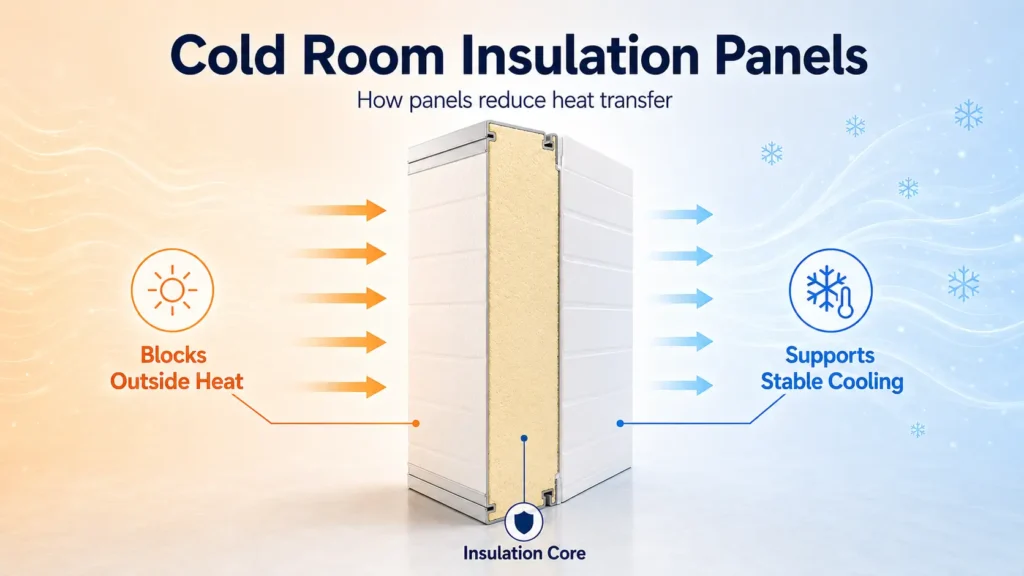
Table of Contents
Quick Answer
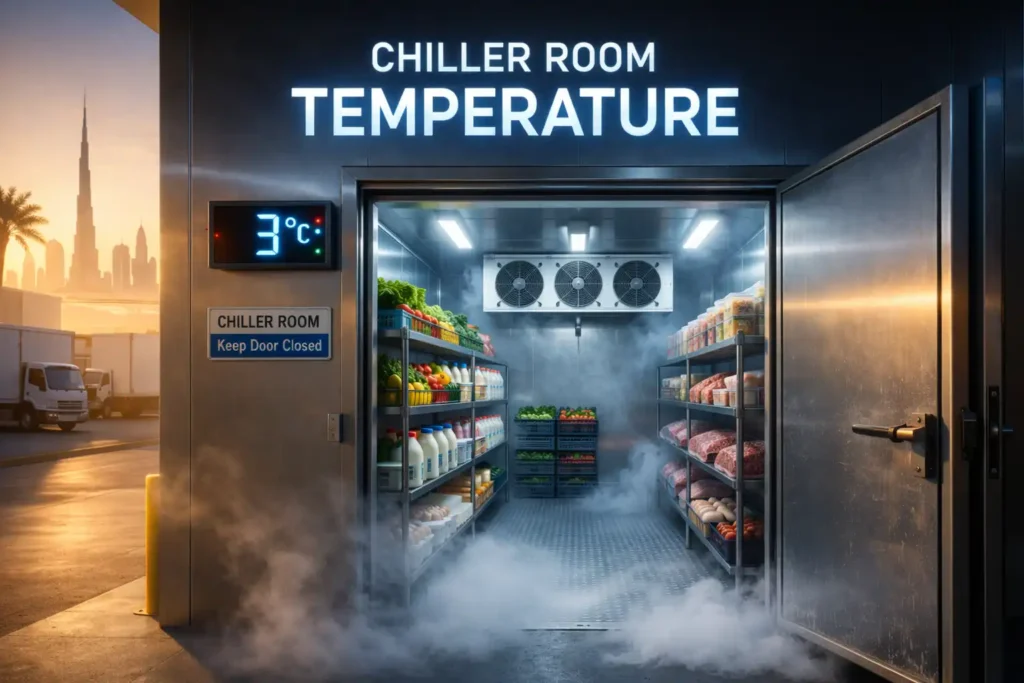
Chiller room panels are the insulated walls and ceiling panels used to build a cold room. Their job is simple: keep cold air inside and slow down the heat coming from outside.
In the UAE, panel quality matters more than usual. The weather is hot, doors are often opened during daily work, and humidity can quickly lead to sweating panels, wet floors, or temperature changes.
For most commercial cold rooms, the right panel depends on three things: temperature, insulation thickness, and site usage. A small storage room, a busy supermarket chiller, and a freezer room will not need the same panel setup.
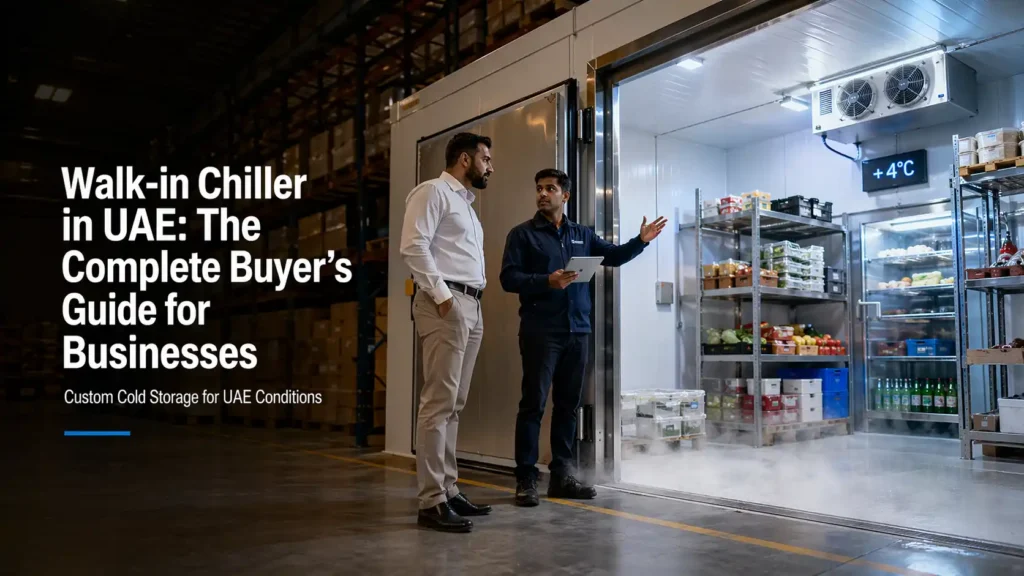
For restaurants, supermarkets, hotels, food suppliers, flower storage, seafood, dairy, and pharma businesses, good chiller room panels in UAE can reduce electricity use, protect stored products, and reduce pressure on the refrigeration unit.
At ChillerRoom.ae, we design and build cold storage systems across Dubai, Abu Dhabi, Sharjah, and the wider UAE. As one of the Best Chiller Room Manufacturers in UAE, we help customers choose the right chiller room panels, cold room insulation panels, and insulated cold storage panels based on real site conditions, not guesswork.
What Are Chiller Room Panels?
Chiller room panels are special insulated panels used to build the walls, ceiling, and sometimes the floor of a cold room.
Think of them like a thick thermal shield.
They stop outside heat from entering the room and help keep the inside temperature stable. Without good panels, the cooling system has to work harder. That means more electricity, more maintenance, and more risk of product damage.
These panels are also called:
- Chiller room panels
- Cold room panel
- Cold store panels
- Coolroom panels
- Sandwich panels
- Refrigerated room panels
- Freezer room panels
- Cold room insulation panels
Coolroom panels are also known in some markets as sandwich panels, SIPs, structural insulated panels, or EPS panels.
Why Chiller Room Panels Matter in UAE
The UAE climate is tough on cold rooms.
Outside air is hot. In coastal areas, humidity is also high. Every time someone opens the cold room door, warm air enters. If the panels are weak, thin, damaged, or badly sealed, the room loses cooling fast.
Good chiller room panels in UAE help with:
- Stable cooling
- Lower electricity bills
- Less condensation
- Better food safety
- Longer product life
- Less pressure on the refrigeration unit
- Better storage for fresh and frozen products
This is important for businesses in Dubai, Abu Dhabi, Sharjah, and across the UAE, especially when storing food, dairy, seafood, meat, beverages, flowers, or medicines.
How Cold Room Panels Are Built
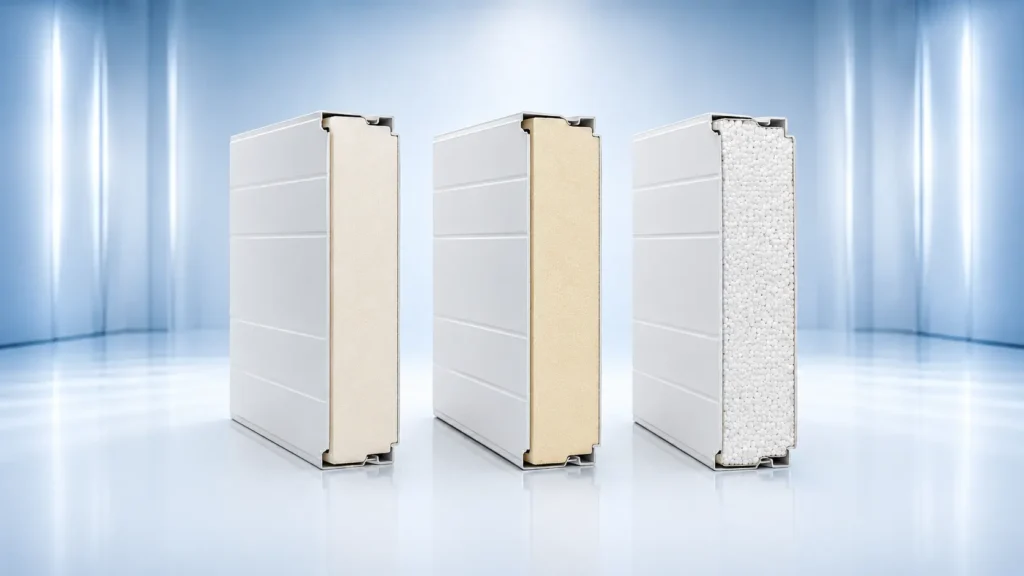
Most cold room panels are made like a sandwich.
There is insulation in the middle and metal sheets on both sides.
The middle part is usually:
PU foam — common for chiller rooms and cold rooms because it gives good insulation for commercial storage. For a deeper look at how polyurethane insulated panels are used in cold rooms and freezer rooms, read our guide on PUF panel cold storage in UAE.
PIR foam — used for strong insulation and better fire performance. In many UAE projects, PIR is chosen not only for safety but also because it can reduce heat transfer in hot conditions.
EPS foam — lightweight and used in some coolroom applications, but it usually has lower insulation performance than PU or PIR. For UAE commercial cold rooms, EPS should be selected carefully and only after checking the room temperature and usage.
The outside layer can be:
Pre-painted galvanised steel.
Stainless steel.
Aluminum.
Food-safe coated steel.
Panel thickness should be selected based on the job. A small chiller room, a busy food storage room, and a freezer room will not need the same panel size. In UAE conditions, the right thickness should be chosen after checking the room temperature, product type, door opening frequency, and outside heat load.
Simple Meaning of U-Value and R-Value
When choosing cold room insulation panels, thickness is important, but it is not the only thing to check.
You may also hear two terms: U-value and R-value.
R-value tells how well the panel resists heat. A higher R-value means better insulation.
U-value tells how much heat passes through the panel. A lower U-value means better insulation.
So, in simple words:
Higher R-value = better insulation.
Lower U-value = better insulation.
This matters because two panels with the same thickness may not perform the same. The material inside the panel, the way the edges are sealed, and the quality of the installation can all change how well the cold room holds temperature.
For UAE cold rooms, always choose the panel based on the required temperature, outside heat, door opening frequency, and product type.
Common Types of Chiller Room and Cold Storage Panels
1. Chiller Room Panels
These are used for rooms that keep products cool but not frozen.
They are common in:
Restaurants.
Hotels.
Supermarkets.
Fruit and vegetable storage.
Dairy storage.
Beverage storage.
Flower storage.
Pharmaceutical storage.
Chiller rooms usually need good insulation because even small temperature changes can affect product quality.
2. Cold Store Panels
Cold store panels are used for larger cold storage areas. These may include storage rooms, warehouses, food processing units, and logistics facilities.
Cold store panels must be strong, hygienic, and properly sealed. Large cold stores also need good roof and ceiling panel design because heat can enter from the top.
3. Freezer Room Panels
Freezer room panels are thicker than normal chiller panels.
They are used for frozen food, meat, seafood, ice cream, and other products that need below-zero storage.
For freezer rooms, panel thickness is very important. If the panel is too thin, the room may lose cooling and form frost or ice around weak joints.
4. Cold Room Roof Panels
Cold room roof panels are used for the ceiling or top section of a cold room.
Many people focus only on wall panels, but the roof is just as important. Poor roof insulation can cause heat gain, dripping, moisture, and temperature issues.
For large cold rooms, the roof panel thickness and support must be checked carefully.
5. Cold Room Floor Panels
Floor insulation is important, especially for freezer rooms.
For normal chiller rooms, floor insulation depends on the project. But for freezer rooms and below-zero storage, insulated flooring is usually needed.
Without proper floor insulation, cold can escape through the floor. This can cause energy loss, condensation, ice build-up, and floor-related problems.
For freezer rooms, the floor, wall panels, roof panels, door, and refrigeration system should all be designed together.
6. Cam Lock Cold Room Panels
Cam lock cold room panels are commonly used in modular chiller rooms and freezer rooms.
A cam lock is used to fasten the panels firmly when the cold room is assembled. This makes the panels easier to align and assemble.
But cam locks alone do not make a cold room airtight.
Airtight performance also depends on:
- Tongue-and-groove joint design
- Sealant quality
- Corner sealing
- Door frame sealing
- Floor and ceiling joint sealing
- Installation workmanship
Many cold room panels use both systems together. The tongue-and-groove joint helps the panels interlock, while the cam lock helps tighten and hold them in place.
For UAE cold rooms, proper sealing is very important because even small gaps can allow warm and humid air to enter.
Panel Thickness: Which One Do You Need?
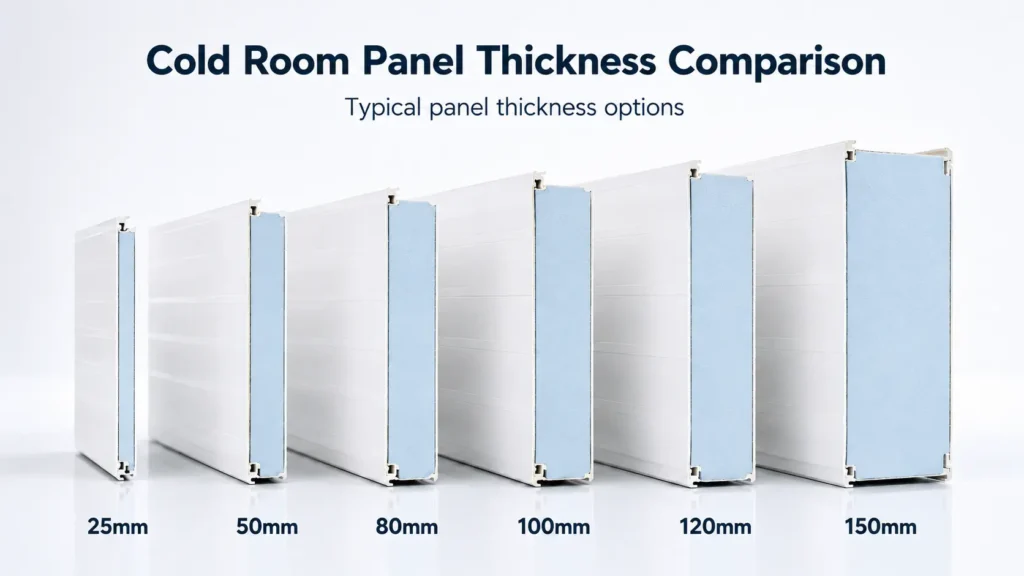
Panel thickness depends on the temperature you want, the room size, door opening frequency, and the UAE site conditions.
Here is a simple guide.
| Panel Type | Best For | UAE Recommendation |
|---|---|---|
| 25 mm coolroom panels | Light partitions or non-critical insulation | Not recommended for commercial chiller rooms in UAE |
| 50 mm coolroom panel | Mild cooling or small low-load spaces | Can be marginal in UAE heat; not ideal for busy food or pharma cold rooms |
| 80 mm panels | Light to medium chiller use | Can work depending on temperature and door usage |
| 100 mm coolroom panels | Commercial chiller rooms | Common choice for many UAE chiller rooms |
| 100 mm cold room panels | Chillers and stronger insulation needs | Good for many commercial cold storage applications |
| 120mm to 150mm panels | Freezer rooms | Better for below-zero storage |
| 150mm to 200mm panels | Deep freezer and heavy-duty cold storage | Used where stronger insulation is required |
For UAE projects, it is safer to choose panel thickness after checking the room temperature, product type, door use, and heat load. A cheap thin panel may save money at first, but it can cost more later through electricity and repairs.
25 mm Coolroom Panels: Are They Enough?
25mm coolroom panels are usually not enough for a full commercial chiller room in UAE conditions.
They may be used for light partitions or areas that do not need strong cooling. But for food, pharma, seafood, dairy, or flower storage, thicker panels are normally better.
50 mm Coolroom Panel: Where It Can Be Used
A 50mm coolroom panel can be used in mild cooling areas, light-duty rooms, or small insulated spaces.
But for busy commercial cold rooms in the UAE, 50mm panels can be risky.
Why? UAE cold rooms often face high outside heat, frequent door openings, and humidity. If the panel is too thin, the room may lose cooling faster. This can increase electricity use and put more pressure on the refrigeration system.
For food storage, seafood, dairy, flower storage, and pharma rooms, thicker panels are usually a safer long-term choice.
100 mm Coolroom Panels: A Common Choice
100mm coolroom panels are commonly used because they give stronger insulation than thinner panels.
For many UAE commercial chiller rooms, 100mm cold room panels can help maintain stable cooling and reduce load on the refrigeration system.
They are often suitable for restaurants, supermarkets, hotels, food storage, dairy storage, flower storage, and beverage storage.
However, 100mm panels are not automatically suitable for every freezer room. For below-zero or deep-freezer storage, thicker freezer room panels may be needed.
Why Vapour Barriers and Sealing Matter in UAE
In the UAE, heat is only one part of the problem. Humidity is another big issue.
When warm, humid air enters a cold room, it can turn into water droplets on cold surfaces. This is called condensation.
Condensation can appear on:
- Panel joints
- Ceiling areas
- Door frames
- Corners
- Floors
- Around cooling units
If moisture enters the panel joints or insulation, the panel may lose performance over time.
That is why good cold room installation should include proper sealing, vapour barrier control, door gasket checking, corner sealing, and correct sealants.
For cold rooms in Dubai, Abu Dhabi, Sharjah, and other UAE locations, this step should not be ignored.
New Panels vs Used Cold Storage Panels
Some businesses search for used cold storage panels to reduce cost.
Used panels can look fine from the outside, but they may have hidden problems.
Before using them, check:
- Dents
- Rust
- Broken joints
- Damaged cam locks
- Wet insulation
- Bad smell
- Hygiene issues
- Old holes or cuts
- Fire rating
- Previous usage
The biggest risk with used panels is hidden insulation damage. A panel can look fine from the outside, but the foam core may already be wet or damaged. If the insulation has absorbed moisture, the panel may lose much of its thermal performance. This can lead to higher energy use and poor temperature control.
For food, medicine, seafood, meat, dairy, and other sensitive storage, new panels are usually the safer option.
Cold Room Control Panel vs Cold Room Insulation Panels
These two things are different.
A cold room control panel is the electrical control box. It helps manage temperature, fans, compressor operation, alarms, and defrost cycles.
Cold room insulation panels are the physical panels used to build the cold room walls, roof, and ceiling.
Both are important.
The insulation panels keep the cold air inside.
The control panel helps manage the cooling system.
How to Choose the Right Chiller Room Panels in UAE
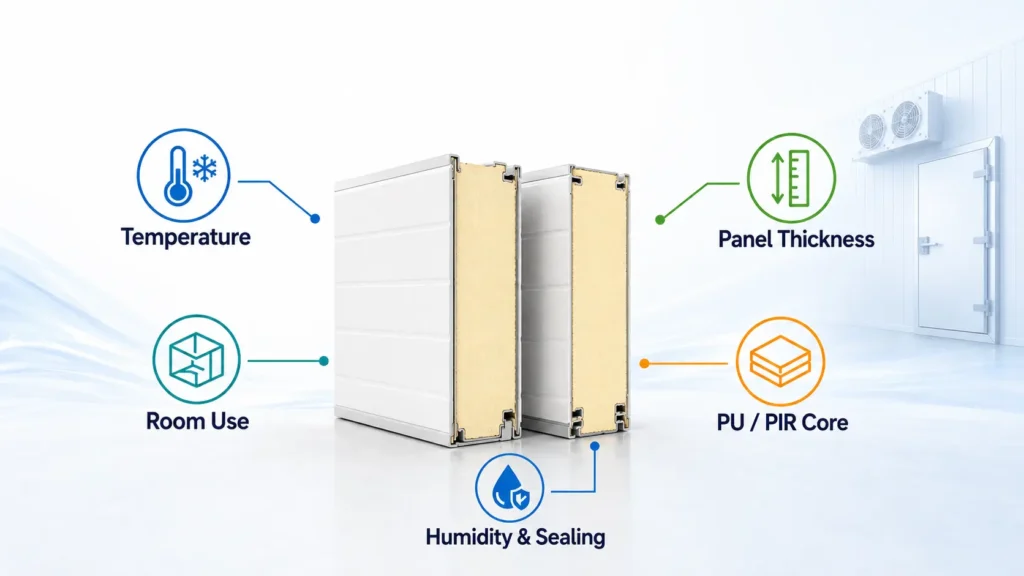
Here is the simple way to choose.
1. Know What You Are Storing
Fresh vegetables, dairy, meat, seafood, flowers, beverages, and medicines do not all need the same storage conditions.
The panel must match the product.
2. Know the Temperature
A chiller room is not the same as a freezer room.
Chiller rooms need positive temperature cooling.
Freezer rooms need below-zero storage.
Deep freezer rooms need even stronger insulation.
3. Choose the Right Thickness
Do not choose panel thickness only by price.
A thinner panel may cost less today, but it may increase electricity use later.
4. Check the Insulation Core
PU and PIR are common choices for commercial cold rooms. EPS may be used in some coolroom applications, but the project requirement must be checked.
5. Look at the Surface Finish
Food and pharma storage need clean and hygienic surfaces.
Stainless steel or food-safe coated steel may be better in sensitive areas.
6. Check the Joint System
Bad joints cause air leakage.
Tongue-and-groove and cam lock cold room panels can help, but only if installed correctly.
7. Check Vapour Barriers and Sealing
In UAE conditions, sealing is very important. Warm and humid air can enter through small gaps and cause condensation.
Ask your supplier how they handle panel joints, vapour barriers, corner sealing, door gaskets, and floor-to-wall connections.
8. Check Fire Rating and Safety
For commercial cold rooms, fire performance should also be checked. This is especially important for food factories, warehouses, supermarkets, pharma storage, and industrial cold storage.
Ask about the panel core, fire classification, safety documentation, and project approval requirements before choosing the panels.
9. Choose the Right Supplier
Good panels are important. Good installation is just as important.
The supplier should understand chiller room design, freezer room panels, cold room roof panels, refrigeration load, doors, sealing, and after-sales support.
Why Choose ChillerRoom.ae?
ChillerRoom.ae is one of the Best Chiller Room Manufacturers in UAE, supporting businesses with practical and reliable cold storage solutions.
We help with:
- Chiller room design
- Cold room panel selection
- Walk-in chiller rooms
- Freezer room panels
- Cold store panels
- Refrigeration system support
- Installation and commissioning
- Cold storage solutions across UAE
Our team works with businesses in Dubai, Abu Dhabi, Sharjah, and other UAE locations.
We do not look at panels as just walls. We look at the full system: insulation, cooling load, airflow, doors, sealing, temperature control, and daily usage.
That is how a cold room performs better for years, not just on the first day.
Common Mistakes to Avoid
Many cold room problems start with small mistakes.
Avoid these:
- Choosing panels only by price
- Using thin panels for a hot UAE site
- Ignoring roof insulation
- Poor sealing around corners
- Using damaged used cold storage panels
- Not checking hygiene requirements
- Treating chiller rooms and freezer rooms the same
- Not matching the panel thickness with the refrigeration capacity
- Choosing suppliers without installation experience
- Using 50mm panels for busy UAE cold rooms without checking the heat load
- Choosing EPS panels without checking insulation performance
- Assuming cam locks alone make the room airtight
- Ignoring vapour barriers and humidity control
- Ignoring floor insulation in freezer rooms
- Not checking fire rating or safety documentation
A cold room is a system. The panels, doors, refrigeration unit, control panel, and installation quality all work together.
Simple Final Advice
If you are planning a chiller room or cold storage room in the UAE, do not treat panels as a basic construction item.
The right chiller room panels in UAE can help you save energy, protect products, reduce maintenance, and keep temperatures stable.
The wrong panels can create daily problems.
For the best result, choose the panel based on temperature, product type, thickness, PU/PIR/EPS core, U-value or R-value, hygiene needs, vapour sealing, fire rating, and UAE weather conditions. And work with a team that understands both cold room panels and refrigeration performance.
Frequently Asked Questions
Chiller room panels in UAE are insulated panels used to build cold rooms. They help keep cold air inside and reduce heat from outside.
A cold room panel is an insulated panel used for cold storage walls, ceilings, roofs, and sometimes floors. It is usually made with an insulation core and metal sheets on both sides.
It depends on the room temperature and usage. For many commercial chiller rooms, 100mm panels are often a better option than very thin panels. Freezer rooms usually need thicker panels.
Usually, 25mm coolroom panels are too thin for serious commercial chiller rooms. They may be used for light insulation or partitions.
Chiller room panels are used for cool storage above freezing. Freezer room panels are thicker and used for below-zero storage.
You can, but you must inspect them carefully. For food and medical storage, new panels are usually safer because used panels may have hidden damage or hygiene issues.
Cam lock cold room panels have a locking system that helps join panels tightly during installation. They are common in modular cold rooms and freezer rooms.
There are many cold room panel suppliers in UAE. ChillerRoom.ae supports businesses with chiller room design, panel selection, installation, and cold storage solutions across Dubai, Abu Dhabi, Sharjah, and the wider UAE.
U-value tells how much heat passes through a panel. A lower U-value means better insulation and less heat entering the cold room.
R-value tells how well a panel resists heat. A higher R-value means better insulation.
EPS panels can be used in some coolroom applications, but they usually have lower insulation performance than PU or PIR. For UAE commercial cold rooms, EPS should be selected carefully.
Yes, freezer rooms usually need proper floor insulation. Without it, cold can escape through the floor and cause energy loss, condensation, or ice-related problems.
Cam locks help tighten and align panels, but they do not stop air leakage by themselves. Airtight performance also depends on joint design, sealants, corner sealing, and installation quality.