Walk-in Chiller UAE: The Complete Buyer’s Guide for Dubai, Abu Dhabi & Sharjah Businesses
Senior Refrigeration Engineer · Chiller Room UAE
Updated 2026 · Estimated read time: 30–35 min
Table of Contents
Quick Answers
- What is a walk-in chiller?
- A temperature-controlled cold storage room designed to store perishable goods like food, flowers, and pharmaceuticals, typically between 0°C to 5°C. What is the ideal temperature for a walk-in chiller?
- Most applications require 2°C to 4°C, but it varies by use (e.g., dairy, meat, flowers, pharma). Why are walk-in chillers important in UAE?
- Due to extreme ambient temperatures, they ensure product safety, longer shelf life, and regulatory compliance. How much electricity does a walk-in chiller consume?
- Energy usage depends on insulation, usage frequency, and system design—but inefficient setups can increase costs by 20–40%. What industries use walk-in chillers?
- Food & beverage, hospitality, supermarkets, pharmaceuticals, florists, and logistics. What affects chiller performance the most?
- Insulation quality, door usage, ambient heat, humidity control, and maintenance. How can energy costs be reduced?
- Improve insulation, minimise door openings, maintain condensers, and optimise temperature settings. What is the difference between a chiller and a freezer?
- Chillers maintain above freezing (0°C to 5°C), while freezers operate below 0°C (typically -18°C).
Key Takeaways
- Temperature precision is everything
Even small fluctuations can impact product quality, especially in food and pharma storage. - UAE climate demands stronger system design
High ambient temperatures mean better insulation, higher-capacity compressors, and efficient airflow are critical. - Energy efficiency = cost savings
Poorly designed or maintained systems can waste significant energy—optimisation can cut costs by 20–40%. - Humidity control is often overlooked
Proper humidity levels prevent spoilage, dehydration, and product damage—especially for flowers and fresh produce. - Door management impacts performance
Frequent or prolonged door openings lead to temperature loss and higher compressor workload. - Regular maintenance is non-negotiable
Cleaning condensers, checking refrigerant levels, and inspecting seals ensures consistent performance. - Compliance matters
Industries like food and pharma must meet HACCP and safety standards, making accurate temperature control essential. - Customisation is key
Each application (meat, dairy, flowers, pharma) requires specific temperature and design configurations.
Introduction — Why Cold Storage Is Non-Negotiable in the UAE
The UAE summers regularly push ambient temperatures above 45°C–50°C. In that kind of heat, a poorly designed or undersized cold storage room is not a minor inconvenience — it is a business risk. Fresh produce wilts in hours. Pharmaceuticals lose potency. Flowers die before they reach the customer. And when a chiller fails during inspection, the consequences range from stock write-offs to licence suspension.
At Chiller Room Manufacturers in UAE, we have installed and maintained walk-in chillers across all seven emirates for businesses of every size — from boutique florists in Jumeirah to pharmaceutical distribution warehouses in Abu Dhabi. This guide combines that field experience with plain-English explanations of everything you need to know before buying, specifying, or upgrading a walk-in chiller UAE.
Whether you are comparing system types, calculating size, or trying to understand UAE municipality requirements — this article has your answers. Explore our complete range of walk-in chiller solutions in UAE or keep reading for the full guide.
What Is a Walk-in Chiller?
Direct Definition
A walk-in chiller UAE is a refrigerated room large enough for a person to enter, used to store temperature-sensitive products at +1°C to +8°C. Unlike a standard refrigerator, it holds bulk commercial quantities — from hundreds of kilograms of fresh produce to thousands of pharmaceutical units — with precise, 24/7 temperature control.
In the UAE, a walk-in chiller is a business necessity, not a luxury. With ambient temperatures regularly exceeding 45°C, cold chain failure is one of the leading causes of product loss in food service, pharmaceuticals, and retail.
Walk-in chillers are distinct from standard refrigerators and display cases in three critical ways:
- Scale: Ranges from 4 m² units for small cafes to 500 m²+ cold stores for logistics operators.
- Precision: Advanced thermostat and sensor systems hold temperature within ±1°C, vital for HACCP compliance and pharmaceutical storage.
- Customisation: Panels, refrigeration units, door types, shelving, humidity, and airflow are all designed to your product and space requirements.
Walk-in chillers typically maintain temperatures between +1°C and +8°C, making them ideal for preserving:
- Fresh produce (temperate varieties), dairy, and beverages
- Pharmaceutical and medical products (vaccines, medicines, biologics)
- Flowers and horticultural items
- Meat, seafood, and poultry
- Prepared foods, bakery items, and confectionery
To understand the full range of cold storage options available in the UAE, read our comprehensive chiller room and freezer room guide.
How to Choose the Right Cold Storage System
Before investing in any refrigeration equipment, match the system type to your actual operation. Here is the plain-English breakdown of each option — and when to choose it.
| System Type | Best For | Typical UAE Use | Not Right If |
|---|---|---|---|
| Portable / Rental Chiller | Events, temporary storage gaps, seasonal peaks (Ramadan, exhibitions, outdoor festivals) | Catering companies, exhibition stands, businesses in temporary premises | You need permanent storage. Energy costs run 40–60% higher than a purpose-built room. |
| Standard Walk-in Chiller (+1°C to +8°C) | Ongoing commercial cold storage of fresh produce, dairy, pharma, beverages, and flowers | Restaurant kitchens, hotel cold rooms, pharmacy storage, supermarket back-of-store | You need to freeze products long-term — a walk-in freezer is the right choice. |
| Walk-in Freezer (−18°C to −22°C) | Long-term frozen storage of meat, ice cream, fish, and frozen prepared meals | Supermarket freezer rooms, food processing plants, logistics cold stores | Your products are fresh or chilled — a freezer is overkill and will damage produce. |
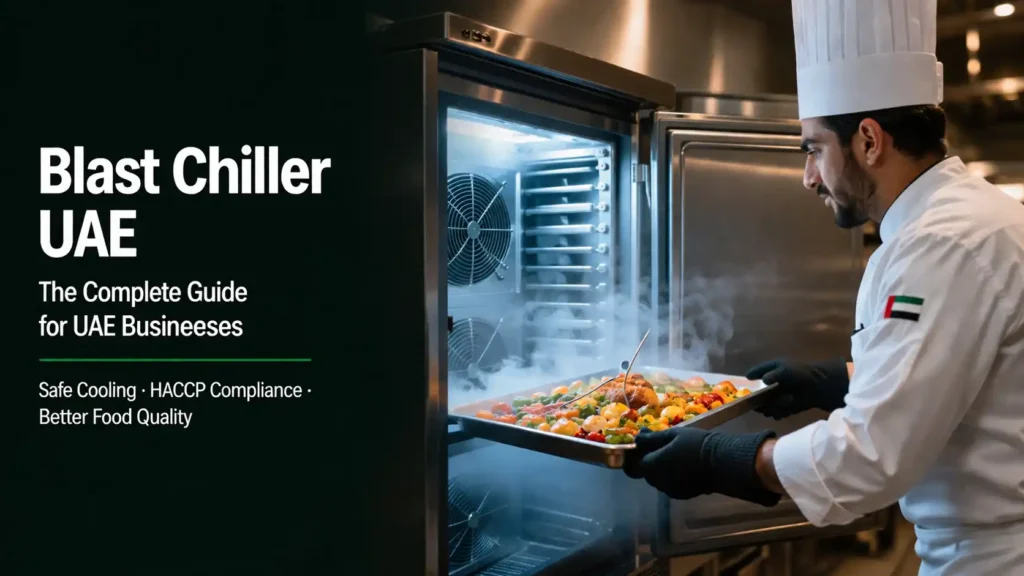
| Blast Chiller / Blast Freezer | Rapid pull-down of hot cooked food from 70°C to below +3°C (HACCP requirement within 90 minutes) | Central production kitchens, airline catering, hotel banqueting, hospital food prep | You need ongoing storage — a blast chiller is a processing appliance, not a storage room. Pair it with a walk-in chiller. |
| Custom Multi-Zone Cold Room | Large operations needing multiple temperature zones under one roof (+2°C chilled / +10°C fresh / −18°C frozen) | JAFZA cold stores, supermarket distribution centres, pharmaceutical warehouses, hospital pharmacies in Abu Dhabi | Your budget or footprint is limited. Start with a standard walk-in and expand. |
Quick Decision Guide — Which System Do I Need?
| Your Situation | Recommended System |
|---|---|
| I run a restaurant and need to store fresh produce, dairy, and beverages | Walk-in chiller (+1°C to +5°C) |
| I am a pharmacy or distributor storing vaccines and medicines | Pharmaceutical walk-in chiller (+2°C to +8°C, validated to WHO GDP) |
| I store frozen meat, ice cream, and long-life frozen goods | Walk-in freezer (−18°C to −22°C) |
| I cook in large batches and need to chill hot food quickly | Blast chiller (paired with a walk-in for storage) |
| I run a flower shop or event floristry business | Flower chiller (+2°C to +8°C, 85–95% relative humidity) |
| I need cold storage for a 3-month event season only | Portable / rental chiller |
| I distribute multiple product types needing different temperatures | Custom multi-zone cold room |
Key Advantages of a Walk-in Chiller UAE
Investing in a walk-in chiller UAE delivers a strong return on investment across multiple operational dimensions. Here are the primary advantages — explained in plain English.
Large Storage Capacity
A walk-in chiller gives you expansive, customisable floor space to store bulk inventory without compromising airflow or temperature consistency — something compact units simply cannot match.
Precise Temperature Control
Modern walk-in chillers are equipped with advanced temperature monitoring systems that allow you to set, track, and maintain precise thermal conditions around the clock. This is vital for compliance with UAE chiller room temperature standards and HACCP food safety regulations.
Energy Efficiency
High-performance insulation panels and variable-speed refrigeration compressors keep your walk-in chiller cost-effective to run. Properly maintained systems can reduce energy bills significantly — explore our dedicated guide on reducing chiller room electricity costs in UAE.
Built for UAE’s Climate
Our walk-in chillers are specifically engineered for the UAE’s harsh desert environment — with anti-corrosion coatings, heavy-duty door seals, climate-resistant components, and condensing units rated for ambient temperatures up to 55°C. A standard European-spec system will struggle in UAE summers; ours will not.
Regulatory Compliance
Walk-in chillers installed by certified suppliers in Dubai, Abu Dhabi, and Sharjah comply with UAE municipality standards, HACCP guidelines, and international food safety regulations — reducing your risk of fines and operational shutdowns.
Scalability and Customisation
From small modular units for cafés to large multi-room cold storage complexes for warehouses, walk-in chiller UAE solutions can be scaled and customised to meet your exact spatial, thermal, and operational requirements.
Walk-in Chiller vs Walk-in Freezer — What Is the Difference?
A common question among UAE business owners is whether they need a walk-in chiller or a walk-in freezer. Both are refrigerated rooms — but they serve distinctly different purposes and operate at very different temperatures.
| Feature | Walk-in Chiller | Walk-in Freezer |
|---|---|---|
| Temperature Range | +1°C to +8°C | −18°C to −22°C |
| Best For | Fresh produce, dairy, pharma, flowers, beverages | Frozen meat, ice cream, fish, long-term frozen storage |
| Energy Usage | Moderate — lower running costs | Higher — greater thermal differential to maintain |
| Typical Industries | Hotels, restaurants, pharmacies, retail, florists | Supermarkets, food processing plants, logistics |
| Humidity Control | Adjustable — 60–95% RH depending on product | Low humidity environment by design |
| Insulation (UAE) | Minimum 100mm PUF panels | Minimum 120mm PUF panels |
Many businesses in UAE benefit from installing both a walk-in chiller and a walk-in freezer side by side — sharing a common structural wall to reduce construction and refrigeration costs. For a full breakdown, read our article on cold room vs chiller room in UAE.
Walk-in Chiller UAE for Pharmaceutical Storage
The pharmaceutical sector in the UAE is one of the fastest-growing industries in the region — and maintaining the cold chain is non-negotiable. A pharmaceutical walk-in chiller must adhere to strict standards set by the UAE Ministry of Health and Prevention (MoHAP) and the World Health Organisation’s Good Distribution Practice (GDP) guidelines.
Direct Definition — Pharmaceutical Walk-in Chiller UAE
A pharmaceutical walk-in chiller is a precision-controlled cold room designed to store vaccines, medicines, biological samples, and regulated medical products at +2°C to +8°C. It must include validated temperature monitoring with data logging, backup power compatibility, and qualification documentation (IQ/OQ/PQ) to comply with WHO GDP and UAE MoHAP requirements.
Our pharmaceutical cold storage and medical chiller solutions in UAE include:
- Temperature accuracy of ±1°C (±0.5°C achievable in premium configurations with PID controllers), validated to maintain the +2°C to +8°C required range
- 24/7 IoT-based temperature monitoring with automated SMS/app alarms and tamper-proof data logging for audit readiness
- Validation documentation (IQ/OQ/PQ) and temperature mapping — essential for Dubai Health Authority and MoHAP inspections
- Backup power compatibility (UPS and generator integration) to prevent cold chain breaks during power outages
- GMP-compliant interior finishes — hygienic wall panels, coved floor joints, and materials approved for pharmaceutical environments
Engineer’s Insight — Validation Is Not Optional
We regularly work with pharmaceutical distributors in Dubai who have purchased a well-engineered cold room but skipped the temperature mapping and qualification documentation (IQ/OQ/PQ). When Dubai Health Authority conducts an inspection, the cold room itself is not the problem — the lack of documented evidence that it performs within specification is. A chiller without validation documentation is non-compliant regardless of how well it works. Budget for validation from day one, not as an afterthought.
Walk-in Chiller UAE for Hotels & Restaurants
The UAE’s hospitality industry — home to thousands of hotels, fine dining restaurants, and catering companies — relies heavily on the walk-in chiller for smooth kitchen operations. From 5-star hotels in Dubai Marina to casual dining outlets in Sharjah’s Al Majaz waterfront, cold storage is the backbone of food service.
Key features of our walk-in chiller Dubai solutions for hospitality businesses:
- HACCP compliance: automated temperature logging for food safety audits, accessible to UAE municipality inspectors on request
- High-humidity zones: maintain 80–90% relative humidity to extend the freshness of vegetables, fruits, and dairy without desiccation
- Heavy-duty doors and traffic-rated floor panels: built for high-access kitchens where staff enter dozens of times per day
- Modular designs: integrate seamlessly into existing kitchen layouts with minimal disruption
- Rapid installation: standard modular units installed in 3–5 working days
Engineer’s Insight — Door Traffic Is Your Biggest Energy Leak
For a busy restaurant walk-in chiller in Dubai Marina, door openings account for 30–40% of the total heat load — more than the transmission load through the walls. A strip curtain and an air curtain together can reduce this infiltration load by up to 80%. We have seen restaurants cut their chiller electricity bill by 20–25% simply by installing a proper air curtain on a door that had none. It costs less than AED 2,000 and pays back within a few months.
Walk-in Chiller UAE Supermarkets & Retail
Supermarkets and retail chains depend on walk-in chillers in UAE to handle large volumes of fresh goods daily. Efficient back-of-store cold storage directly impacts product shelf life, wastage levels, and profitability.
Our retail-grade walk-in chillers are designed with:
- High-capacity evaporator units for rapid temperature recovery after heavy door traffic
- Anti-condensation glass door options for front-of-store display chilling
- Stainless steel interior panels for easy cleaning and UAE municipality hygiene compliance
- Integrated shelving and racking systems for maximum SKU organisation
- Remote temperature monitoring system integration via mobile apps and cloud dashboards
If energy bills are a concern, our dedicated guide on how to reduce chiller room electricity costs in UAE covers cost-saving measures that do not compromise performance.
Walk-in Chiller UAE for Flowers & Horticulture
The UAE imports millions of stems of fresh flowers every week for weddings, events, and retail — making floral cold storage one of the most specialised applications of the walk-in chiller. Flowers are far more sensitive to temperature fluctuation and air movement than most food products.
Our flower chiller solutions in UAE are engineered to maintain temperatures between +2°C and +8°C with high relative humidity of 85–95% to extend the vase life of cut flowers and living plants. Key features:
- Gentle, uniform airflow systems — high-velocity air from a standard evaporator will desiccate flower petals rapidly. Our units use low-velocity, evenly distributed airflow to prevent this.
- Ethylene gas management — ethylene accelerates senescence (ageing) in cut flowers. Our systems include ventilation options to actively remove ethylene from the chiller atmosphere, extending bloom life.
- Hygienic drainage systems — easy floor washing for florists and event companies
- Custom sizing — from small retail flower shops to large horticultural wholesalers and event companies
Important — Ethylene: Two Opposite Uses Explained
Ethylene gas plays two very different roles in refrigerated storage — and confusing them is costly:
• In flower chillers: ethylene accelerates flower ageing. The goal is to REMOVE or minimise ethylene to extend vase life. Ethylene management systems ventilate it out.
• In fruit ripening rooms: ethylene is INJECTED at controlled concentrations to trigger and manage the ripening of bananas, avocados, mangoes, and other climacteric fruits.
These two applications must never share the same cold room. Flowers stored in a ripening room will die prematurely. This is one of the most common and costly mistakes in UAE cold storage design.
Walk-in Chiller UAE for Fruits & Vegetables
Fruits and vegetables are among the most temperature-sensitive commodities stored in a walk-in chiller — and the UAE market handles a particularly wide variety of produce, from temperate European imports to tropical Asian and African fruits.
Critical Temperature Distinction — Tropical vs Temperate Produce
Not all fruits and vegetables should be stored at the same temperature:
• Temperate produce (apples, pears, grapes, lettuce, broccoli, berries): +1°C to +5°C
• Tropical produce (mangoes, bananas, papayas, pineapples, avocados): +10°C to +13°C
Storing tropical fruits below 10°C causes chilling injury — pitting, browning, skin darkening, and failure to ripen. This is one of the most common causes of tropical fruit loss in UAE distribution and retail.
We offer advanced fruit ripening and cold storage solutions in UAE that allow importers and distributors to control the ripening process. Our systems include:
- Ethylene gas injection and precision ventilation systems for controlled ripening of bananas, avocados, mangoes, and other climacteric fruits
- Multi-temperature zone configurations — a chilled zone (+1°C to +5°C) adjacent to a fresh zone (+10°C to +13°C) in a single facility
- CCTV-compatible, insulated rooms with secure access control for high-value inventory
- Remote temperature monitoring via mobile apps with real-time alerts
How to Size a Walk-in Chiller for Your Business
The most common and costly mistake in UAE cold storage is an undersized or incorrectly specified chiller. Most contractors size systems based on room dimensions. The correct starting point is product load and UAE operating conditions — not floor area.
Engineer’s Insight — Sizing Is Not About Room Size
Most contractors in the UAE size a chiller based on the dimensions of the room. That is the wrong starting point. The right starting point is the product load — how much product enters at what temperature, and how quickly it needs to be pulled down. A 20 m² room storing freshly arrived produce from a 38°C delivery truck has a completely different refrigeration requirement than the same room storing pre-chilled products from a controlled warehouse. If your system was sized on room dimensions alone, it is almost certainly undersized for peak load.
The 4 Factors That Determine the Right Chiller Size
1. Product load — total weight of goods entering the chiller per day, their starting temperature, and the heat they release as they cool down. Fresh produce arriving at 30°C places a far higher load on the system than pre-chilled stock.
2. Infiltration load — heat entering through door openings. In a busy restaurant kitchen in Dubai, door traffic is consistently the number one load underestimated by contractors. A chiller door left open for 30 seconds in 45°C ambient lets in enormous heat.
3. Transmission load — heat coming through walls, ceiling, and floor from the UAE ambient environment (up to 50°C external surface temperature in summer). This is why UAE-specification insulation panels must be a minimum of 100mm thick for chillers and 120mm–150mm for freezers — not the 80mm used in European markets.
4. Equipment load — heat generated by internal lighting, evaporator fan motors, and any powered equipment stored inside.
UAE-Specific Sizing Rule
Always add a 15–20% load buffer on top of the standard calculation.
Why? Because most global sizing charts assume a 32°C to 35°C design ambient temperature. In the UAE, your condenser may face 48°C to 50°C of direct summer heat on an external wall or rooftop. A system sized to the European standard will be at the limit of its capacity during UAE peak summer, which is exactly when you need it to perform most reliably.
Engineer’s Insight — The Condenser Pays the UAE Tax
Every refrigeration system has to reject heat to the outside air. In the UAE, ‘outside’ means 45°C to 50°C in summer. A condenser unit rated at 35°C ambient — which is the default for most European-specification equipment — loses roughly 25–30% of its cooling capacity when the ambient reaches 48°C. If your supplier did not specifically account for UAE summer peak temperatures in the condenser selection, your chiller will struggle every August — exactly when you need it most.
Regulations for Walk-in Chiller UAE
Cold storage compliance in the UAE is governed by multiple regulatory bodies, depending on your industry and emirate. Understanding which authority applies to your business — and what they require — is essential before commissioning any system.
| Regulatory Body | What They Require | Who It Affects |
|---|---|---|
| Dubai Municipality (Food Safety Dept) | Cold room compliance with HACCP food handling and temperature monitoring standards. Inspectors may request temperature logs on any visit. | All food businesses in Dubai — restaurants, supermarkets, catering, food manufacturing |
| Abu Dhabi Agriculture & Food Safety Authority (ADAFSA) | All food businesses in Dubai — restaurants, supermarkets, catering, and food manufacturing | Food distributors, retailers, and cold chain operators in Abu Dhabi |
| UAE Ministry of Health and Prevention (MoHAP) | GDP compliance, validated and documented cold storage for pharmaceutical products, IQ/OQ/PQ qualification documentation. | Pharmacies, hospitals, pharmaceutical distributors and manufacturers across UAE |
| Trakhees / Free Zone Authorities (JAFZA, DAFZA, KIZAD) | Building, electrical, and refrigeration system compliance for commercial installations inside free zones. Separate permit process from mainland municipalities. | All cold room installations inside UAE free zones |
| Dubai Civil Defence (DCD) | Temperature monitoring records, validated cold storage, and regular inspections for food storage and distribution facilities. | Large industrial cold stores and logistics facilities using natural refrigerants |
Note on Refrigerant Compliance
The UAE is a signatory to the Kigali Amendment to the Montreal Protocol, which is phasing down high-GWP HFC refrigerants. If you are currently operating systems on R-404A — a refrigerant widely used in walk-in freezers — be aware that:
- R-404A is being phased out globally due to its very high global warming potential (GWP: 3,922).
- Modern replacements include R-448A, R-449A, and R-452A for low-temperature applications, and R-407A or R-407F for medium-temperature.
- Natural refrigerants (CO₂ and NH₃) are increasingly used in large UAE logistics cold stores for their zero or very low GWP.
Ask your supplier to specify a compliant refrigerant for any new installation. We always recommend future-proof options.
How Much Does a Walk-in Chiller Cost in UAE?
Cost is one of the most searched topics in this category and one of the least transparently answered. Below are realistic market ranges based on our experience installing cold rooms across the UAE — these are supplied-and-installed figures, not equipment-only prices.
| System Type | Approx. UAE Installed Cost (AED) | What Affects the Price |
|---|---|---|
| Small modular chiller (up to 10 m²) | AED 15,000 – 35,000 | Room size, insulation spec, refrigerant type, monitoring system |
| Medium custom chiller (10–30 m²) | AED 35,000 – 90,000 | Custom panelling, door spec, airflow design, municipality approvals |
| Large or pharmaceutical chiller (30 m²+) | AED 90,000 – 300,000+ | Validation documentation, GMP finishes, monitoring complexity, civil works |
| Walk-in freezer (standard, 10–25 m²) | AED 45,000 – 120,000 | Heavier insulation, more powerful refrigeration unit, floor heating (anti-frost) |
| Blast chiller (10–30 tray capacity) | AED 18,000 – 55,000 | Blast capacity, blast-freeze capability, stainless spec |
| Annual Maintenance Contract (AMC) | 5–8% of system value/year | Coverage scope, response time SLA, included parts |
ROI Note
A well-specified walk-in chiller UAE typically pays back its installation cost within 12–24 months for high-volume food businesses, primarily through reduced product spoilage (30–60% reduction is achievable) and lower energy bills versus inadequate cold storage alternatives.
These are illustrative market ranges. Site-specific conditions — civil works, electrical supply, compressor location, municipality permit costs — affect the final price. Always request a site-specific quote.
Why Walk-in Chillers Fail in UAE — and How to Prevent It
Understanding the most common failure modes — especially those unique to UAE operating conditions — is the best investment you can make before buying or specifying a cold room. We also recommend reading our dedicated article on why chiller rooms fail in UAE.
Engineer’s Insight — Airflow Is the Silent Killer
In Dubai, we have seen chiller rooms fail not because of the temperature setting or the compressor specification, but because airflow was never properly designed. A shelf placed just 10 cm in front of an evaporator coil can create a warm zone of +6°C in a room set to +2°C. Most buyers never discover this because the thermostat sensor is positioned in the wrong location and reads correctly. Product spoilage tells the real story.
- Undersized condensing unit — the most common failure in UAE. The condenser sits on a rooftop or external wall in 48°C ambient heat, but was sized for European design conditions. It loses 25–30% of its capacity in UAE summer peak.
- Door seal failure — desert dust and heavy traffic degrade PVC door seals rapidly. A failing door seal can increase energy consumption by 20–30% overnight. Monthly visual inspection is essential.
- Poor airflow design — shelving placed directly in front of evaporator coils blocks air circulation, creating warm spots and temperature inconsistency that cannot be fixed without repositioning the coil or the shelving.
- Blocked condenser coils — sand and dust clog external condenser coils in UAE conditions quickly. Monthly cleaning is essential, not optional.
- Refrigerant leakage — high-pressure cycling in UAE heat accelerates refrigerant leak rates at fittings and valves. Annual leak testing and refrigerant charge verification is standard practices for any compliant AMC.
- Inadequate insulation thickness — 80mm PUF panels (standard in Europe) are insufficient for UAE chillers. The industry-recommended minimum is 100mm for chillers and 120–150mm for freezers installed in UAE ambient conditions.
How to Reduce Electricity Costs for Your Walk-in Chiller UAE
Operating a walk-in chiller UAE in extreme heat comes with significant energy demands — but the right equipment choices and maintenance practices can dramatically reduce running costs.
DEWA Commercial Electricity Tariff — 2025/2026 Confirmed Rates
DEWA charges commercial electricity on a tiered slab system:
| Monthly Consumption | Rate (AED/kWh) |
|---|---|
| 0 – 2,000 kWh | AED 0.23 |
| 2,001 – 4,000 kWh | AED 0.28 |
| 4,001 – 6,000 kWh | AED 0.32 |
| 6,001 kWh and above | AED 0.38 |
| + Fuel surcharge (all slabs) | ~AED 0.06 |
| + VAT | 5% |
A commercial walk-in chiller UAE operation typically consumes well above 6,000 kWh/month, bringing the effective all-in rate to approximately AED 0.44–0.47/kWh after fuel surcharge and VAT.
Abu Dhabi businesses pay a flat AED 0.20/kWh via TAQA/ADDC with no fuel surcharge — approximately 30–40% cheaper than Dubai rates for equivalent consumption.
Our top energy-saving recommendations:
- Use a minimum of 100mm PUF insulation panels to reduce heat ingress — every additional 20mm of insulation in UAE conditions can reduce compressor run time by 8–12%
- Install variable-speed (inverter) compressors that adjust capacity based on load — saving 15–35% versus fixed-speed units during off-peak hours
- Fit air curtains and strip curtains on all walk-in chiller doors — reduces infiltration load by up to 80%, one of the highest-ROI improvements available
- Implement IoT-based temperature monitoring systems to detect door seal failures, refrigerant loss, and compressor inefficiency before they become expensive problems
- Schedule monthly preventive maintenance, including condenser coil cleaning (monthly in UAE dusty environments), door seal inspection, and refrigerant level checks
- Use LED lighting with motion sensors inside the chiller room — standard fluorescent fittings generate heat inside the cold room and add to the compressor load
- Locate the condensing unit in shade where possible, or install a condenser shade structure — reducing ambient temperature at the condenser by 5–8°C can recover 10–15% of lost capacity in UAE summer
For a complete deep-dive into cost-reduction strategies, visit our guide on reducing chiller room electricity costs in UAE.
Choosing the Right Walk-in Chiller Supplier in Dubai, Abu Dhabi & Sharjah
Not all cold storage providers are equal. When selecting a supplier for your walk-in chiller UAE, these are the critical factors that separate a reliable partner from a low-cost contractor who will cost you more in the long run.
| What to Look For | What to Ask | Red Flag |
|---|---|---|
| UAE Climate Experience | Have you installed chillers in buildings with similar UAE ambient conditions? Can you show us projects in Dubai / Abu Dhabi / Sharjah? | Supplier uses European sizing charts without UAE ambient correction |
| End-to-End Service | Do you handle design, manufacture, installation, commissioning, and after-sales? Or do you subcontract any stage? | Installation subcontracted to unlicensed third parties |
| Certifications | ISO certification, UAE municipality approval, pharma GDP validation capability? | No local municipality registration or approvals |
| Temperature Monitoring | Do you offer integrated IoT monitoring with real-time alerts, data logging, and cloud access? | Basic thermostat dial only — no digital logging |
| Insulation Specification | What panel thickness do you supply for UAE conditions? Is the condenser rated for 50°C ambient? | Standard 80mm panels offered without UAE climate discussion |
| AMC and Warranty | Do you offer annual maintenance contracts? What is your response time SLA for breakdowns in UAE? | No AMC available — breakdown support ad hoc only |
At ChillerRoom.ae, our team provides free site assessments, detailed proposals, and turnkey walk-in chiller installations across Dubai, Abu Dhabi, Sharjah, and all seven emirates — including free zones such as JAFZA, DAFZA, and KIZAD.
Explore our full range of cold storage services and cold storage solutions or contact us today for a free consultation.
Frequently Asked Questions (FAQs)
A walk-in chiller in UAE is a large, refrigerated room designed for commercial and industrial cold storage. Unlike a standard refrigerator, it stores bulk quantities of perishable goods and maintains precise temperatures between +1°C and +8°C. It is essential for businesses in the UAE’s hot climate where maintaining the cold chain is a regulatory and commercial requirement — not just a convenience
The correct temperature depends on what you are storing:
- Meat, poultry, and seafood: +1°C to +3°C
- Dairy products and beverages: +2°C to +5°C
- Temperate fresh produce (apples, lettuce, berries): +1°C to +5°C
- Tropical fresh produce (mangoes, bananas, papayas): +10°C to +13°C
- Pharmaceutical products (vaccines, medicines): +2°C to +8°C (as per WHO GDP and UAE MoHAP)
- Flowers and cut stems: +2°C to +8°C at 85–95% relative humidity
For detailed specifications by product type, see our chiller room temperature guide for UAE.
A walk-in chiller in UAE maintains temperatures from +1°C to +8°C — suitable for fresh food, beverages, flowers, and pharmaceuticals. A walk-in freezer in UAE operates at −18°C to −22°C, used for frozen meat, ice cream, and long-term frozen storage. Many businesses in UAE install both side by side, sharing a structural wall to reduce construction costs.
A pharmaceutical walk-in chiller in UAE is a precision-controlled cold room storing vaccines, medicines, and biological samples at +2°C to +8°C. In UAE, it must comply with WHO Good Distribution Practice (GDP) guidelines, UAE Ministry of Health and Prevention (MoHAP) requirements, and include validated temperature monitoring with IQ/OQ/PQ documentation. Dubai Health Authority inspectors may request full temperature logs and validation records at any time.
Typical installed costs range from AED 15,000–35,000 for a small modular unit (up to 10 m²), AED 35,000–90,000 for a medium custom system (10–30 m²), and AED 90,000–300,000+ for large or pharmaceutical-grade installations. Annual maintenance contracts (AMC) typically cost 5–8% of the system value per year. See Section 13 for a full cost breakdown.
A temperature monitoring system uses digital sensors placed inside the walk-in chiller to continuously track and record temperature and humidity. Modern IoT-based systems connect via Wi-Fi or GSM to send real-time SMS or app alerts when temperatures deviate from set thresholds. Data is stored in cloud-accessible logs for compliance audits. This is a regulatory requirement for pharmaceutical storage in UAE and best practice for all food service operations.
Standard modular walk-in chiller units are typically installed in 3–5 working days. Custom-built or large-scale systems — including civil preparation, municipality approval, and commissioning — take 2–6 weeks depending on size and complexity. We plan installation schedules to minimise disruption to your business operations.
Yes — and this is a very common configuration across UAE supermarkets, catering facilities, and food processing plants. A walk-in chiller and walk-in freezer can be installed as adjacent units sharing a common structural wall, significantly reducing construction and refrigeration costs. This dual cold room setup gives you complete cold chain management in one footprint.
Yes. We supply, install, and maintain walk-in chillers in Dubai, Abu Dhabi, Sharjah, Ajman, Ras Al Khaimah, Fujairah, and Umm Al Quwain. We also serve commercial and industrial clients inside UAE free zones including JAFZA, DAFZA, KIZAD, SAIF Zone, and Fujairah Free Zone. Contact us via chillerroom.ae for a free site consultation anywhere in the UAE.
The industry-recommended minimum for UAE conditions is 100mm PUF (polyurethane foam) panels for walk-in chillers and 120mm–150mm for walk-in freezers. The standard 80mm panels used in European markets are insufficient given the UAE’s ambient temperatures — which regularly exceed 45°C in summer. Under-insulating a UAE chiller is one of the most common causes of high energy bills and compressor failure.
Glossary — Key Cold Storage Terms Explained
These definitions help buyers, operations managers, and procurement teams understand common technical terms used by cold room engineers and regulators in the UAE.
| Term | Plain-English Explanation |
|---|---|
| HACCP | Hazard Analysis Critical Control Points — a food safety management system that identifies and controls biological, chemical, and physical hazards in food production. Walk-in chillers in food service must be HACCP-compliant, meaning temperature is logged and verifiable. |
| GDP | Good Distribution Practice — WHO guidelines governing how pharmaceutical products must be stored and distributed to maintain their safety and efficacy. Any pharmaceutical walk-in chiller UAE must comply with GDP. |
| IQ/OQ/PQ | Installation / Operational / Performance Qualification — validation documentation required for pharmaceutical cold rooms. IQ confirms the system was installed as specified. OQ confirms it operates within defined parameters. PQ confirms it performs consistently under real-world conditions. |
| Temperature Mapping | The process of placing multiple data loggers throughout a cold room and running them for a defined period (typically 24–72 hours) to document the actual temperature distribution, including hot and cold spots. |
| PUF Panel | Polyurethane Foam Panel — the insulated wall, ceiling, and floor panels used to construct walk-in chillers and freezers. PUF is the industry standard for cold room construction. Minimum 100mm thickness is recommended for UAE chiller applications. |
| AMC | Annual Maintenance Contract — a service agreement between the cold room owner and the supplier covering scheduled preventive maintenance, emergency breakdown response, and defined spare parts coverage. |
| Climacteric Fruit | Fruits that continue to ripen after harvest by producing their own ethylene gas — mangoes, bananas, avocados, tomatoes. Must be stored at +10°C to +13°C and should never be placed in a standard chiller set below +8°C. |
| Condensing Unit | The outdoor or remote component of a refrigeration system that rejects heat to the ambient air. In UAE, the condensing unit must be rated for ambient temperatures up to 55°C to perform reliably in summer. |
Conclusion
A high-quality walk-in chiller UAE is far more than a cold room — it is a compliance asset, a product protection system, and a long-term business investment. Designed correctly for UAE’s extreme climate, sized to the actual product load, built with proper insulation thickness, and maintained on a regular schedule, a walk-in chiller will serve your business reliably for 10–20 years.
As the most trusted walk-in chiller suppliers in Dubai, Abu Dhabi, and Sharjah, we bring together technical excellence, deep local knowledge, and unwavering after-sales support to deliver cold storage solutions that perform flawlessly in the UAE’s demanding environment — from day one through every summer to come.
Ready to Get Started?
📌 Walk-in Chiller UAE page — explore all solutions