Blast Freezer UAE: The Practical 2026 Guide for Hotels, Restaurants, Pharma and Marine
Senior Refrigeration Engineer · Chiller Room UAE
Updated 2026 · Estimated read time: 30–35 min
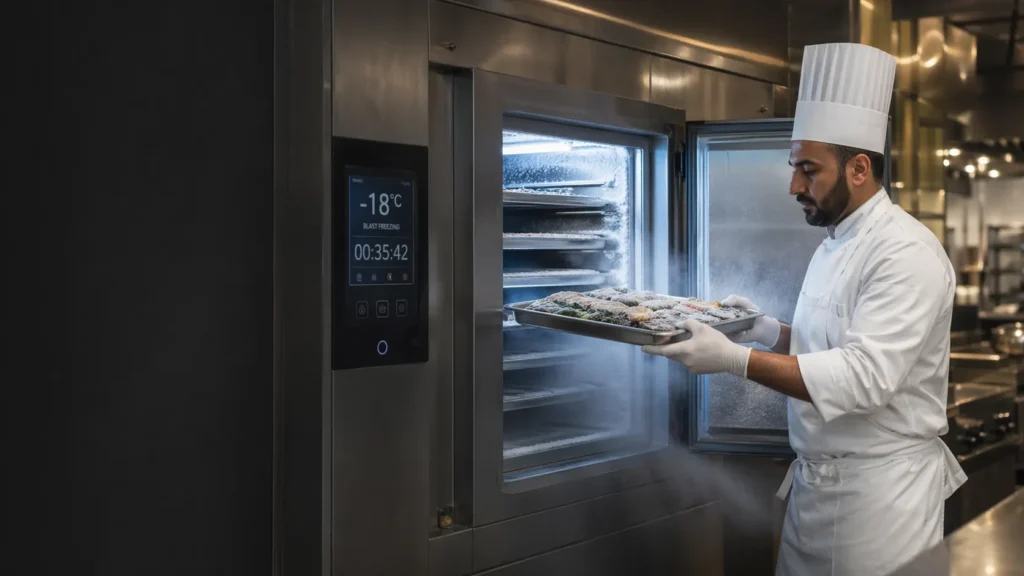
Table of Contents
Quick Answers: Blast Freezer UAE
- What is a blast freezer UAE?
A high-performance refrigeration system that rapidly reduces product core temperature to -18°C or lower using high-velocity cold air. - How fast does a blast freezer work?
Typically 2–5 hours depending on product type, thickness, and load size. - Blast freezer vs blast chiller?
Blast chiller UAE → cools to +3°C (short-term storage)
Blast freezer UAE → freezes to -18°C or below (long-term storage) - Why is it essential in UAE?
Extreme ambient temperatures (45°C+) make slow cooling unsafe and inefficient. - Who needs a blast freezer UAE?
Hotels, restaurants, catering units, food manufacturers, pharma companies, marine processors, and logistics providers. - What size blast freezer do I need in the UAE?
- Small: 10–60 kg per cycle
- Commercial: 60–500 kg per cycle
- Industrial: 500 kg+ or continuous systems
- Can a normal freezer replace it?
No — standard freezers are for storage, not rapid temperature reduction. - Key benefit?
Preserves food quality, safety, texture, and shelf life while ensuring HACCP compliance.
Key Takeaways
- Speed is everything
Blast freezer UAE reduce freezing time by up to 80–90%, preventing large ice crystal formation and preserving product integrity. - Designed for UAE conditions
Only systems with high-ambient ratings (45–52°C+), proper airflow, and hot-gas defrost perform reliably in Gulf climates. - Airflow matters more than the temperature display
Freezing efficiency depends on air velocity (2–6 m/s or higher) — not just the thermostat reading. - Correct sizing prevents costly mistakes
Always size based on peak production load, not kitchen space or average usage. - Energy efficiency impacts long-term cost
Look for inverter compressors, EC fans, and low-GWP refrigerants to reduce operating expenses. - Food safety compliance is non-negotiable
Blast freezing ensures rapid passage through the bacterial danger zone (+8°C to +63°C) and supports HACCP documentation. - Improves profitability
Lower drip loss, longer shelf life, and reduced waste directly increase margins. - Not one-size-fits-all
Small kitchens, large factories, and pharma operations all require different configurations and specifications. - Installation quality matters as much as equipment
Poor insulation, wrong defrost type, or improper condensing unit placement can reduce performance by 30–50%. - UAE expertise is critical
Systems designed for Europe often fail in the UAE without local engineering adaptation.
Introduction: Why Freezing Technology Matters More in the UAE Than Anywhere Else
The UAE is one of the most demanding environments on earth for cold chain operations. With ambient temperatures routinely exceeding 45°C in summer, a standard refrigeration unit is not just insufficient — it is a liability. Whether you run a five-star hotel kitchen in Dubai, a pharmaceutical distribution hub in Abu Dhabi, a seafood processing plant in Sharjah, or a large-scale food logistics operation across the Emirates, your ability to preserve product quality safely and efficiently determines your bottom line.
This is where a blast freezer UAE solution transforms operations. Unlike conventional refrigeration, which cools products slowly and allows ice crystals to damage cellular structure, a blast freezer drops the core temperature of food or pharmaceutical products rapidly — preserving quality, safety, and commercial value simultaneously.
As one of the leading chiller room manufacturers in UAE, we specialise in custom cold storage, blast freezers, and energy-efficient refrigeration systems designed specifically for the demands of the Gulf climate. From compact small blast freezer UAE units for boutique restaurants to large-scale industrial blast freezer installations for logistics warehouses, our solutions are engineered for UAE conditions — not imported as afterthoughts.
This guide is written for business owners, operations managers, and procurement professionals who need authoritative, practical information before making a significant capital investment. We cover what blast freezers are, how they work, the types available, how to choose the right system, and what mistakes to avoid.
What Is a Blast Freezer UAE?
A blast freezer UAE is a high-performance refrigeration system that freezes products rapidly by forcing extremely cold air over them at high velocity. The goal is to bring the core temperature of a product down to -18°C or lower in the shortest possible time — typically within 90 minutes to 4 hours, depending on product type, density, and quantity.
This is 5 to 10 times faster than a standard freezer — and that speed is the entire point.
This category of equipment goes by several names depending on its specific function:
Blast Chiller Freezer
A blast chiller freezer is a dual-mode unit capable of both chilling (reducing product temperature to +3°C core) and hard freezing (bringing products to -18°C core or below). This versatility makes it particularly popular in commercial kitchens, catering facilities, and food processing operations where different product types require different temperature treatments.
Blast Cooler
A blast cooler focuses on rapid chilling rather than hard freezing. It brings hot or warm food products to a safe core temperature of +3°C as quickly as possible — passing through the bacterial danger zone (above +8°C) rapidly to halt bacterial growth. This +3°C core temperature, not merely “below +8°C,” is the target required under HACCP guidelines and UAE food safety regulations. A blast cooler is an essential part of any professional cold chain system, even if it does not hard-freeze.
Industrial Blast Freezer UAE
An industrial blast freezer UAE is a large-scale, high-capacity unit designed for continuous or high-volume freezing operations. These systems are found in food manufacturing plants, seafood processing facilities, and large logistics hubs. They are engineered for 24/7 operation, often integrated with conveyor systems, and built to handle hundreds of kilograms to multiple tonnes of product per hour.
Understanding these distinctions is the first step in choosing the right equipment for your UAE operation. For a deeper look at commercial kitchen applications, see our guide on blast chillers for commercial kitchens in UAE.
How Blast Freezer UAE Works: The Science Behind Rapid Freezing
The Fast Freezing Process
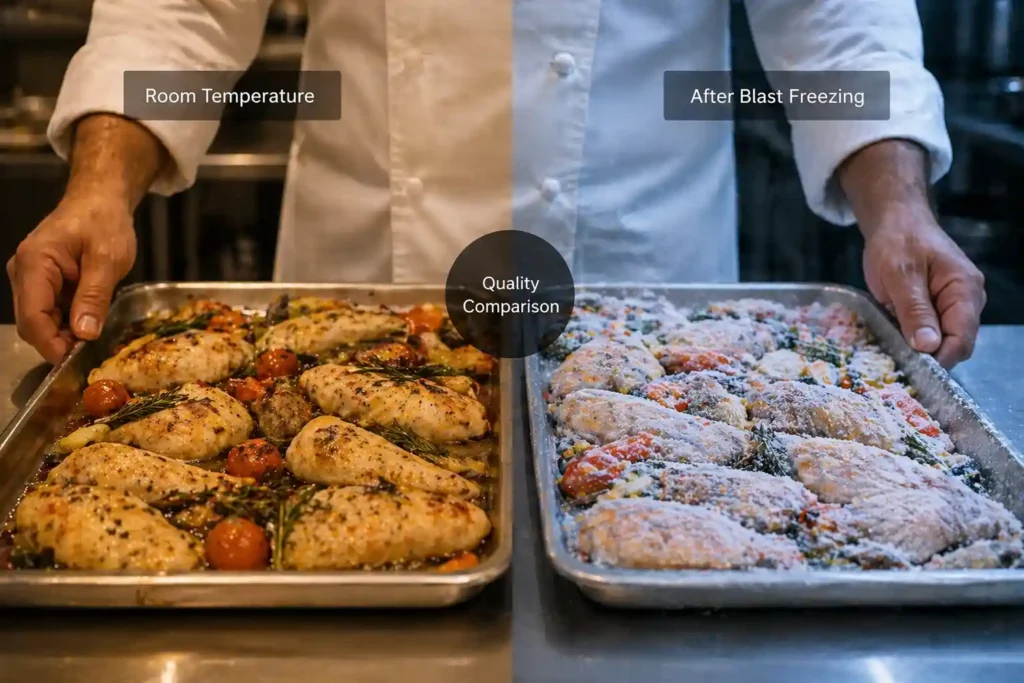
Conventional freezers rely on still or slowly circulating cold air to gradually reduce a product’s temperature. This slow process allows large ice crystals to form between the cells of food (extracellularly). These crystals draw moisture out of the cells and rupture cell walls — which is why slowly frozen food turns soggy, loses flavour, and suffers texture damage when thawed.
A blast freezer UAE system works differently. Powerful fans circulate air at high velocity — typically 2–6 metres per second for commercial units, and up to 8–10 metres per second in industrial tunnel and spiral systems — across evaporator coils chilled to between -30°C and -40°C. This turbulent airflow dramatically increases the rate of heat transfer, reducing freezing time by 80–90% compared to conventional freezing.
Because blast freezing happens so fast, small ice crystals form within the cells (intracellularly) rather than between them. Cell walls stay intact. When the product is thawed, it retains its original texture, moisture content, flavour, and nutritional value. This is the fundamental scientific advantage of blast freezing over conventional methods.
Engineer’s Insight: “The most common mistake we see in UAE food businesses is judging a blast freezer by its temperature display, not its airflow performance. A unit showing -35°C on the controller is doing nothing useful if the fan motor has degraded and airflow has dropped by 40%. We always verify air velocity at the product zone during commissioning — because that is what actually freezes the food, not the set point on the screen.”
Temperature Ranges
| System Type | Evaporator Coil Temp | Target Core Temp | Typical Cycle Time | Application |
|---|---|---|---|---|
| Blast Cooler | -5°C to -15°C | +3°C | 90 min (light load) | Rapid chilling of hot foods |
| Blast Chiller | -10°C to -20°C | +3°C | 90 min – 2 hrs | Safe temperature reduction pre-storage |
| Blast Chiller Freezer | -30°C to -40°C | -18°C | 2–5 hrs (load dependent) | Hard freezing for long-term storage |
| Industrial Blast Freezer | -35°C to -45°C | -18°C to -40°C | Continuous | High-volume industrial freezing |
Note on Blast Cooler coil temperature: UAE high-ambient installations typically operate toward the lower end of this range (-12°C to -15°C) to achieve reliable pull-down in hot conditions. Systems specified for temperate climates at -5°C to -10°C may underperform during peak UAE summer.
Important note on cycle times: All cycle times depend on product type, portion thickness, starting temperature, tray spacing, and load weight. 90 minutes apply to light, shallow-portioned loads starting at around 70°C. Dense or fully loaded cycles — such as solid joints of meat or large blocks of fish — can take 2.5 to 4 hours even in a correctly specified machine. Always size your blast freezer based on worst-case product loads, not average loads.
How It Differs from a Standard Chiller Freezer
A standard chiller freezer is designed for storage — to keep a product that is already cold at a stable temperature. It lacks the airflow power and evaporator capacity to rapidly remove heat from warm or freshly cooked products.
Placing hot food into a standard chiller freezer is not only ineffective — it is dangerous. The slow temperature reduction creates an extended window in the bacterial danger zone (+8°C to +63°C), increasing contamination risk and potentially raising the temperature of other products stored in the same unit. A blast freezer UAE eliminates this risk by moving product through the danger zone in minutes.
Advantages of a Blast Freezer UAE System
1. Food Safety Compliance
UAE food safety law is clear on temperature control. Federal Law No. 10 of 2015 and the GCC Standardisation Organisation’s food hygiene guidelines, aligned with Codex Alimentarius, both mandate that cooked food must pass through the bacterial danger zone as rapidly as possible.
The Abu Dhabi Agriculture and Food Safety Authority (ADAFSA) — which replaced the former ADFCA in 2019 — and Dubai Municipality’s Food Safety Department both conduct unannounced inspections and routinely request temperature records as part of operational audits.
A blast freezer with integrated HACCP data logging gives you the documented evidence of compliance you need during audits — not just safe food, but proof of safe food.
2. Extended Shelf Life
Blast-frozen products maintain quality significantly longer than conventionally frozen goods. Seafood blast-frozen within hours of catch can maintain near-fresh quality for months. Prepared meals retain the flavour and texture that consumers notice. For export businesses, shelf life directly affects your product’s competitiveness in international markets.
3. Reduced Product Loss (Drip Loss)
Blast-frozen products typically show drip loss of less than 1% on thawing, compared to 5–8% or more for conventionally frozen items. At commercial scale, that reduction in moisture loss translates directly to revenue. For a plant processing one tonne of product per day, even a 3% improvement in drip loss saves tens of thousands of dirhams annually.
4. Energy Efficiency
A modern blast freezer UAE system costs more per hour to run than a storage freezer — but it operates for far fewer hours per product cycle. When products enter long-term storage already at target temperature, your storage units run less hard, reducing total cold chain energy consumption. Look for inverter-driven compressors, EC (electronically commutated) fans, and low-GWP refrigerants such as R-452B, R-448A, or R-290 (propane) — a natural refrigerant increasingly specified in UAE for its efficiency and low environmental impact.
For detailed energy reduction strategies, read our guide on reducing chiller room electricity costs in UAE.
5. Operational Efficiency and Throughput
Blast freezing shortens production cycles significantly. A food manufacturer that previously needed overnight holding before packaging and dispatch can now complete the process within hours. This improves cash flow, reduces inventory holding costs, and enables faster delivery schedules.
6. Nutritional Value Preservation
Rapid freezing locks in vitamins, minerals, and natural flavours at their peak. For premium food brands, health-food producers, and export businesses targeting quality-conscious markets, this is a tangible commercial advantage that shows up on nutritional labels and repeat purchase rates.
Engineer’s Insight: “In UAE food factories, we regularly find blast freezers that are technically running at the right temperature — but operators are stacking product 30–40% deeper on trays than the system was designed for. The outside layers freeze correctly while the centre of the stack takes three to four times longer. The HACCP log looks clean because the probe reads the outer layer. The product in the centre is not safe. Correct loading protocol is as important as the machine itself.”
Blast Freezer vs Blast Chiller: Understanding the Difference
This is one of the most common points of confusion among UAE buyers. Both terms are sometimes used interchangeably, but they refer to systems with meaningfully different performance capabilities.
Quick answer: A blast chiller reduces the product to +3°C for short-term refrigerated storage. A blast freezer reduces the product to -18°C or below for long-term frozen storage. A blast chiller freezer does both.
Comparison Table: Blast Chiller vs Blast Freezer
| Feature | Blast Chiller | Blast Freezer / Blast Chiller Freezer |
|---|---|---|
| Target Core Temperature | +3°C | -18°C or below |
| Cycle Time | 90 min – 2 hrs (load dependent) | 2–5 hrs (load dependent) |
| Primary Function | Safe cooling of hot cooked food | Hard freezing for weeks or months of storage |
| Food Safety Role | Passes food through danger zone quickly | Eliminates microbial activity through freezing |
| Shelf Life Achieved | 3–5 days refrigerated | Weeks to months frozen |
| Typical UAE Users | Restaurants, hotels, catering | Food manufacturers, marine, logistics, pharma |
| Energy Consumption | Moderate | Higher per cycle (offset by fewer cycles needed) |
| Size Range | Small to medium | Small, commercial, and industrial |
| Equipment Cost | Lower | Higher |
A Blast Chiller alone is appropriate for operations that chill food for short-term refrigerated service within 5 days. A blast chiller freezer or dedicated blast freezer is required when products need to be stored frozen, distributed through a cold chain, or exported internationally.
Many UAE food businesses benefit most from a blast chiller freezer — a dual-mode unit that handles both functions in a single machine. This is particularly relevant for hotel banqueting operations, large catering companies, and central production kitchens producing both chilled and frozen components.
Types of Blast Freezers Available in UAE
Choosing the right type of blast freezer depends on your product type, volume, space constraints, and operational requirements. Here is a breakdown of the main categories available in the UAE market:
1. Small Blast Freezer UAE
A small blast freezer is designed for lower-volume operations — boutique restaurants, bakeries, pastry kitchens, small food manufacturers, gelato producers, and pharmacies. Capacity typically ranges from 10 kg to 60 kg per cycle.
Despite their compact size, quality small blast freezer units achieve the same rapid temperature reduction as their larger counterparts. They are an excellent entry point for businesses that want to improve food safety and product quality without a major infrastructure investment.
Key features of small blast freezers for UAE operations:
- Available as plug-and-play units (single-phase power, 220V)
- Programmable soft chilling and hard freezing cycles in one machine
- Suitable for pastries, proteins, prepared meals, gelato, and pharmaceutical samples
- Footprint is often comparable to a standard upright refrigerator
2. Commercial Blast Freezer UAE
A commercial blast freezer UAE is designed for medium- to high-volume food service and production operations. Capacities typically range from 60 kg to 500 kg per cycle. These are the workhorse units found in large hotel kitchens, food courts, central production facilities, and mid-scale food manufacturers.
Commercial blast freezer units in the UAE typically feature:
- Multiple programmable freezing cycles for different product types
- Hot gas defrost systems — preferred over electric defrost in UAE’s high-humidity environment, as they are faster, more effective, and cause less temperature disruption to the cabinet
- Stainless steel construction (AISI 304) for hygiene and durability
- Remote condensing unit options — essential for UAE plant rooms that regularly exceed 45°C ambient
3. Industrial Blast Freezer UAE
An industrial blast freezer UAE is designed for large-scale, continuous freezing operations. Capacities range from several hundred kilograms to multiple tonnes per hour. These are the systems used by seafood processors, large food manufacturers, meat packing plants, and major cold chain logistics providers.
Industrial blast freezer configurations common in UAE include:
- Tunnel blast freezers — product moves through on conveyors for continuous freezing
- Spiral blast freezers — space-efficient continuous system for high volumes
- Batch blast freezers — large chamber units for pallet-level freezing
- Plate blast freezers — contact freezing for flat products like fish fillets and burger patties
Industrial systems in UAE are commonly built around compressors from Bitzer, Copeland (Emerson), Carrier, and Daikin — brands valued in the Gulf for parts availability, local service support, and proven performance in high-ambient conditions.
Engineer’s Insight: “Most contractors in the UAE size blast freezers based on room dimensions. That is the wrong starting point. Sizing should start with product load — kilograms of product at what starting temperature, to what target temperature, in what time window. We have seen brand-new blast freezers installed in Dubai that were two sizes too small because the specification was based on kitchen floor space, not production throughput. The operator discovers the problem six months later when they cannot keep up with peak demand.”
4. Custom Cold Storage Blast Systems
For operations with unique requirements — unusual product dimensions, specific regulatory constraints, limited space, or specialised industries such as pharmaceuticals or marine processing — a custom-designed blast freezer system in the UAE is often the optimal choice.
How to Choose the Right Cold Storage System: A Decision Guide
This is one of the most common questions we receive from UAE businesses. Use this guide to match your situation to the right system type before making a purchasing decision.
If you need to move refrigeration to a different location or need temporary cold storage: A portable chiller is the right choice. These are self-contained mobile units suitable for events, temporary operations, or bridging gaps during a fixed installation. They are not designed for blast freezing.
If you need to store large volumes of already-cold product: A walk-in chiller or walk-in freezer is the right choice. Critical point: never put freshly cooked or warm food directly into a walk-in chiller. Always blast chill first, then transfer to walk-in storage.
If your space, product, or regulations are non-standard: A customised chiller system engineered specifically for your operation will outperform any off-the-shelf unit. Best for pharma, marine, non-standard layouts, and multi-zone requirements.
If you need to rapidly chill cooked food for refrigerated service within 5 days: A blast chiller reduces the product to a +3°C core quickly and in HACCP compliance. This is the standard for restaurants, hotels, and catering operations.
If you need to freeze product for long-term storage, shipping, or export: A blast freezer or blast chiller freezer is the right investment. Size guide:
- Under 60 kg per cycle → small blast freezer
- 60–500 kg per cycle → commercial blast freezer
- Over 500 kg per cycle, or continuous throughput → industrial blast freezer
Industry Applications of Blast Freezer UAE
Hotels, Restaurants, and Catering (HORECA)
The UAE’s hospitality sector — from Michelin-recognised fine dining across Dubai and Abu Dhabi to large-scale event catering — depends on blast freezing for quality consistency and waste reduction. Hotels with banqueting operations use commercial blast freezers to batch-cook and freeze large quantities ahead of events, reducing day-of kitchen pressure without sacrificing quality. Restaurant chains use blast freezers in central production kitchens to standardise output across multiple outlets — dishes are prepared, blast-frozen, and distributed for regeneration at the point of service.
Pharmaceutical and Medical
Temperature-sensitive pharmaceuticals, vaccines, biologics, and laboratory samples require precise, validated cold chain management. In the UAE’s pharmaceutical sector, a blast freezer is often used for rapid stabilisation of products after manufacturing or compounding, before transfer to long-term controlled-temperature storage.
Pharmaceutical blast freezing requirements differ critically from food applications: stricter temperature validation, 21 CFR Part 11 or EU GMP compliance, continuous monitoring with data logging, and often cryogenic temperature requirements (-60°C or below for certain biologics and plasma products).
For a detailed overview of pharma-specific cold storage requirements, read our guide on pharma cold storage and medical chillers in UAE.
Marine and Fisheries
The UAE has a significant fishing industry, and Dubai’s fish market is one of the largest in the region. Rapid freezing of fresh catch — ideally within hours of landing — is critical to maintaining quality for both domestic sale and export. Industrial blast freezers are standard equipment in UAE fish processing plants, capable of freezing whole fish, fillets, or shrimp within hours of catch.
Marine-grade blast freezers are built with epoxy-coated or stainless steel condensing coils and sealed components to withstand high-humidity, salt-air environments. A standard commercial blast freezer installed in a coastal marine environment without a marine-grade specification will experience significant coil corrosion and capacity loss within 18 to 24 months.
Engineer’s Insight: “In Dubai’s marina and port sector, we often see blast freezer installations fail within 18 months — not because of poor equipment, but because of salt air corrosion on the condensing coil. Marine environments need epoxy-coated or stainless condensing coils and an aggressive preventive maintenance schedule. Never install a standard commercial blast freezer in a marine environment and expect it to perform on spec beyond the first year.”
Logistics and Cold Chain Warehousing
As the UAE grows as a global logistics hub — positioned between European, African, and Asian markets — the demand for cold chain warehousing with integrated blast freezing capability is growing rapidly. Third-party logistics (3PL) providers increasingly offer blast freezing as a value-added service for food importers and exporters transiting through UAE ports and airports.
Large logistics operators use industrial blast freezers to rapidly bring ambient-temperature imports to frozen specification before long-term warehousing, or to freeze products pre-export to meet destination market requirements. Our article on cold room vs chiller room explains how different systems work together in a larger cold chain infrastructure.
How to Choose the Right Blast Freezer UAE for Your Business
Selecting the correct blast freezer UAE is one of the most consequential procurement decisions a UAE food or logistics business can make. A system that is undersized, incorrectly specified, or poorly suited to your product type will underperform from day one and cost significantly more to operate and maintain. Here are the key criteria to evaluate:
1. Freezing Capacity — Size for Peak Load, Not Average
Calculate your maximum daily or per-shift output that requires blast freezing — not your average day. A restaurant producing 100 kg of prepared food per dinner service needs a blast freezer that can handle that volume within a practical cycle time.
Questions to ask before specifying:
- What is my maximum daily or hourly output that requires blast freezing?
- How many freezing cycles can I practically run per day, given my production schedule?
- Do I need continuous-process capability (industrial) or batch processing (commercial)?
Undersizing creates bottlenecks and food safety risks. Oversizing wastes capital and energy.
2. Temperature Range Required
| Product Type | Required Core Temperature |
|---|---|
| Standard food (cooked meals, vegetables) | -18°C |
| Ice cream and gelato | -25°C to -30°C |
| Tuna and premium seafood | -40°C to -60°C |
| Pharmaceutical products | -20°C to -80°C (validated) |
| Plasma and certain biologics | -80°C and below |
Do not purchase a blast freezer rated to -18°C if your product requires -40°C. The cost difference between specifications is far less than the cost of a product recall or regulatory failure.
3. Available Space and Condensing Unit Placement
A small blast freezer fits within an existing kitchen. An industrial blast freezer may require a dedicated building, structural reinforcements, and specialist electrical infrastructure. Early-stage planning should always involve a site survey by an experienced refrigeration engineer.
In the UAE, ambient temperatures in plant rooms regularly exceed 45°C. A remote condensing unit placed outdoors — away from the blast freezer cabinet — is almost always essential for reliable system performance and longevity. An integrated condensing unit in a hot plant room will significantly reduce the system’s capacity and shorten its service life.
4. Energy Efficiency and Running Costs
In the UAE, electricity is a major ongoing operating cost. The key efficiency indicators to look for:
- COP (Coefficient of Performance): The ratio of cooling output to energy consumed. A good modern blast freezer should achieve a COP of 2.0–3.5, depending on operating conditions. Higher COP means lower running costs.
- Inverter-driven compressors: Modulate power output to match load — significantly more efficient than fixed-speed on/off compressors
- EC fans: 30–50% more efficient than standard AC fan motors
- Low-GWP refrigerants: R-452B and R-448A replace R-404A. R-290 (propane) is gaining traction for smaller commercial units for its efficiency and very low environmental impact
A more efficient blast freezer UAE costs more upfront but delivers a significantly better total cost of ownership over its operating life.
5. HACCP Data Logging and Compliance
Any blast freezer purchased for a UAE food business in 2025 should include — or be compatible with — continuous temperature data logging. ADAFSA and Dubai Municipality inspectors request temperature records. A blast freezer with built-in HACCP reporting and exportable data logs protects you during audits and demonstrates due diligence in food safety management.
6. Certifications
Ensure the equipment carries:
- NSF certification — an internationally recognised standard for food equipment hygiene design, widely specified in UAE hotel, healthcare, and food manufacturing procurement
- HACCP-compliant design documentation
- UAE MoIAT standards compliance (formerly ESMA), where required
Cost of a Blast Freezer UAE: What Affects the Price?
Blast freezer pricing in the UAE varies considerably depending on size, type, specification, and manufacturer. Rather than providing figures that quickly become outdated, it is more useful to understand the factors that drive cost — so you can evaluate supplier quotes accurately.
Factors That Influence Blast Freezer UAE Price
| Factor | Impact on Price |
|---|---|
| Capacity (kg per cycle) | Higher capacity = higher cost |
| Temperature range | Deeper freezing capability = higher cost |
| Compressor brand | European brands (Bitzer, Copeland) cost more; offer longer life and better parts availability in UAE |
| Remote vs integrated condensing | Remote units cost more to install but are essential for UAE climate performance |
| Control system | Touchscreen, HACCP logging, and remote monitoring all add cost |
| Installation complexity | Custom fit-outs, structural work, and electrical upgrades |
| Energy efficiency features | Inverter compressors and EC fans add upfront cost; meaningfully reduce 5–10 year running costs |
| After-sales support | Local UAE service contracts and spare parts availability |
We recommend engaging with an expert for a site assessment and an accurate, no-obligation quotation tailored to your specific requirements. Accurate pricing requires a load calculation — not a standard price list.
Energy Efficiency and UAE Climate Challenges
Operating any refrigeration system in the UAE presents engineering challenges that simply do not exist in temperate climates. Summer ambient temperatures exceeding 45°C place extreme thermal loads on condensing systems. Coastal humidity — particularly in Dubai, Sharjah, and Abu Dhabi — creates heavy ice buildup on evaporator coils between cycles, requiring properly managed defrost systems.
A blast freezer UAE system that performs well in a European climate may be chronically unreliable in Gulf conditions if it has not been specifically engineered for high ambient temperatures. Key design adaptations required for the UAE:
- High-ambient condensing units rated for operation at 50–52°C+ ambient
- Hot gas defrost — faster and more effective than electric defrost in high-humidity UAE environments, and causes less temperature disruption to the cabinet interior
- Insulated refrigerant pipework to minimise heat gain between the condensing unit and the evaporator in hot plant rooms
- Oversized evaporator coils to compensate for reduced temperature differential in high-ambient conditions
- Variable-speed fan controls to maintain airflow performance as ambient temperature fluctuates throughout the day
Engineer’s Insight: “We tested a well-known European commercial blast freezer in a Dubai food factory last year. At 7am it performed perfectly — hitting all rated specs. By 2pm in August, with the plant room at 47°C, it was taking 90% longer than its rated cycle time. The condensing unit had not been specified for UAE high-ambient conditions. The buyer had no idea, because the unit had passed commissioning in the cooler morning hours. Always insist on testing your blast freezer at peak ambient temperature — afternoon in summer — before signing off on commissioning.”
Choosing a blast freezer from a supplier with genuine UAE installation experience — not simply a reseller of imported catalogue equipment — is the most reliable way to avoid expensive performance failures within the first two to three years of operation. For an in-depth look at why cold storage systems fail in the UAE, read our article on why chiller rooms fail in UAE.
Common Mistakes to Avoid When Buying a Blast Freezer UAE
Mistake 1: Poor Insulation Planning
The blast freezer cabinet is only part of the system. If the room or space in which it operates lacks adequate insulation from UAE’s extreme heat, the unit will overwork itself, consume excess energy, and fail prematurely. Walls, floors, and ceilings adjacent to blast freezers should meet appropriate thermal insulation standards. Most installers underspecify insulation to reduce upfront cost — always request a written thermal specification as part of your installation contract.
Mistake 2: Sizing by Room Dimensions, Not Product Load
A contractor who calculates blast freezer size based on the physical volume of the room rather than the actual product load (kilograms per cycle, starting temperature, target temperature, cycle frequency) will almost always undersize the system. Always provide your installer with your peak production data — not just your room dimensions.
Mistake 3: Specifying Electric Defrost Instead of Hot Gas Defrost
In UAE conditions, electric defrost is slower and less effective at managing ice buildup on evaporator coils in high-humidity environments. Hot gas defrost defrosts the coil faster, causes less temperature disruption to the cabinet, and is more energy-efficient across the operating year in Gulf conditions. Always specify hot gas defrost for UAE blast freezer installations.
Mistake 4: Choosing on Price Alone
The cheapest blast freezer available in the UAE market is rarely the best value. Lower-priced units typically have fixed-speed compressors, shorter service life, inadequate local warranty support, and no UAE-stocked spare parts. When a blast freezer fails in the middle of a production run, the cost of lost product, emergency service, and downtime can exceed the price difference between a budget unit and a quality unit many times over.
Mistake 5: No Planned Maintenance Programme
Blast freezer UAE are high-intensity mechanical systems. Condenser coils in the UAE accumulate dust rapidly — especially in industrial areas of Sharjah, Jebel Ali, and Al Quoz. A condenser with even 20% dust blockage can reduce system efficiency by 30–40% and raise compressor discharge pressure enough to shorten compressor life significantly. A preventive maintenance programme is not optional — it is a fundamental operational requirement. As a minimum for UAE conditions:
- Monthly: Condenser coil cleaning; evaporator coil and defrost verification
- Quarterly: Door seal inspection and replacement where worn
- Bi-annually: Full refrigerant system pressure check and compressor oil analysis
- Annually: Full system performance test against original commissioning data
Why Choose Us for Your Blast Freezer UAE Requirements?
As established chiller room manufacturers in UAE, we bring engineering expertise, local climate knowledge, and proven installation experience that equipment resellers cannot match.
Deep UAE Experience: We have designed, supplied, and installed cold storage and blast freezing systems across the UAE for over a decade. We understand the specific challenges of the Gulf climate and engineer every solution accordingly — not from a European catalogue applied to a different continent.
Custom-Engineered Solutions: No two operations are identical. We do not sell off-the-shelf systems and hope they fit. We assess your specific product types, volumes, space constraints, and regulatory requirements — then design a blast freezer UAE solution built precisely for your needs. Explore our full range of cold storage services.
End-to-End Project Delivery: From initial consultation and load calculation through to design, supply, installation, commissioning, and ongoing maintenance, we manage the entire project. Our clients do not need to coordinate multiple contractors.
Energy-Efficient Specifications: We specify and install only equipment that meets modern energy efficiency standards — inverter-driven compressors, EC fans, and appropriate low-GWP refrigerants as standard. Running costs matter as much as purchase price in the UAE business environment, and we engineer for both.
Responsive UAE-Based Technical Support: Our UAE-based technical team is available for planned maintenance and emergency callouts. We maintain a local spare parts inventory to minimise downtime for our clients.
Whether you need a compact small blast freezer for a growing restaurant, a commercial blast freezer for a hotel’s central kitchen, or a large-scale industrial blast freezer for a food manufacturing facility, we have the expertise and product range to deliver the right solution.
Frequently Asked Questions (FAQs) Blast Freezer UAE
A blast freezer UAE is a high-performance refrigeration unit that rapidly reduces the core temperature of food or other perishables by circulating extremely cold air at high velocity. UAE businesses need blast freezers because the extreme ambient temperatures make conventional freezing dangerously slow, and because food safety regulations require rapid temperature reduction through the bacterial danger zone (+8°C to +63°C). For businesses in food service, manufacturing, pharma, and logistics, a blast freezer is an essential tool for safety compliance, quality preservation, and operational efficiency.
The terms shock freezer and blast freezer refer to identical technology. Both use high-velocity cold airflow to rapidly freeze products. “Shock freezer” is the common term in European markets; “blast freezer” is the standard term in the UAE and the wider Gulf region. If a UAE supplier quotes you for a shock freezer, they are quoting for a blast freezer — same technology, different regional terminology.
Blast freezer price in the UAE depends on capacity, temperature range, compressor brand, installation complexity, and energy efficiency specification. Entry-level small blast freezers for commercial kitchens represent a modest investment. Large-scale industrial systems involve significantly higher capital costs plus installation. Accurate pricing requires a site assessment and load calculation. Contact us for a no-obligation quotation tailored to your specific requirements.
No. A standard chiller freezer is a storage unit — designed to maintain products that are already cold at a stable temperature. It does not have the airflow power or evaporator capacity to rapidly remove heat from warm or freshly cooked products. Placing hot food into a chiller freezer creates food safety risks, can raise the temperature of other stored products, and may trigger overload protection on the unit. A blast freezer is specifically engineered for rapid temperature reduction and cannot be substituted with standard storage refrigeration.
Most small to mid-size UAE restaurants will find a small blast freezer with a capacity of 20–60 kg per cycle sufficient for their daily production needs. Larger operations — high-volume catering kitchens, hotel banqueting, large food courts — will require commercial blast freezer units with higher per-cycle capacity. The right size depends on your peak production volume per service and the number of practical cycles per day. Our team can help you calculate the correct specification based on your actual output data.
Not exactly. A Blast Chiller is designed to rapidly reduce product temperature to +3°C core for short-term refrigerated storage, typically consumed within 5 days. A blast chiller freezer is a dual-mode unit that can both chill (to +3°C) and hard freeze (to -18°C or below). For businesses that need both chilling and freezing capabilities, a blast chiller freezer offers greater flexibility in a single machine. For operations that only need to chill food for same-week refrigerated service, a dedicated blast chiller may be sufficient.
Yes — but only if they are correctly specified for high-ambient conditions. Standard blast freezers designed for temperate European climates can underperform significantly or fail prematurely in the UAE’s extreme heat. Blast freezers intended for UAE deployment must feature high-ambient-rated condensing units capable of operating at 45–52°C ambient, hot gas defrost systems, appropriate refrigerant selection, and oversized evaporator coils. Always confirm the ambient temperature rating before purchasing, and always conduct commissioning tests at peak afternoon temperatures in summer — not just at 7am when the plant room is cool.
Ready to Invest in the Right Blast Freezer UAE Solution?
Whether you are evaluating your first blast freezer purchase or looking to upgrade an ageing system, our team of UAE-based cold storage specialists is ready to help. We offer:
- Free initial consultation — discuss your requirements with an experienced engineer
- Custom system design — no off-the-shelf, one-size-fits-all approach
- Competitive, transparent pricing — full project cost including installation
- Long-term support — maintenance contracts and UAE-based technical service
Do not compromise on one of the most important investments your cold chain operation will make. Contact us today to arrange a consultation and discover why businesses across the UAE trust us as their preferred cold storage and blast chiller solution provider.
Contact Us for a Free Consultation →